



This is not just another airline, and this is not just another flight route. Flydubai, which operates one of the busiest routes to and from Israel, with 10 flights a day, represents the alternative: the State of Israel and an Arab country enjoying relations that, not so many years ago, we could only have dreamed of. The state of war since October 7 has changed nothing, and the confrontation with Iran has only strengthened ties between the two countries.
The first time I arrived in Dubai, before direct flights began and before Israelis flooded the United Arab Emirates, I found myself at the central market. Before my eyes was an astonishing sight: a giant Israeli flag at the entrance to the market. I had to pinch myself. Am I in an Arab country?
When I got closer, it turned out to be a flag made entirely of fruit. That was because, even before passenger flights began, Agrexco cargo flights had started operating, and the Emiratis took pride in a market packed with fresh agricultural produce from Israel.
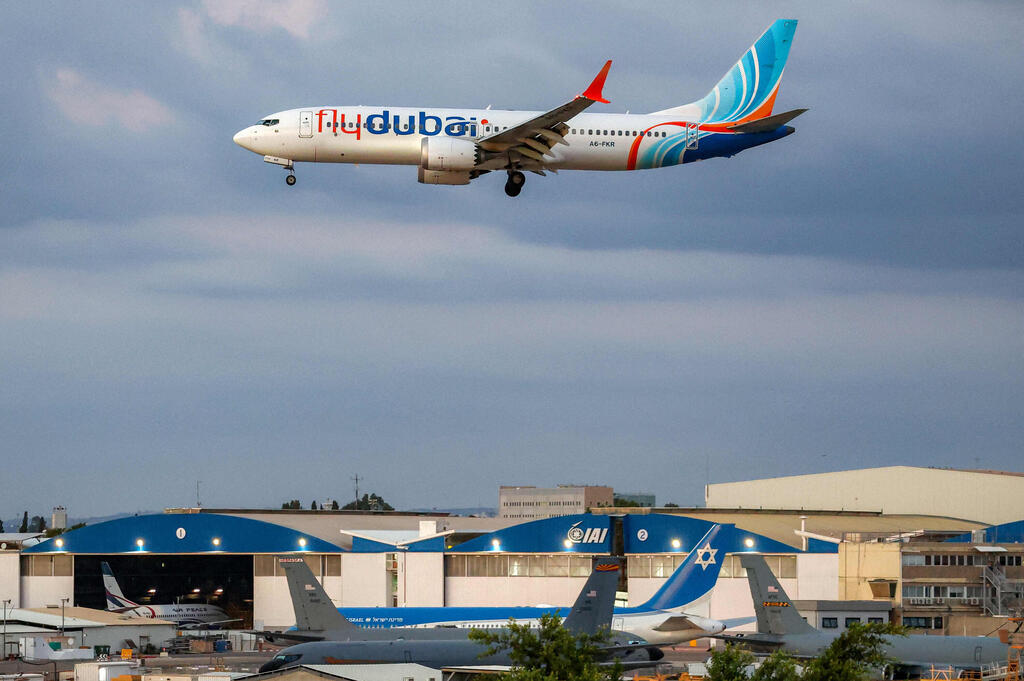
Flydubai operates one of the busiest routes to and from Israel
(Photo: Jack Guez / AFP)
Peace with Egypt also began with a pleasant welcome at Khan el-Khalili. What followed is well known. An Israeli who visits there today risks his life. In the United Arab Emirates it is different. The good relations continue. In many ways, they are even growing stronger. And the busy route to Dubai is one of the clearest symbols of those ties.
So whoever tried to carry out an attack was, in effect, trying to strike at the crown jewel of normalization. The air route to Dubai is not another covert channel of relations, as exists with other Arab countries, including some that constantly issue hostile statements. This is an open and well-known relationship. Israelis may need to hide their identity in many Arab countries. Not in the United Arab Emirates.
The attack was supposed to turn those relations into one of the worst disasters in the history of aviation in general and in relations between Israel and the Arab world in particular. That did not happen, apparently also thanks to the resourcefulness of Israelis on that dramatic flight, who quickly understood what was happening in the cockpit. The details will still become clear. But it seems that thanks to them, or partly thanks to them, a mega-disaster was averted.
Relations with the United Arab Emirates are an alternative. Here is an Arab, Muslim country where expressions of hatred toward Israelis or Jews, to the extent they exist, are negligible compared with similar manifestations in Western countries.
'Hostility? Never'
On my first visit there, I saw a Jewish man wearing a kippah. What are you doing in Dubai, I asked him, and what is it like to walk around with a kippah in a Muslim country? "I work at the local branch of an international bank," he answered, and added: "In Paris, where I lived, I tried to hide the kippah. Here, by contrast, I am greeted warmly by many people I do not know. Hostility? Never."
Something else that should be obvious also needs to be said. Muslims are not Islamists. Not all of them, and probably not most of them. It is true that in Egypt and Jordan, despite peace treaties, incitement against Israel continues. And it is true that far too many Muslims in Europe are Islamists. Precisely for that reason, the United Arab Emirates, with its education for tolerance, presents an alternative based on mutual respect between Jews and Muslims. And even if this is only an island of normality in a sea of hostility, it is exactly this island that the attacker wanted to destroy.
Why did it happen now? Yigal Carmon, head of the Middle East Media Research Institute, or MEMRI, made a point of recalling that Iran had threatened that if its planes could not fly, then other planes would not fly either. In his assessment, what happened yesterday was the fulfillment of that threat.
Carmon says this was an event on the scale of a casus belli. But even if someone in Israel knows something, they will not say so, because at this stage the United States does not want to renew the confrontation with Iran.
This time, the incident ended thanks to the resourcefulness of a handful of Israelis who, while taking a risk, saved nearly 180 passengers. And, apparently, they also managed to prevent an Israeli response that could have led the region into another violent and bloody confrontation.