


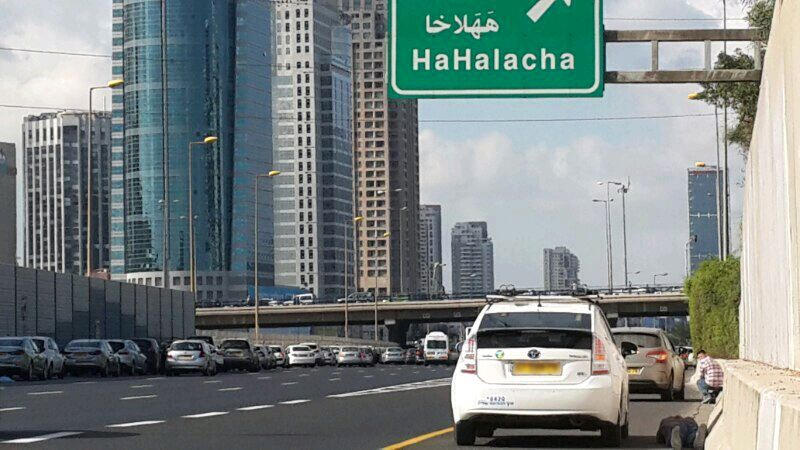
“Again? Where should I stop and take cover?” I ask myself for the fifth time this week, driving along Israel’s roads — never calm, even in routine times. Another alert: sirens in three minutes. This time I’m in the Lachish area, on Route 6 heading south. My eyes scan quickly for the safest place to pull over. My heart pounds, racing faster than an interceptor.
Frequent driving is an inseparable part of my life. I usually enjoy it — starting the car, putting on music, letting my thoughts wander. Not anymore, not since Operation Roaring Lion. Now the road unfolds in tense silence, with one goal: get there as quickly as possible, preferably without sirens along the way. “They won’t break my routine,” I tell myself, and anyone who asks why I keep “staying on the line.”
'An outsider wouldn’t understand'
“Where are you from?” I hear a voice and look toward a man lying beside me in a roadside ditch.
“Depends,” I reply impatiently.
“Maybe you should change position? If something falls nearby, that pole could be dangerous. Move a bit to the left.”
I look at him, silent, withdrawn, like the others lying nearby. After a minute or so, understanding we have a few more moments together, a conversation begins — typical of this absurd reality that briefly connects us. Sometimes people share names, sometimes professions and family status; there’s no time for political arguments. “Maybe romances and a ‘baby boom’ will come out of these situations,” I think to myself, trying to inject some humor as I look around.
“Look,” one woman says, pointing to the sky, where interceptor missiles trace white lines. The booms sound distant, and my heartbeat begins to slow. “That’s it for now,” I tell myself. I stand up, brushing thorns and grass off my coat.
“Not yet,” comes the voice of “that guy.”
“Why? There was a clear signal.”
“Not for me,” he insists. “My wife will get mad.”
“Where is she?”
“At home, in Kiryat Gat. But she can feel me — that’s all I need.”
I look at him. He’s serious. I’m not sure whether to laugh or feel sad. I lift my leg over the guardrail and open the car door.
“Hey, you,” he calls out, “my wife says it’s OK to go.”
I smile, get in the car and continue driving. A few kilometers before I reach home, the same sound blares again, jolting the heart. I stop once more. This time, silence settles among those gathered.
“That was south of here, and it was an interception, not an impact,” one man says when the boom is heard, trying to sound authoritative.
 Yael Walzer
Fifteen minutes later, at home near the safe room (mamad, a reinforced security room in many Israeli homes), I think back to my childhood — to the trench dug in our yard during the Six-Day War, where we lay as children, trembling with fear. At the same time, I think about a country that teaches its citizens not to let fear manage their lives.
A phone call from a friend interrupts this very Israeli, almost schizophrenic inner dialogue. “Are you coming to my birthday this weekend?”
“Of course,” I reply, grabbing a large towel to put in the car. “They said it’s going to rain,” I tell myself, already shifting to thoughts about Passover shopping.
An outsider wouldn’t understand.