

Here’s a thought experiment: Every morning before work, you find a new scratch on your car. Sometimes in front, sometimes in back, sometimes on the side. A neighbor looks at you sheepishly and apologizes. The damage isn’t major — hardly enough to justify a trip to the garage or even a delay. On some mornings, a damp cloth does the trick. You take a deep breath, get in and drive off. Who among us hasn’t experienced something similar?
Now imagine it happens 215 times over two years. At some point, it’s clear this isn’t an accident. You’d stop accepting excuses. You’d take action. File an insurance claim. Call the police.
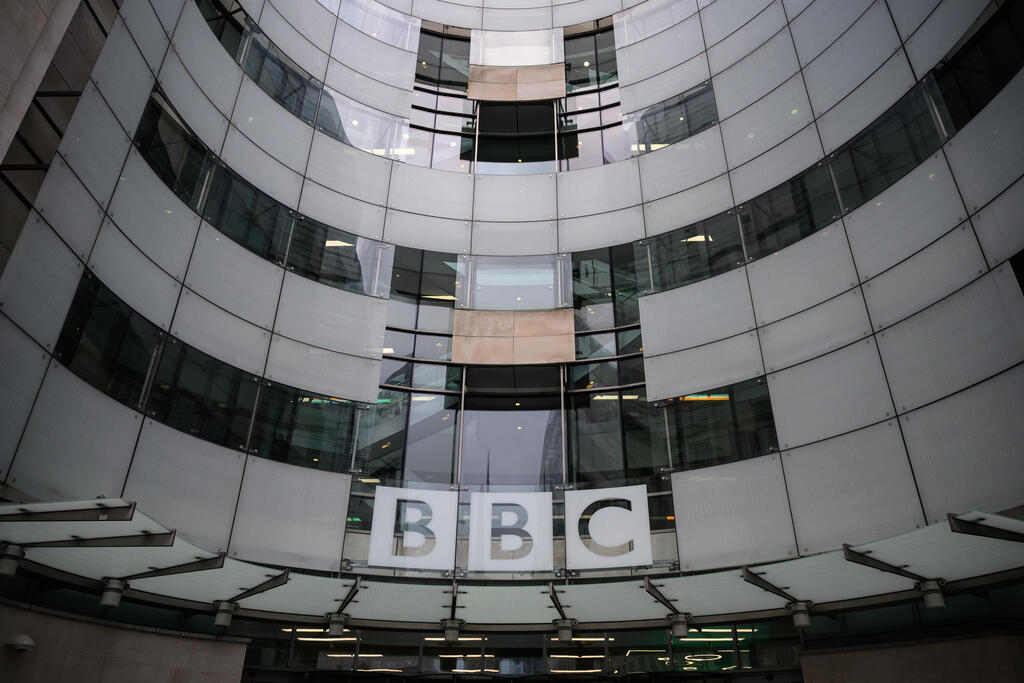
London, United Kingdom, BBC
(Photo: Leon Neal/Getty Images)
This is what the State of Israel has experienced with the British Broadcasting Corporation since October 7. The organization that once stood for “telling the truth in the service of peace” has become a front for warfare. Blatant falsehoods, half-truths and distortions of fact have become routine. Over two years, 215 corrections or apologies have been issued. While Israel’s embassy in London worked diligently to counter the bias — and even the president of Israel got involved — it wasn’t enough to trigger a national reckoning. Yet it should have been. The impact has been strategic: harming Israel’s national interests, affecting the personal safety of Israelis abroad and restricting the operational freedom of the Israel Defense Forces.
The BBC is not just another broadcaster. It’s a symbol of free journalism, a supposed global benchmark for accuracy and credibility — some would even say a cultural emblem of Britain itself. But what Israel has faced is not mere “cumulative inaccuracy.” It has been the target of a dangerous influence campaign that has helped fan the flames in Western public discourse.
Such a situation requires a real-time response on a national level — far beyond what a single embassy could manage. When a media organization of the BBC’s stature promotes a bundle of falsehoods, it cannot be treated as a local London issue. It demands a coordinated campaign out of Jerusalem, involving both government and civil society, to expose the systemic bias. That means public statements and behind-the-scenes diplomatic pressure. It means making clear that choosing political agendas over journalistic integrity carries a cost. It means conditioning any “day after” cooperation with the UK on efforts to combat British-based antisemitism. None of this happened.
Israel failed to escalate the response to a broadcaster that was metaphorically scratching its car every day. No insurance rates rose. No police were called. The BBC’s top executives eventually resigned — but for unrelated reasons. They clashed with the wrong man: Donald Trump. If not for that infamous edited segment on Panorama, Israel might have woken up to another blood libel this very morning.
Yes, resources are limited. Budgets are tight. Manpower is lacking. Not every issue can be addressed at all times. But the hard truth is this: the BBC succeeded in acting against Israel not because of those constraints, but because Israel does not view public perception as a core component of its national security doctrine. It complains about image problems but does little to proactively protect or promote it.
The damage done by the BBC over the past two years is difficult to quantify. What’s important to understand is that new leadership at the network won’t fix the problem. The distortion is embedded at the grassroots level. The same is true of other major media outlets. Unless Israel begins to treat attacks on its image with the same urgency it reserves for physical threats, the information war will continue to be fought by a handful of brave yet isolated voices. And other broadcasters will internalize the same troubling message: when it comes to Israel, better to ask forgiveness than permission.
To prevent that, Israel must take the initiative — before the next attack targets the wrong car.