

According to a well-known folk tale, Napoleon once passed by a synagogue on Tisha B’Av and was surprised to hear the crying and lamentations. When he understood that the deep mourning was over the destruction of the Temple 2,000 years earlier, he said with reverence that a people that remembers to cry over such an ancient destruction will merit rebuilding what it lost. Memory, according to this legend, is a constructive force for repair.
But this year, on Tisha B’Av 5786, we should fear that perhaps we have forgotten. True, we will fast and observe the customs of the national day of mourning by rote habit, but there is no escaping the conclusion: We have forgotten.
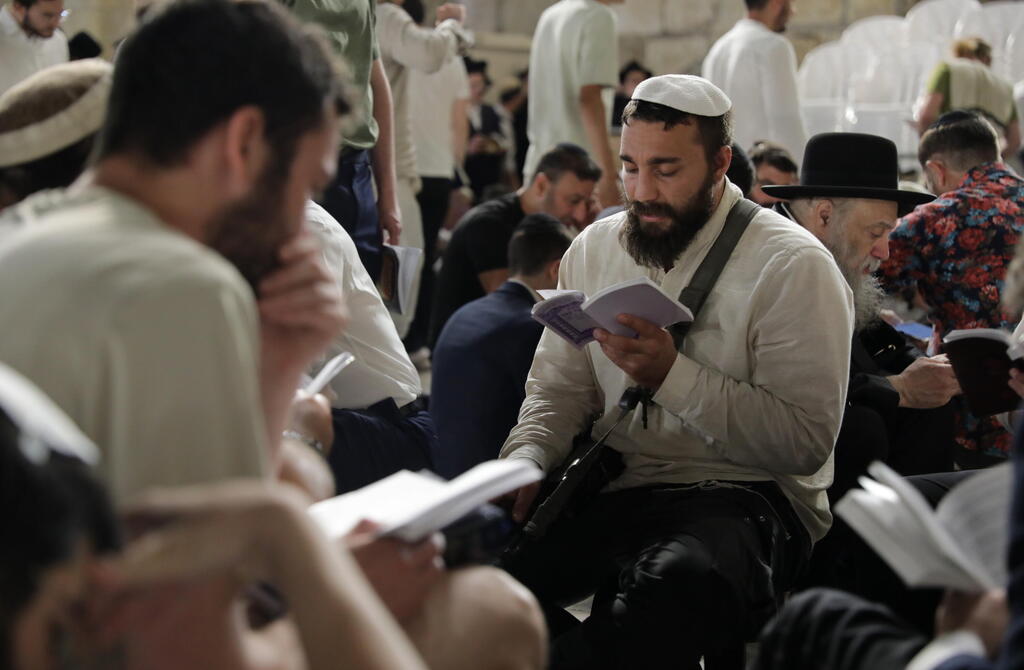
Reciting the Book of Lametations at the Western Wall on Tisha B'Av
(Photo: Alex Gamburg)
Tradition attributes the loss of Jewish independence in the two previous kingdoms to hatred among brothers, which ate away from within at the Jews’ ability to stand against their enemies. The burning of the storehouses - while the enemy was laying siege to Jerusalem - is the clearest symbol of the madness to which hatred among brothers can lead. And here too today, we are in danger of setting fire to the storehouses of sovereignty — undermining the rule of law, losing trust in state institutions, weakening governance — once again while at war with our enemies.
According to a recent JPPI survey, most Israelis, some 55%, believe the greatest threat to our future is not outside the country’s borders — security threats and antisemitism in the world — but within. In their view, the greatest threat is not from Khamenei or Mamdani, but from the preferences and actions of the neighbor in the shared apartment building. This intuition has something to rely on, but it is important to be precise: The danger does not stem from the very existence of disagreement among us, but from the way we manage it.
The public sphere has become an arena in which a “zero-sum game” is being played: Either I win, or I am defeated. Each side in the dispute believes with all its heart that a victory by its rival will make the shared home unfit for it to live in. This is an apocalyptic reading of reality, one to which many have become addicted, and it is fertile ground for fanaticism. And fanaticism, as Jewish history teaches, is the true battering ram for bringing down the walls of sovereignty.
Disagreement is not a problem that needs to be fixed
Disagreement is an inseparable part of a living society. The great question is whether we are capable of disagreeing with one another without denying the legitimacy of the other, without turning him into an enemy who must be defeated. For that, empathy is required — not agreement. Empathy means the ability to understand that even someone who thinks differently from me is acting out of a worldview, values and genuine concern for the future of the state.
Try a painful exercise: If you are voters of the left or the right, are you willing to say that Bezalel Smotrich or Yair Golan may be wrong, but they seek the good no less than you do? Allow me to guess that each side is offended by the very comparison. And that is exactly the problem.
But empathy alone is not enough. A polarized society needs agreed-upon rules of the game for managing disagreement. Israel needs a “lean constitution” — a basic system of governing rules that will establish stable agreements about how public life is managed. Such a system, had it existed, would have thwarted the possibility of carrying out a regime revolution, as the outgoing coalition tried to do, and would also prevent the opposite but parallel fear that if the current opposition wins the coming election, it will lead a counter-regime revolution.
 Yedidia Stern
In the absence of agreed-upon rules for managing disagreement, each side fears that if it does not defeat the other now, it will be defeated tomorrow. That fear creates a cycle in which each camp tries to use its power to reshape reality unilaterally in its own favor, and in doing so undermines the wall of Jerusalem of our generation. The road to my paradise leads to our shared hell.
The three weeks between the 17th of Tammuz, when the walls of Jerusalem were breached, and Tisha B’Av, when the Temple was destroyed, are called the days of “Bein HaMetzarim,” the period of distress. The expression is taken from the Book of Lamentations: “All her pursuers overtook her between the narrow straits.” How tragic that the pursuers threatening our future, then as now, are us. Will we know how to remember the consequences of fanaticism in previous generations and overcome the curse?
We can begin the repair, after the election, by accepting binding and entrenched rules of the game for managing disagreement.
Yedidia Stern is president of JPPI, the Jewish People Policy Institute.