

Across European capitals, a familiar mood is returning: anxiety without clarity. Governments brace for consequences that have not yet materialized but already feel real.
The latest tremor comes from Washington, where U.S. President Donald Trump is weighing the possibility of striking Iran. European officials, diplomats and security analysts openly discuss retaliation scenarios, regional escalation and the risk of a widening conflict whose repercussions could extend far beyond the Middle East.
Fear, in international politics, rarely travels alone. It summons memory, identity and reflex.
Psychologists have long studied how associations shape perception. Consider the Mariko Aoki phenomenon, the curious tendency some people report of feeling the urgent need for a bathroom upon entering a bookstore. Researchers suspect conditioning. Environmental cues quietly provoke reactions that feel sudden and involuntary.
Another example is the 11:11 clock phenomenon. People repeatedly notice the same symmetrical numbers. The coincidence appears meaningful, though psychology attributes it to pattern recognition rather than any hidden design.
Both quirks illuminate something fundamental about cognition. Human beings are creatures of association. Stimuli trigger responses that often bypass deliberate reasoning.
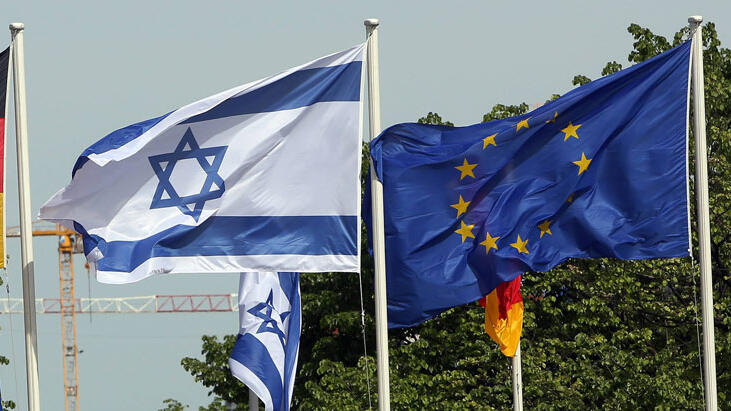
This perspective helps explain the uneasy dynamic between Israel and the European Union (EU). In Israeli public discourse, references to Europe frequently provoke immediate emotional reactions. Skepticism. Irritation. Defensiveness. The consistency is Pavlovian – a stimulus appears, and a conditioned response follows.
For years, observers primarily attributed this sensitivity to history. Europe occupies a singular place in the Jewish and Israeli consciousness. The Holocaust is not merely remembered. It is woven into collective identity.

Police secure the area outside a synagogue in La Grande-Motte, southern France, after a suspected arson and car explosion attack on Aug. 24, 2024, in an incident French authorities said they were investigating as a possible antisemitic act
(Photo: REUTERS/Manon Cruz)
Sadly, antisemitism in Europe is no longer confined to history books. Since the October 7 Hamas onslaught and the war that followed, Jewish communities across the continent have reported rising hostility and renewed insecurity. Synagogues require heavier protection. Jewish students describe harassment. Incidents once assumed to belong to a darker era have reemerged in contemporary public life.
This shift reshapes perception. When European leaders sharply criticize Israeli military operations in Gaza, many Israelis do not hear their statements in isolation. They encounter them alongside reports of attacks on Jewish institutions, antisemitic rhetoric at demonstrations and a broader atmosphere of unease. The psychological effect is cumulative. Pre-existing sensitivities are exacerbated by present-day experience.
At the same time, Europe’s posture toward Israel has grown more politically charged. The Gaza war is deeply embedded in domestic debates across EU member states. Electoral pressures, coalition politics, street protests and media narratives shape governmental responses. European foreign policy increasingly reflects domestic politics.
Complicating matters further is the EU’s self-conception as a “Normative Power.” Unlike traditional geopolitical actors’ emphasis on military strength (hard power), the EU defines much of its global role through values, legal frameworks and moral language (soft power). Human rights. International law. Humanitarian principles. These are not merely instruments of policy; they are foundational components of European identity.
From the European perspective, most criticism of Israel stems from this normative commitment. The suffering and displacement of Palestinian civilians demand a response composed in the language of Europe’s political vocabulary. Silence seems like moral abdication.
For many Israelis, European admonitions carry a uniquely charged resonance. Israelis look at Europe and see not only the Holocaust but centuries of colonial expansion, imperial violence and exploitation. They also see a continent in the midst of grappling with resurgent antisemitism. In that context, a question surfaces with emotional force. Who is Europe to lecture Israel on morality and the use of force?
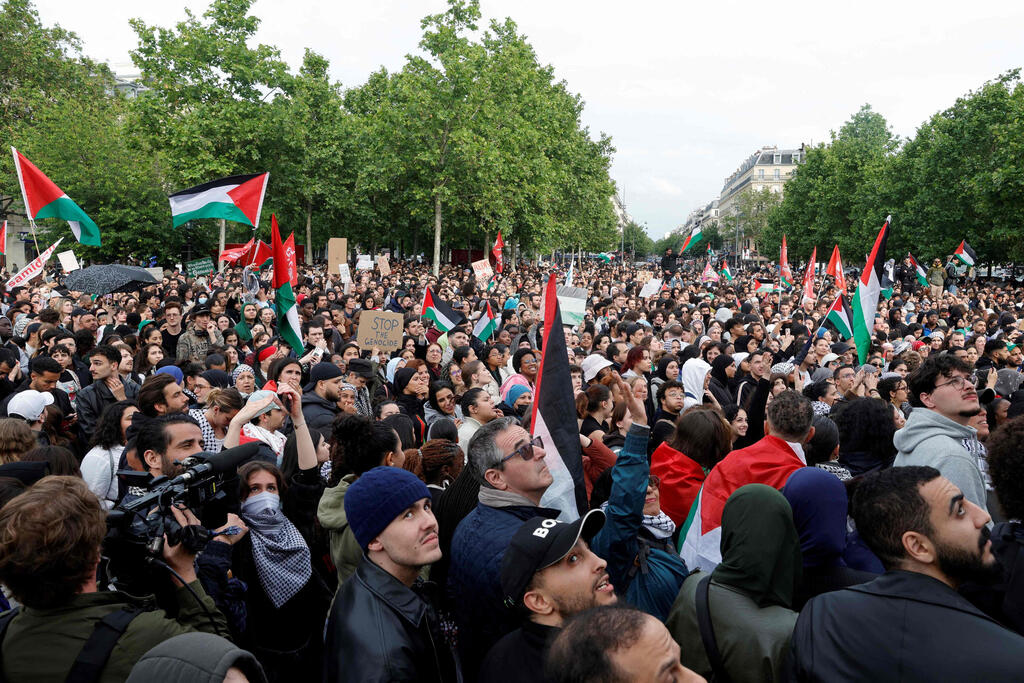
Pro-Palestinian demonstration in Paris, France
(Photo: Geoffroy VAN DER HASSELT / AFP)
Across Europe, a parallel psychological mechanism is at work. European societies interpret Israeli actions through the prism of their own historical reckoning. Europe’s colonial past remains a source of enduring guilt. Images of overwhelming military power exercised over a largely stateless population evoke uncomfortable parallels.
For some Europeans, Israel is a mirror reflecting elements of Europe’s own troubled past. Occupation. Power asymmetry. Civilians suffering. The response is often cloaked with moral urgency, sometimes moral absolutism.
The prospect of confrontation with Iran intensifies these dynamics. Israeli security anxieties are inseparable from Tehran’s rhetoric, regional proxy conflicts and nuclear ambitions. These are not abstract strategic puzzles in Israel. They are perceived as existential threats. Under such conditions, Israeli society is primed for heightened vigilance. External pressure feels less like principled disagreement and more like disregard for vulnerability.
European governments, meanwhile, navigate domestic landscapes where public opinion on Gaza exerts growing political influence. Leaders respond to voters, activists and coalition partners. Criticism of Israel becomes not only an ethical positioning but a political necessity.
Both sides act rationally within their own frameworks. Yet the interaction of these frameworks produces persistent friction. This is the reflex problem.
Conditioned reactions are rooted in real experiences. Israeli sensitivities arise from history and present insecurity. European responses arise from normative commitments and historical introspection. But when reflex dominates, nuance collapses.
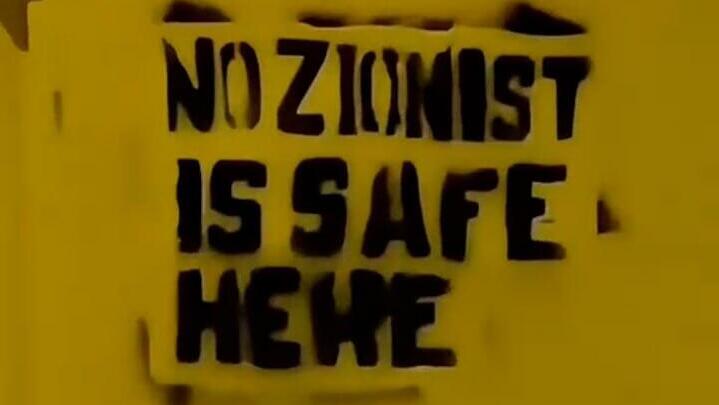
Antisemitic graffiti in Athenes, Greece
(Photo: from social media)
If Israelis interpret most European criticism as latent hostility, meaningful debate becomes nearly impossible. If Europeans interpret Israeli defensiveness as moral blindness, empathy evaporates. Breaking this cycle requires uncommon self-awareness.
For Europe, credibility as a normative actor depends on confronting antisemitism with unflinching clarity. Jewish insecurity erodes moral authority. Values lose persuasive force when they appear unevenly defended.
For Israel, diplomatic resilience may benefit from distinguishing between criticism rooted in prejudice and criticism rooted in genuinely held normative frameworks. Not every rebuke is animus, even in a climate where animus undeniably exists.
Most importantly, both societies must recognize the psychological dimension shaping their interaction. Europe is not merely a political entity in Israeli and Jewish consciousness. It is a symbol fraught with memory and suspicion. Israel is not merely a foreign state in European politics. It is a symbolic arena for debates about power, morality and history.
Symbols trigger emotion. Emotion shapes reflex. Reflex shapes policy. Unlike harmless perceptual quirks, political reflexes carry consequences. They narrow the space for dialogue precisely when dialogue becomes most necessary, especially at moments of mounting uncertainty, when fear once again sets the tone across continents.
- Prof. Sharon Pardo is a Senior Fellow at the Jewish People Policy Institute (JPPI) and a professor of European studies and international relations in the Department of Politics and Government at Ben-Gurion University of the Negev.