

With the passing of Sen. Lindsey Graham, one of the most colorful, influential and important voices in American politics has fallen silent. Graham was not merely a standard “friend of Israel” on Capitol Hill. He was an iron defender and a moral shield who never hesitated to stand before the cameras and proclaim the justice of Jerusalem’s cause.
Behind the lilting Southern accent, biting humor and emphatic hand gestures stood a brilliant politician who wielded considerable influence over American policy.
Israel has lost not only a powerful ally in Washington, but a true friend who devoted a significant part of his political career to strengthening the strategic relationship between the two countries.
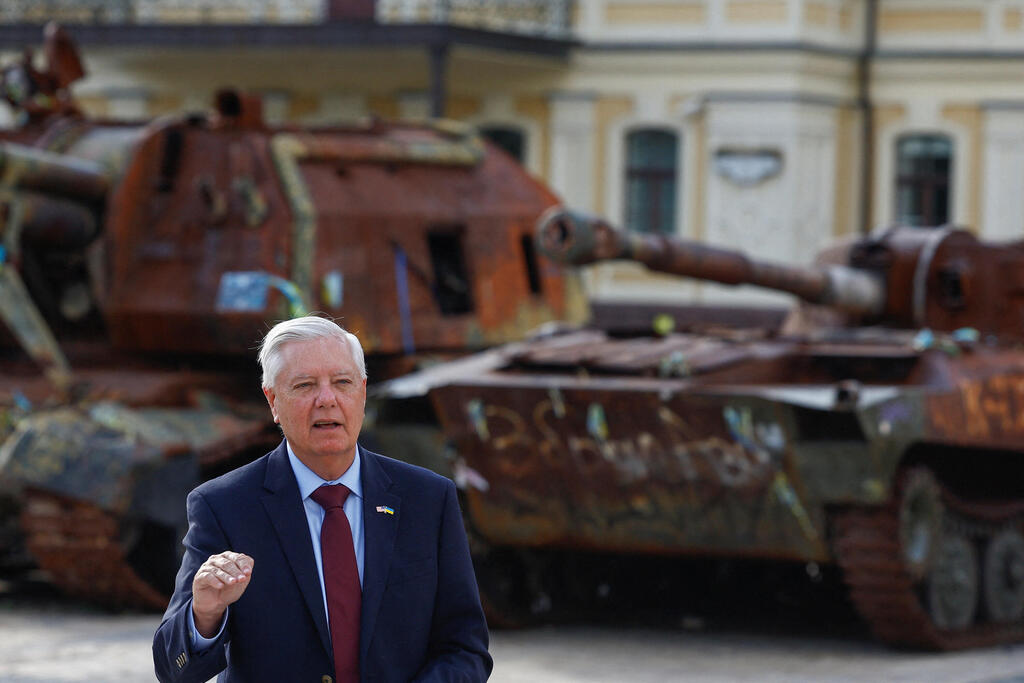
(Photo: REUTERS/Valentyn Ogirenko)
The tragedy that shaped the sheriff
To understand Graham’s toughness, one must return to the small town of Central, South Carolina, where he was born in the summer of 1955. He grew up in a working-class family that operated a business combining a restaurant, bar and pool hall.
When he was a young college student of about 21, his world collapsed. Both of his parents died within roughly 15 months of one another. Graham did not break. With the help of relatives, he took responsibility for his younger sister, legally adopted her and continued on to law school.
He carried the toughness he had acquired into military service as a legal officer in the U.S. Air Force, where he was stationed in West Germany. He continued serving for decades through active duty, the National Guard and the reserves, including short deployments as a military lawyer in Iraq and Afghanistan during congressional recesses, before retiring in 2015 with the rank of colonel.
He never married and had no children.
From the Clinton trial to the Senate
Graham’s political career began in the South Carolina House of Representatives, where he served from 1993 to 1995, but his breakthrough onto the national stage came with the Republican Revolution of 1994.
At the end of 1998, he was appointed as one of the House impeachment managers, and in early 1999 he presented the case against President Bill Clinton in the Senate trial.
In 2003, he stepped into the enormous shoes of Strom Thurmond in the Senate and became a distinctly conservative voice. He led an effort to impose a federal ban on most abortions after the 15th week of pregnancy and promoted bipartisan cooperation on red-flag laws aimed at restricting access to firearms by dangerous individuals.
From a live on-air feud to a close alliance
Graham reached the peak of his political influence during the Trump era, though the road there was filled with obstacles.
Anyone who remembers the 2015 Republican primaries will find it difficult to forget their public confrontation. After Graham called Trump a “jackass,” Trump retaliated by reading Graham’s personal cellphone number aloud before millions of viewers.
Despite that, Graham showed pragmatism, became one of Trump’s closest allies in the Senate and used his direct access to the president to advance a hawkish foreign policy supportive of Israel.
The bitter enemy of the ayatollahs’ regime
When it came to the Middle East, Graham must be remembered as one of Iran’s fiercest enemies. He consistently pushed for crippling sanctions and refused to accept any compromise over Tehran’s nuclear program or its terrorist proxies.
Only recently, while addressing tensions in the region, he warned that the Iranians had badly misjudged Trump.
A global hawk: the Russia-Ukraine war
His hawkish and uncompromising worldview was not limited to the Middle East. After the outbreak of the war between Russia and Ukraine, Graham became one of the loudest and most determined voices in support of Kyiv and a leading advocate for supplying weapons to the Ukrainians.
He did not hesitate to cross diplomatic lines when he publicly suggested that the only way to end the war was for someone close to Vladimir Putin to “take this guy out.”
He also provoked Moscow’s fury during a visit to Kyiv when he declared that American aid to Ukraine was “the best money we’ve ever spent.”
Republican backing for a trilateral agreement
Graham understood the potential of regional initiatives such as IMEC, the multinational project designed to strengthen connectivity, infrastructure and economic integration between India, the Middle East and Europe.
Under the Biden administration, Graham became one of the leading Republican supporters of efforts to forge a trilateral agreement among the United States, Saudi Arabia and Israel.
He met Saudi Crown Prince Mohammed bin Salman and worked to rally Republican support in the Senate for a defense treaty. That effort was critical because ratification of a treaty requires the backing of two-thirds of senators, a threshold a Democratic administration would have struggled to reach on its own.
The negotiations were led by the Biden administration and the Saudi and Israeli leaderships and, alongside normalization, included security arrangements, a civilian nuclear program and the Palestinian issue.
The day after: the battle over his Senate seat
Beyond the personal loss, Graham’s sudden death is also shaking the political system in South Carolina. Only last month, in June, he won the Republican primary and secured the party’s nomination for the November 2026 general election.
The state’s governor will now have to appoint a temporary replacement to preserve the Republican seat until the end of the term. At the same time, the party will be required to select a replacement candidate to represent it at the ballot box in the fall, in accordance with state party rules.
 Dr. Kobby Barda
Whoever replaces him will have to try to fill the shoes of a figure whose voice was so prominent and influential.
Graham’s support for Israel was consistent, public and unmistakable throughout his years in the Senate. Israel has lost not only a powerful ally in Washington, but a true friend who devoted a significant part of his political career to strengthening the strategic relationship between the two countries.
- Dr. Kobby Barda is a faculty member at the Holon Institute of Technology’s multidisciplinary school and a senior fellow at the Jewish People Policy Institute
First published: 11:22, 07.12.26