

Like the Israeli public, the wider Middle East is riveted by the aftermath of Israel's elections. Across the region, uncertainty and anxiety are growing amid the realization that the political deadlock will affect not only Israel's future but potentially the fate of the entire Middle East.
The inconclusive election results reinforce a perception that has gained ground internationally since October 7: that amid an unending conflict, Israel is gradually losing its balance, changing for the worse and becoming increasingly unrestrained, particularly in its use of military force.
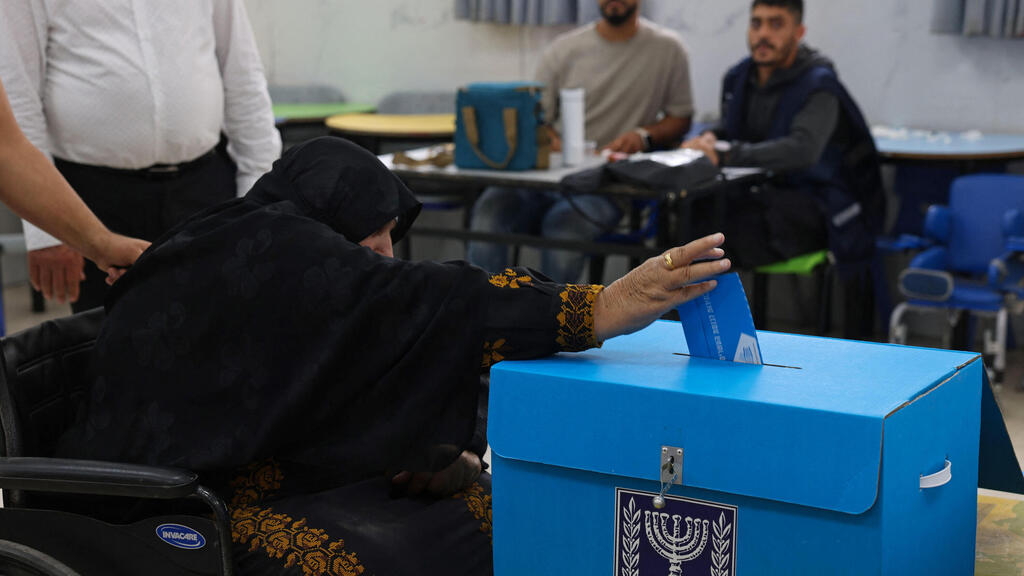
The Arab vote isn't a gift to Israel's enemies. The backlash may be
(Photo: Hazem Bader/ AFP)
More specifically, many in the Middle East believe that while Netanyahu grapples with the political impasse, he will also push for another strike against Iran, probably after the U.S. midterm elections on November 3. Such an operation could be carried out jointly by Israel and the United States, or by Israel alone with American approval. It would further destabilize an already turbulent region, would not necessarily provide a definitive answer to the threats posed by Iran and could even disrupt preparations for another election in Israel.
The Arab community's electoral gains, and the harsh, delegitimizing rhetoric directed at Arab voters in their aftermath, have attracted considerable attention across the region. Contrary to the distorted argument heard in Israel that the electoral success itself is a "gift to the enemy," it appears that those seeking Israel's downfall are drawing satisfaction primarily from the debate that has erupted over the Arab vote. Israel's enemies claim that the controversy surrounding Arab citizens has exposed the country's underlying "apartheid logic," arguing that international pressure and punitive measures are needed to protect a disadvantaged minority subjected to discrimination and persecution.
More broadly, Jewish Israelis appear to believe that the debate over the treatment of Arab citizens is an internal matter of little interest to the outside world. In reality, the world is watching closely and drawing troubling conclusions about Israel's internal transformation. Israel increasingly appears to be a country that no longer attaches the same importance to international public opinion, whose leadership promotes bizarre notions of a "Spartan" existence and reliance on cryptocurrency, and where fantasies are becoming normalized, from overthrowing the Iranian regime to emptying Gaza of its population.
The fierce attacks on Arab citizens appear to complement the severe deterioration in the West Bank. Together, these developments portray a country increasingly shaped by extremist ideas and practicing discrimination and oppression against non-Jews under its control. What began with Bezalel Smotrich's 2021 declaration that "Israeli Arabs are citizens, for now at least" has now converged with an enthusiastically promoted "settlement revolution," pursued with little discussion of what will become of the millions of Palestinians living in the West Bank.
Bitter enemies such as Hezbollah and Hamas go even further, arguing that Israel's widening internal divisions suggest that Yahya Sinwar's prediction may ultimately come true. According to that vision, the October 7 attack would trigger a shock that would destabilize Israel and eventually bring about its collapse, despite the severe defeats suffered by the various components of the so-called axis of resistance. Hezbollah Secretary-General Naim Qassem declared: "The election results are an expression of defeat. Confusion and crises are emerging in Israel on every level, and these will affect its future." Israel's enemies also derive particular satisfaction from the country's deteriorating international standing and the growing discussion of emigration among Israelis.
The regional jungle
In this context, Israel's enemies also appear pleased to see characteristics of the "regional jungle" emerging inside the "Israeli villa," a familiar metaphor portraying Israel as an island of Western-style order surrounded by regional instability. These include political interference in security investigations involving rival political figures, dysfunctional governance, the silencing of dissenting voices, contempt for criticism and sweeping rejection and delegitimization of minorities. In recent days, these tendencies have been reflected in declarations that any government dependent, even indirectly, on Arab votes would not be recognized, as well as a lawmaker's call to arm in preparation for a possible violent confrontation between Jews and Arabs.
Meanwhile, an international clock is ticking, one that most Israelis do not even realize exists. Throughout the election campaign, much of the world, led by the United States, refrained from pressuring Israel over issues requiring difficult decisions or policy changes, particularly Gaza, Lebanon and the West Bank. There is no guarantee that the international community will continue granting Israel such breathing room if the country heads into yet another election. Pressure is likely to intensify, even if tensions with Iran escalate again, particularly through European sanctions in response to the chaos engulfing the West Bank, which shows little sign of subsiding and could grow worse.
Since October 7, Israel has repeatedly proclaimed its ambition to transform the mindset of people across the region, particularly by uprooting extremist ideas, above all in Gaza. Yet the only mindset that appears to be undergoing a fundamental transformation is that of Israelis themselves, and mostly for the worse. Against the backdrop of the prolonged war, expressions and ideas once considered reprehensible have become normalized, from claims that "there are no innocents" to talk of "voluntary transfer" and the increasingly racist elements of public and political discourse since the elections. Disturbingly, these views are being echoed and, at times, actively encouraged across the media landscape.
An Israel already scarred by repeated upheavals is experiencing an especially severe convulsion in the aftermath of the elections. In less than a week, the country's political language has changed in ways that should frighten every citizen, particularly because of the danger that the distance between words and actions is shrinking. Israelis must not only take a hard look in the mirror but also recognize that the country's image abroad is changing dramatically, inflicting damage that cannot be repaired through better public diplomacy or more effective messaging. Israel remains preoccupied with identifying enemies, and this week many government supporters effectively declared Arab citizens to be the worst of them. Yet the country is discovering that its emerging identity has itself become one of the gravest threats it faces, perhaps the most serious of all.
The author is a senior researcher at Tel Aviv University and author of The Flood Generation.