

Admit it, you didn't see this coming: the prime minister decided to green‑light resuming discussions on the draft exemption law. Was it direction from Dov Lando, the most influential figure among the Lithuanian ultra‑Orthodox, pushing the Boaz Bismuth law that already delivered for him? Or was it the ruling by Zalman Rubinstein, deputy president of the Supreme Court, who led the panel together with Justices Yitzhak Mintz and Yehuda Wilner—all conservative judges—giving the government 45 days to define economic sanctions for draft‑dodgers? Or maybe it was the week‑long protests outside Shas Knesset members’ homes that forced Netanyahu to cool the deal before it got out of his control.
And most intriguing: Can we derive from Netanyahu’s decision to resume talks something about his intention to stand again in the next elections?
There is no guaranteed majority for the Bismuth framework—also called the Ariel Atias Outline—but some Haredi factions, notably Agudat Israel (unlike the Lithuanian stream), gave their okay to continue negotiations because they align with Shas' Aryeh Deri, who is eager to return to government.
Gallery
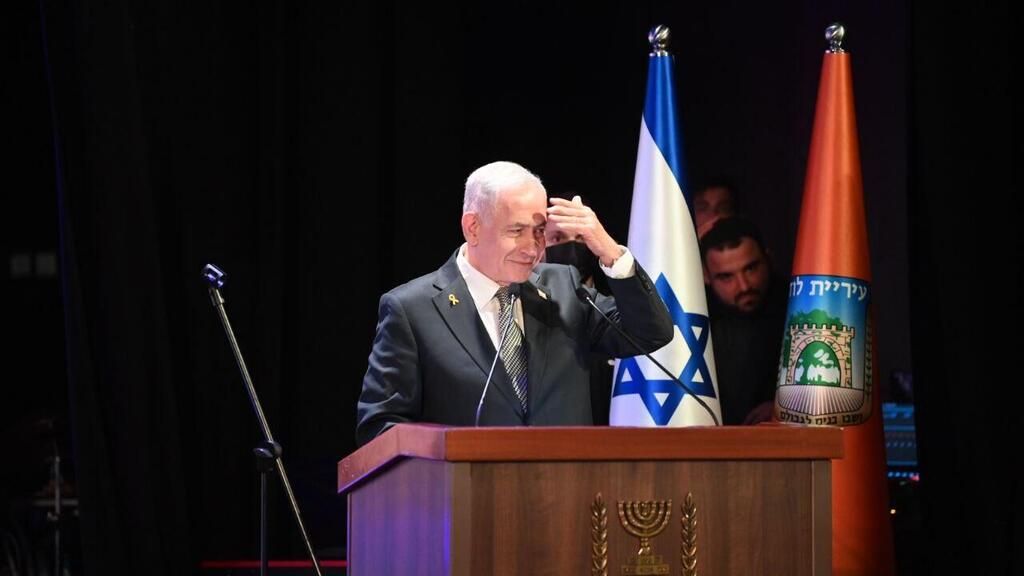
Prime Minister Benjamin Netanyahu is in his favorite space: it’s the limbo between decision and indecision
(Photo: Yair Sagi)
Is the draft exemption law an indicator of Netanyahu’s direction? Hard to say. Because it’s such a socially explosive law—capable of sparking crisis and conflict across the public, coalition and opposition, even within parties—its passage might hint he intends not to run for reelection again, or that “his time has passed.” Because why would he leave behind a controversial legacy law in his party when all he wants is to prolong his tenure.
But if he does intend to run again, the expectation is that Netanyahu will first try to secure the Haredi parties to pass the budget without the conscription law but with large amounts of money, legislation and widened powers, and push the draft law into the next government.
One thing is certain: Netanyahu is now in his favorite space—aside from the king‑suite at the Israeli Air Force museum or a luxury hotel with his billionaire pals: it’s the limbo between decision and indecision, when you can still throw all the balls up in the air, dribble, explode large, surprise. In other words, he’s still hesitating, agonizing and above all not rushing a decision until he’s sure what causes him the least personal damage. The dilemma is clear: in a pre‑election period, should he prefer keeping the Haredim in his government or head to elections with the campaign message that he refused to extend the evasion law.
Avigdor Liberman, leader of the Yisrael Beiteinu party, blames the IDF for the Haredi recruitment fiasco. “The army failed miserably,” he says. He is seeking alternative means of removing rights from the evaders—and some he simply doesn’t like. After his proposal (alongside Yair Lapid) to strip the vote from non‑conscripts drew harsh criticism, Knesset lawmaker Oded Forer, No. 2 in Yisrael Beiteinu, is advancing a bill to strip voting rights from all prisoners. His rationale: the Haredim who evade draft duty will be put in prison, where, according to the new law that Lieberman is drafting, they will be prohibited from voting
In Liberman’s view, no one will oppose this law—common in many democracies—because voting rights would be removed from anyone jailed, not just dodgers. After the door closed on him, Liberman tries to climb in via the window, even if it has bars on it.
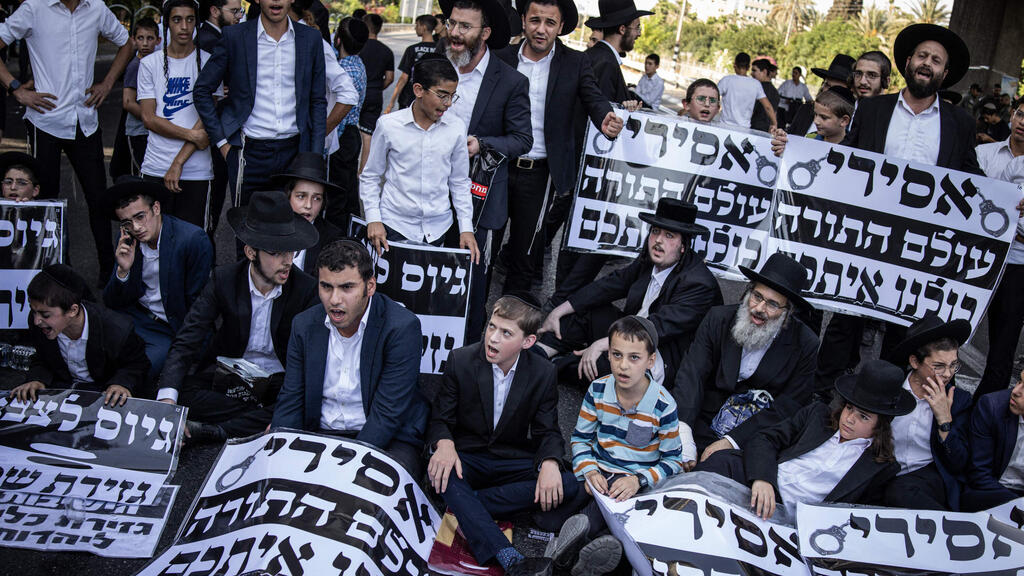
Haredim protest against the draft
(Photo: John Wessels / AFP)
But the draft law is only one stumbling block on the path of the government that this week cemented its status as a satellite state. Even in its toughest days, Israel never reached the position it holds now. There have been instances of pressure, sometimes a prime minister has been forced to back down on a particular issue, but it has never happened that the fate of the country is in the hands of other countries
F‑35 jets are handed out like birthday bags: Turkey, Saudi Arabia—while it’s not clear that ours still enjoy a qualitative edge. Things are fluid under Trump; and now the U.S. president is smitten. Just not with us. Turkey and Qatar take over in Gaza; the U.S. grants a defense treaty to Qatar; Syria’s president, once a terrorist in Al‑Qaida, now grows into a regional leader, smeared with American‑made perfume. And while the whole circus plays out, the United Nations Security Council declares the pathway to a Palestinian state without speaking to Israel.
How did it happen? Simple: our prime minister is personally beholden to Trump. We are under an unwritten agreement: Trump will help Netanyahu avoid prison, and in return Netanyahu will not condemn any of Trump’s moves. Yes, it’s incredulous—but hey, where were you the last few weeks when Netanyahu’s pardon‑campaign kicked off at the White House?
Internationally, we’ve completely lost public‑opinion ground—even within the Republican Party. Except for a few old timers, the younger generation is no longer with Israel. At best they regard us as just another country, at worst as one that uses AIPAC and Jewish money to control U.S. policy.
In none of the Gulf countries—UAE, Egypt, Jordan—did they even meet with Netanyahu since the election. We are in enormous internal weakness, a huge rift in the nation—and when you’re weak, it’s easier to accept diktats.
The damage Netanyahu has inflicted on the country is obvious to all—but his method of recovery is already familiar: continue the right‑left, secular‑religious, Arab‑Jew divide; allow radicals to unleash violence in Judea and Samaria; install a lunatic ministerial committee of the most extreme ministers to dictate our national inquiry committee composition. That’s Netanyahu’s style.
As always, Netanyahu throws a chunk of meat into the arena, makes us fight among ourselves and forget his own failures. And yes—it works fantastically. After all, the main thing is that more time passes.