

The talk of "unity" brings to mind an old joke about two madmen planning to escape from the psychiatric institution where they are being held. "If the fence is high, we'll dig underneath it," one says. "If it's low, we'll jump over it," says the other, who goes out to scout the grounds. He returns looking dejected. "We've got a problem," he tells his friend. "There's no fence."
In much the same way, treating "unity" as the only way to avert the disaster of another election rests on a fanciful assumption: that such an option even exists. This is not to say that a political agreement between rival parties is impossible, but rather that reaching such an agreement would inevitably turn the word "unity" into a sad joke.
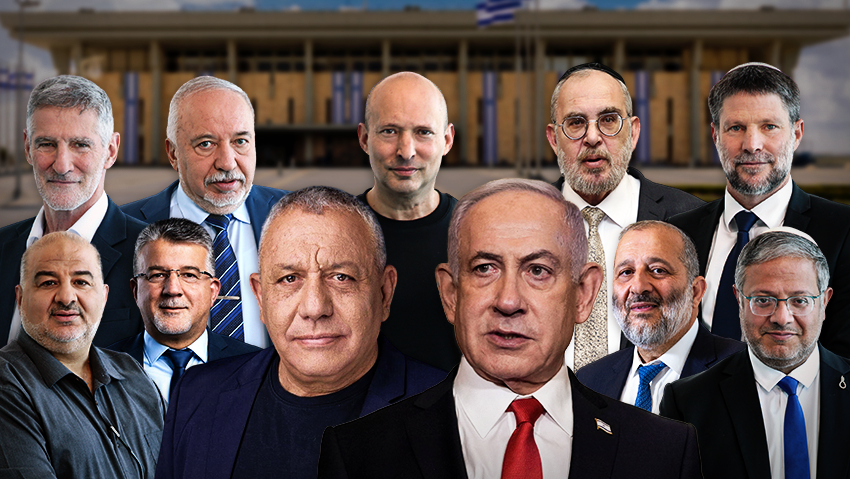
Party leaders
(Photos: Shutterstock, Shalev Shalom, Elad Malka, Joint List Spokesperson's Office, Reyan Preuss, Alex Kolomoisky, Oliver Contreras/AFP)
Contrary to what many claim, the vision of "unity" was not destroyed by the last two occasions on which the prime minister exploited public pressure to form an "emergency government," during the coronavirus pandemic in 2020 and the war in 2023, only to treat his partners as though they were grasshoppers. Those episodes certainly did nothing to inspire confidence that today's Benjamin Netanyahu is even capable of understanding the concept. But suppose the election results and the international community's revulsion toward figures such as Bezalel Smotrich and Itamar Ben-Gvir (with Netanyahu himself not far behind on that particular hit parade) have made him see the light, and that his greatest ambition now is to make Gadi Eisenkot a full partner in leading the country.
Yet once again, that pesky little caveat gets in the way of this idyllic vision: There is absolutely no indication that this is the case, or anything remotely close to it. Quite the opposite. Throughout the campaign, Netanyahu made clear that his next coalition would be based on the existing one, which he would simply be happy to expand.
As the election approached, when polls showed he would not secure the majority he needed (and on that point they were right), he systematically undermined the political legitimacy of Israel's Arab citizens, including by building a campaign around allegations of "fraud" before a single ballot had even been cast. On Election Day, he devoted 250% of his energy to that effort, which manifested itself not only in racist rhetoric but also in alarming cooperation with the security forces, including the police and Shin Bet. His conduct brought the prospect of a Jan. 6-style coup attempt far closer than anything resembling "unity." Since the polls closed, allegations of a "stolen election" have only intensified, while the inflammatory rhetoric directed against 20% of the country's citizens has escalated from delegitimization to dehumanization.
And after all that, if we are to listen to voices that are hypocritical on the one hand and defeatist on the other, the large segment of the public that supported the Jewish opposition is supposed to accept that it would be better for its representatives to break their promise not to join a government with Netanyahu, let alone serve under him, than to break their promise not to rely on the Arab parties. You might as well tell a rooster that it has no choice but to go to the butcher, and not to worry: That's not really a sharp knife in the butcher's hand. He's just extremely happy to see you.
Because the truth is that Netanyahu, after the election, is in an even more dangerous frame of mind than he was before it. This only reinforces the central moral principle of the "change bloc," indeed, the only moral principle on which its members agreed: He cannot be allowed to continue. His party has become an amalgam of populism and Kahanism, and sending him and his party into opposition is a necessary, though certainly not sufficient, condition for any attempt to put things back together.
Eisenkot and his allies may decide that they have no better options, and from a purely political standpoint, perhaps they are right. But that would not be "unity." It would be surrender.
The attempt to persuade supporters of the "change bloc" to embrace "unity" is completely disconnected from Netanyahu's conduct. You might as well tell a rooster that it has no choice but to go to the butcher.