

The full extent of the crisis in southern Syria is becoming clearer by the hour. The Druze community in the Sweida province—one of Israel’s quietest and most reliable partners along the northern border—is now under coordinated attack by the new regime in Damascus and affiliated local militias. Reports from the ground speak of dozens of casualties, mass evacuations of civilians, and a military attempt to crush Druze resistance in the region.
This dramatic development comes just as Israeli and Western circles are revisiting the idea of a potential agreement with the regime of Ahmad al-Sharaa, who has succeeded Bashar al-Assad and is backed by Turkey and Qatar.
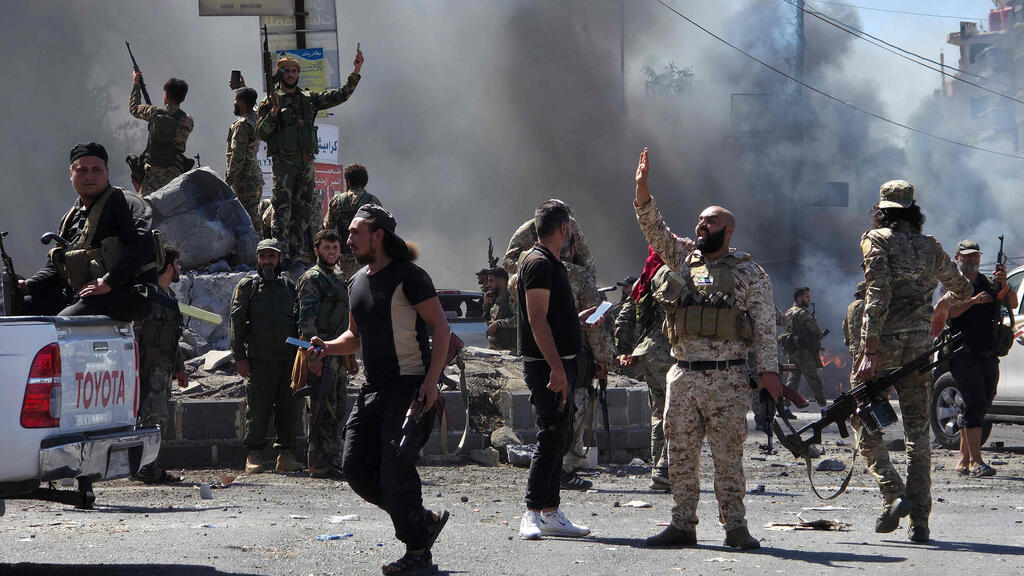
Southern Syria
(Photo: Sam Hariri/ AFP)
Meanwhile, in late June, a large international gathering of Muslim religious leaders took place in Turkey. At the event, a radical fatwa was issued: the October 7 attack was defined as “legitimate jihad,” Israel’s right to exist was denied, and any cooperation with it was labeled treason. The conference, held in Istanbul under the ideological umbrella of the Turkish government and supported by Islamic organizations worldwide, sent a clear message. President Erdoğan did not speak explicitly, but his silence spoke volumes.
While the West may view this as an opportunity for stabilization, Israel must face reality. Behind the proposal for a non-aggression pact lies an effort to normalize the regional status quo, but in practice, it offers a significant advantage to the Sunni-Islamist bloc and exposes Israel to multi-layered strategic risks.
The message to Israel is unmistakable: Turkey and Qatar seek to expand their influence in Syria through a softened diplomatic mechanism. In game theory terms, this is a classic Strategic Deception Game. On this move, one player proposes a false reconciliation in order to solidify power and prepare for a future confrontation.
A prime example is a new trade initiative taking shape that links Saudi Arabia, Jordan, Syria, and Turkey, while bypassing Israel. Should Israel give diplomatic approval to the rule of Abu Mohammad al-Julani in Syria, it would grant him legal access to this corridor, undermining the India–Israel–Europe initiative and stripping Israel of its role as a key East–West connector.
At the same time, Syria is currently controlled by a coalition of Islamist factions, some of which openly promote jihadist ideologies. A political agreement that formalizes their authority would give them the time, funding and legitimacy to become a full-fledged army poised at Israel’s doorstep with clear and hostile intentions.
 Dr. Kfir Tshuva
Israel’s freedom of operation could also be jeopardized. Turkish bases in Syria, ostensibly established under the guise of “security cooperation,” may restrict Israel’s operational reach, compromising its strategic capabilities to counter threats from Iran, Hezbollah, and weapons smuggling.
Get the Ynetnews app on your smartphone: Google Play: https://bit.ly/4eJ37pE | Apple App Store: https://bit.ly/3ZL7iNv
On the international front, a policy of “de-escalation” could prompt the West to lift sanctions on Turkey and allow it to acquire F-35 fighter jets—a move that would tip the regional airpower balance against Israel for the first time since the 1980s.
Equally troubling is the abandonment of Israel’s long-standing quiet partners: the Druze in the south and the Kurds in the north. The Druze are already paying in blood. Without clear conditions in any agreement—guaranteeing protection for these communities—Israel risks not only losing trusted allies but also dismantling one of the most stable informal security mechanisms along its borders.
What today appears to be a calm diplomatic arrangement may soon prove to be a costly strategic mistake. Israel must demand firm, transparent terms and resist being swept into the illusion of “non-aggression”—a concept crafted by others to serve their interests.
Dr. Kfir Tshuva is an expert in game theory and decision-making and lectures in economics at the Ramat Gan Academic College and Bar-Ilan University.