

Even if no hostages were alive in Gaza, one could argue that conquering the city would not justify the cost in soldiers’ lives, harm to civilians and international isolation. But there are hostages alive in Gaza. Israel’s government has no right to condemn them to death.
There is nothing amusing about the plight of the hostages—or their families. Like many others, I return from protests at Hostages Square angry, frustrated and in tears. Yet some close to the prime minister’s office twist the cries of despair into smug humor. A few days ago, one such figure mocked protesters as ungrateful: when Netanyahu pursued a partial deal, they demanded a full one; now that he pursues a full deal, they want partial. His thin smile said it all: “See how clever I am.”
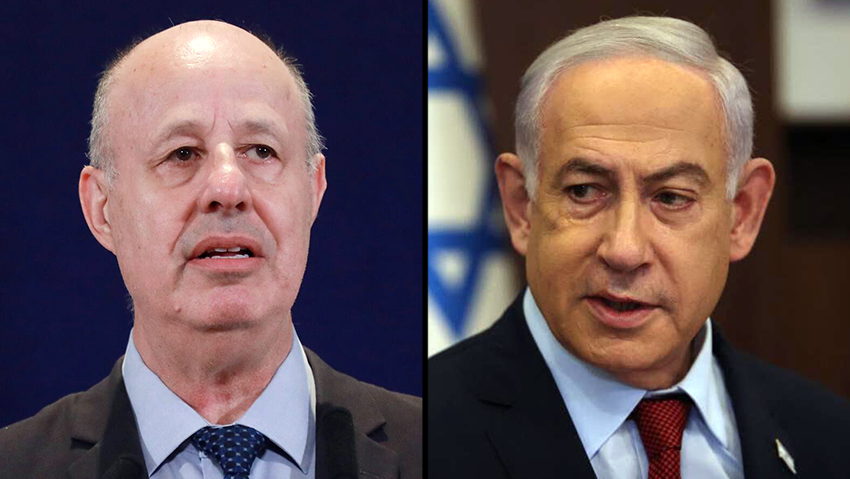
National Security Adviser Tzachi Hanegbi, Prime Minister Benjamin Netanyahu
(Photo: Yonatan Sindel, Dana Kopel)
In truth, there is no contradiction—neither in the hostages’ campaign nor in Netanyahu’s maneuvers. As numerous investigations have shown, from the first months of the war, Netanyahu has done everything possible to avoid a deal. The few who returned—alive or dead—came back through military operations. Those with dual citizenship were freed thanks to the personal intervention of Joe Biden, Donald Trump or Vladimir Putin. The others returned despite Netanyahu’s maneuvers, not because of them.
Yesterday, at the start of the Cabinet meeting, Netanyahu claimed credit for the return of 207 hostages, alive and dead. Not for the first time, he sold achievements that were not his. Why the same man who once released 1,027 prisoners for one soldier in good condition has since hardened against deals is open to interpretation. Some attribute it to threats from Finance Minister Bezalel Smotrich and National Security Minister Itamar Ben-Gvir; others to pressure from his family; still others to his complicated relationship with Hamas. He believed he had deterred them, even co-opted them into his vision of a weakened, divided Palestine. They betrayed him.
From the first debate over a deal, I believed Israel should pursue every option. “Whoever saves one life, it is as though he has saved an entire world.” Elderly or young, soldier or civilian, partial deal or full, cease-fire or temporary pause—the priority is their release. With Hamas, delay means abandonment.
And so we arrive here: Netanyahu, steadfast; the hostages, wasting away.
IDF Chief of Staff Eyal Zamir understands this. He and his colleagues are doing everything within their limited space to persuade the Cabinet to accept a deal. But Netanyahu refuses. The offer is on the table, yet he will not discuss it. Like the Turkish admiral who declared “No Malta” after failing to capture the island, Netanyahu declares: “No deal.”
One might expect at least one minister, perhaps a member of the Knesset, to stand up and say: perhaps you are wrong, Mr. Prime Minister. Perhaps there is merit in what the chief of staff and all the security chiefs are saying. That is how democracy should work—even under strong leaders like David Ben Gurion or Menachem Begin, someone eventually spoke up.
 Nahum BarneaPhoto: Avigail Uzi
But not now. All that emerges are anonymous whispers to journalists, paired with public shows of loyalty to Netanyahu’s every whim. Fear of his political machine paralyzes them—along with dreams of succession.
Einav Zangauker, one of the most outspoken voices among hostage families, said last weekend that if her son Matan dies in Gaza, she will accuse Netanyahu of murder. The words are harsh, but the responsibility is justified.
Netanyahu is not alone. He is surrounded by enablers. One is National Security Adviser Tzachi Hanegbi. Recently, he has been portrayed as siding with security chiefs in urging a deal. In theory, this makes him a rare dissenting voice—a longtime Netanyahu ally and appointee willing to take a stand.
But Hanegbi is no chief of staff. The responsibility for war is not on his shoulders, nor the fate of hostages. He heads a neutered body with little influence. If he truly believes rejecting a deal in favor of conquering Gaza is a historic mistake, he must act: resign, and explain directly to the Israeli public what transpired in government over the months before Oct. 7 and in the 23 months since. Who abandoned, who deceived, who misled. If ever there was a time for Tzachi to act, it is now.