

The current round of war with Iran has clearly and tangibly exposed what Israel has said for years: the ayatollahs’ regime poses a clear and immediate danger not only to Israel, but also to stability-seeking countries in the Middle East, including Israel’s partners in the Abraham Accords, the U.S.-brokered normalization agreements signed in 2020.
The echoes of explosions from Iranian missile and drone launches have, in this war, become part of a new reality in the United Arab Emirates and Bahrain, in addition to fire directed at Kuwait, Qatar, Oman and Saudi Arabia — and this is no coincidence. In its desperation, and amid the growing military pressure brought to bear by Israel and the United States, Iran is also directing its fire at those it views as cooperating with the “Great Satan” and the “Little Satan” — terms used by Iran to refer to the United States and Israel — and as challenging its extremist and dangerous worldview and that of the deadly Shiite “axis of resistance” it has led for years.
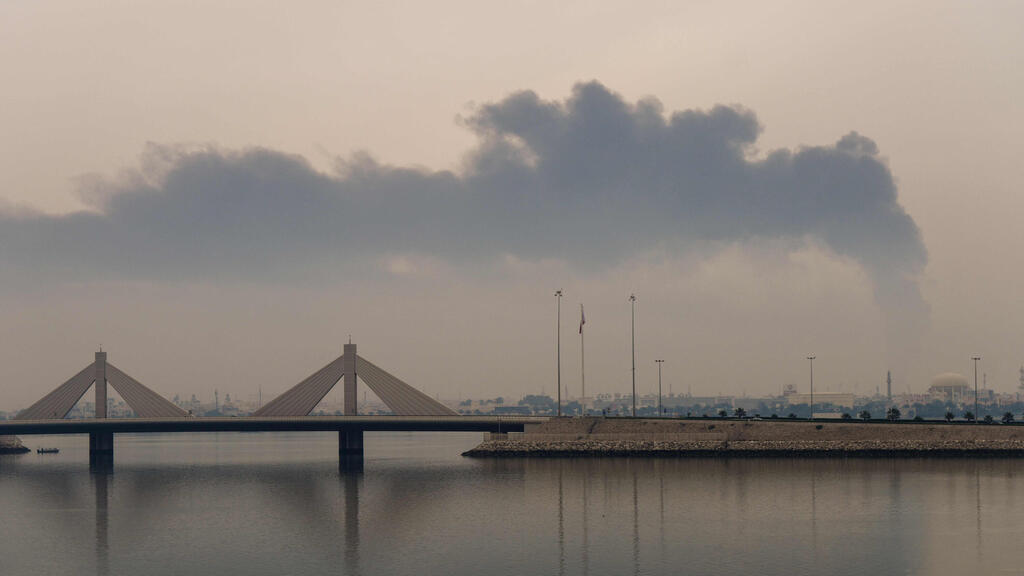
Iranian attack on oil tankers in Bahrain
(Photo: Fadhel MADHAN / AFP)
The deliberate decision by the United Arab Emirates and Bahrain to join the regional normalization framework of the Abraham Accords in 2020, alongside Israel and with U.S. backing, was a courageous step. It reflected not only a shared interest in promoting stability in the face of Iran’s destructive interference, but also a formal recognition by these states that Israel is a positive force contributing to regional stability and a partner worth cooperating with, despite criticism from opponents of the move.
Iranian strikes during the war targeting symbols of stability, prosperity and economic power — such as Abu Dhabi and Dubai — along with Tehran’s decision to close the Strait of Hormuz to oil tanker traffic, are aimed not only at causing economic harm and a sense of vulnerability among Gulf states. They are also intended to create a psychological effect, projecting the image of a neighborhood bully not to be challenged.
The heavy missile barrages launched last night toward Israel and the United Arab Emirates, in what appears to be a retaliatory action by Iran’s Islamic Revolutionary Guard Corps following a night of targeted killings in which senior regime figure Ali Larijani was also reported killed, are another reminder of the urgent need for joint action by Israel and regional states to shape the desired postwar reality.
Leverage the close coordination
At this stage, it is important to ensure that the shared threat posed by Iran is translated into a long-term plan of action. It is not enough to weaken the terror regime and its various proxies and stop after declaring military victory. The unprecedented close coordination between the United States and Israel should also be leveraged for a complementary and necessary diplomatic effort — namely, expanding the normalization framework of the Abraham Accords.
With prudent conduct and sound diplomacy, this effort could also include Saudi Arabia, which, in light of the war, is likely to strengthen its resolve to play a leading regional role and deepen its coordination with Washington. This aligns with shared economic interests and with the development vision of Crown Prince Mohammed bin Salman.
The dramatic events of the moment — literally and figuratively — have created a convergence of interests for establishing such a regional coalition. This is now an urgent priority not only for Israel, but also for the United States, which seeks to preserve stability in the Middle East and to present a “victory picture” that would bolster President Donald Trump’s image as a peacemaker, effectively “returning the investment.” It is equally vital for Gulf states, for whom the latest war has served as a wake-up call underscoring the need to strengthen their defense and security layers.
After two and a half years of a multifront war that, alongside significant achievements, has also carried substantial diplomatic costs for Israel and increased alienation in the international arena, the conflict with Iran may create a shift in the currently skewed perception of Israel. It could restore not only Israel’s military strength, but also its diplomatic and moral standing.
This can and should be Israel’s moment to draw on its extensive experience and offer needed assistance to its Gulf partners in strengthening civilian defense and expanding security and economic cooperation — as a model for building bridges of success for the benefit of the entire region.
 Roy Binyamini
Ultimately, the regional dominance of the Abraham Accords bloc — alongside countries such as Egypt and Jordan — represents a strategic opportunity in a region that has repeatedly shown it does not tolerate a vacuum. Time is therefore a critical factor. If Israel and its allies hesitate to seize this moment, other actors may seek to shape their own axis of influence. One such actor could be Turkey, which continues to aspire to regional expansion and leadership with a Sunni Islamist orientation aligned with the Muslim Brotherhood, under President Recep Tayyip Erdogan’s neo-Ottoman vision.
The author is a former division head at Israel’s National Security Council and an expert on the Middle East and Africa.