


The incident near the village of Tel on Friday nearly two weeks ago was not a terror attack. It was a violent confrontation that developed into a gun battle after dozens of Israeli civilians went on a “hike” through the alleys of the Palestinian village, crossing Areas A and B.
According to the findings of the IDF investigation, the hikers neither requested military authorization nor asked for security protection. Entry by Israelis into Area A, which is under full Palestinian control, is prohibited without explicit authorization from the military commander responsible for the area. Under Israeli law, entering without such approval is a criminal offense.
Gallery
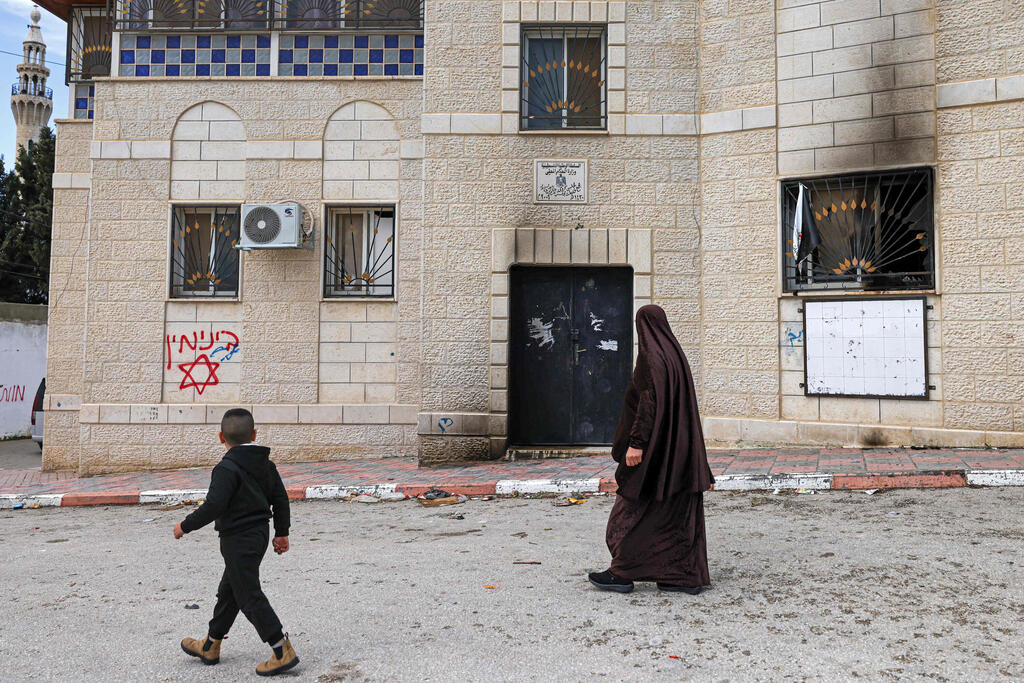
Palestinians inspect damage in the village of Jalud after a suspected settler attack involving arson, clinic vandalism and graffiti
(Photo: Zain JAAFAR / AFP)
The hikers also passed through Area B, which is under Palestinian civilian control but Israeli military control. The IDF remains the sovereign authority throughout the West Bank.
The word “terror attack” does not accurately describe the brawl that developed between Tel residents and the hikers. There was no advance planning, and the Palestinians did not arrive armed at the scene where Maj. Yuval Ezra, Gilad Farm deputy security coordinator Benayahu Mellet and four Palestinians were killed.
Only after Mellet removed the rifle strap from his back and neck and raised the weapon with one hand during a physical confrontation did a Palestinian attacker manage to seize it and shoot both him and company commander Ezra.
The IDF investigation exposed several additional tactical and microtactical failures in the conduct of the military force. But in general, the soldiers acted properly when they rushed to help hikers who had explicitly violated IDF instructions.
The military does, in principle, permit hiking in the area, provided the excursion and its route are coordinated in advance.
The hikers knew that security tensions had risen sharply in the days before the excursion. They also knew it was Friday, when most village residents would be at home rather than at work.
They nevertheless entered the village in a group of dozens, almost certainly aware that the territorial brigade would not have authorized such a route had they requested approval.
An alert surveillance soldier discovered their presence and summoned IDF forces.
The details of this violent incident, however, are not the main issue. They expose a more fundamental reality: The IDF, although formally the sovereign power in the territory, is unable to enforce the law. Neither can the police or the Shin Bet.
A large and extremist group that has emerged from within the West Bank settlement movement has taken the law into its own hands. It has effectively become the sovereign power on the ground and acts as it pleases. The IDF merely provides security for its whims.
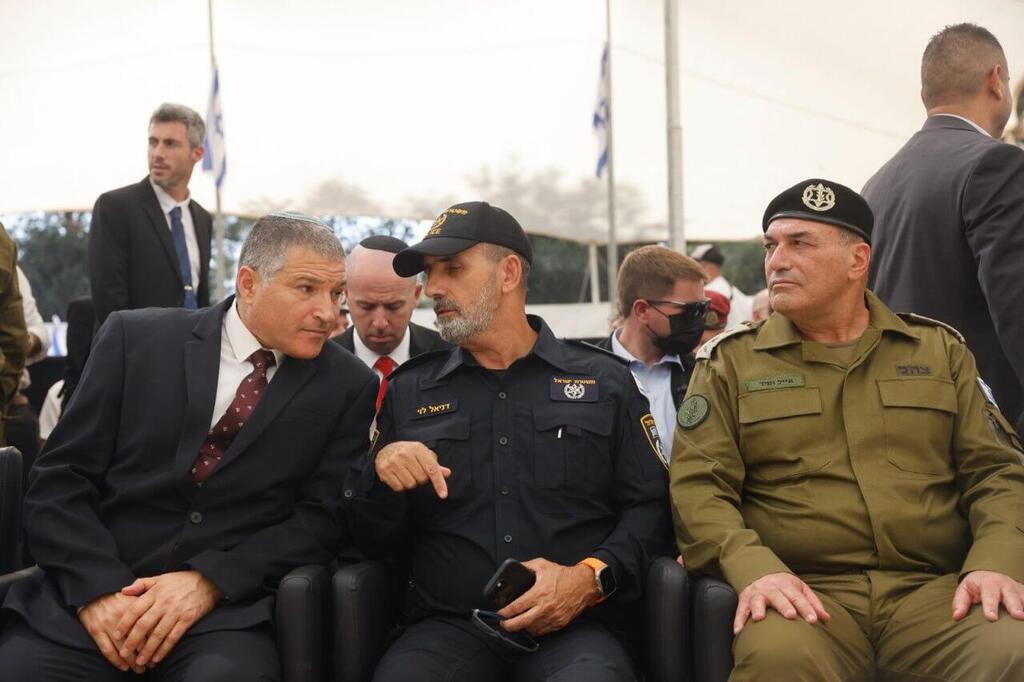
Shin Bet chief David Zini, Police Commissioner Danny Levy and IDF Chief of Staff Lt. Gen. Eyal Zamir
(Photo: Olivier Fitoussi)
Consider one example. At the beginning of the week in which the Tel incident occurred, a fire threatened Gilad Farm.
Fire investigators and police forensic experts determined conclusively that the blaze had not been deliberately started but was caused by negligence.
That finding did not prevent members of the same extremist Jewish group from establishing 13 illegal outposts around Gilad Farm and the nearby village of Tel.
Those outposts join roughly 100 unauthorized outposts and farms established across the West Bank in recent months.
IDF and police forces are already stretched to their limits. Yet instead of removing these outposts, they are forced to expand their deployments and use expensive technology, intelligence collection systems and defensive resources to protect them.
The surveillance soldier who discovered the uncoordinated hike near Tel identified it because the group was moving close to one of these illegal outposts, an area that until recently had not even been part of her operational responsibility.
Here is another example. Last week, groups of dozens of Jews entered Nablus, an Area A city, committing a criminal offense under Israeli law.
The IDF sent forces, but not to remove them. The soldiers were deployed to protect them until the group chose to end its provocation and leave voluntarily.
There is a long list of similar incidents in which the IDF, and to some extent the Israel Police, neither arrest the lawbreakers nor file indictments against them.
Proving that an Israeli entered Area A is simple. Prosecuting such an offense is not legally complicated.
The IDF permits coordinated Jewish visits to Nablus every few weeks and provides security for them. Those visits usually pass without unusual incidents.
But the Jews who entered Nablus without coordination knew perfectly well that the army would not approve their entry. Their objective was to create a provocation, and the IDF secured that provocation.
The conclusion is unavoidable: The IDF has lost control of the extremists within the settlement movement and has become a private security company for their whims and illegal actions.
Whether the issue is provocative “hikes” through Palestinian communities or the establishment of unauthorized outposts, the military is also increasingly acting on behalf of right-wing politicians.
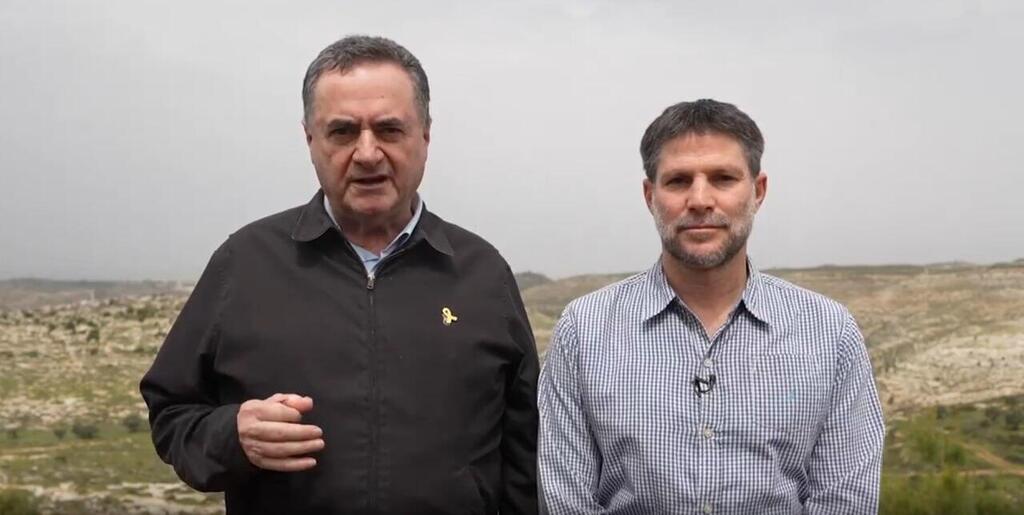
Defense Minister Israel Katz and Finance Minister Bezalel Smotrich during a joint tour of the West Bank
(Photos: Elad Malka, Shira Keinan, Defense Ministry)
The IDF is now preparing to seize another refugee camp, apparently Balata, despite the absence of a genuine operational need.
The current security challenge in the West Bank is posed primarily by lone attackers or small cells carrying out imitation attacks. It is not the same threat that existed two or three years ago, when organized armed battalions operated in the Jenin and Tulkarm refugee camps, using explosives and other weapons.
The IDF has largely dismantled those organized groups. The remaining threat is best addressed through precise intelligence, preventive arrests and other focused methods in which the military has developed considerable expertise.
Taking over another refugee camp will make little difference in the fight against Palestinian terrorism.
It will, however, allow Defense Minister Israel Katz to tell his voters, “I instructed the IDF,” while Finance Minister Bezalel Smotrich can take satisfaction in seeing another stage of his so-called victory plan carried out by Israeli soldiers.
A situation in which the IDF has lost control of Jewish extremists and terrorists, while providing them with security services, is intolerable in a properly functioning state.
Those same extremists, rather than showing gratitude to the soldiers protecting their lives, attack IDF officers, from Central Command chief Maj. Gen. Avi Bluth to the late Maj. Yuval Ezra, accusing them of failing to seek confrontation or act aggressively enough.
This politicization of military action endangers the Zionist enterprise itself.