

Twenty years ago, when I first walked through the gates of a pre-military academy that combined Torah study with military service, we were a small handful. We were among the first cohorts, pioneers in a world where the options for a religious teenage girl in the IDF were limited to just a few roles, wrapped in a modest support framework provided by the academy.
Today, when I look into the eyes of my students at the state-religious high school I lead, I see a completely different reality. I see young women driven not only by a desire to contribute, but by a deep understanding that they are an inseparable part of the story of the state. They want to be part of it: young religious women who are secure in their religious identity and unwilling to forgo their share.

A female fighter in an elite unit
(Photo: Avigail Uzi)
The discussion conducted over our heads, in rabbis’ rooms or in the political committees of Religious Zionist parties, often seems disconnected from reality on the ground. The truth is simple: The train has already left the station. The era of “consultations” over whether it is appropriate for a religious girl to enlist is over. Today, our girls are not waiting for approval. They are voting with their feet, and our role is to prepare them and accompany them.
As the head of an educational institution that is Zionist and religious, I do not merely “allow” enlistment, I educate toward it. I believe the IDF is the people’s army, and as such, we must be there. Military service is not an obstacle to the religious world. It is the place where faith meets Israel’s complex reality and refines it. The old fear that the army would corrupt our girls has been proven wrong. On the contrary: When they arrive prepared, strong in their faith and supported by community and proper education, military service strengthens their spiritual world. They find themselves praying with new depth, holding fast to faith with greater responsibility and sanctifying God’s name at every step.
Avoiding military service harms the ability of a religious woman to be an organic part of Israeli society. There is no reason a religious woman should have to wait until age 30 to feel she has done her part in the national effort and seek to complete this important chapter.
Today, all options are open to those who enlist, from education, technology and intelligence to combat and training roles. They are everywhere: significant, professional and God-fearing. They do not need to choose between their religious identity and their Israeli identity. Service in the IDF is the place where these two poles unite into a single whole.
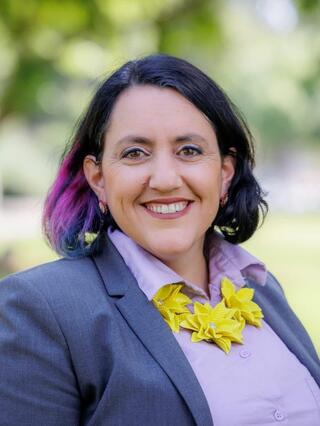 Roni Hazon WeissPhoto: Noam Feiner
It is time for the spiritual and political leadership of Religious Zionism to recognize reality: Our daughters are already there. They are at the forefront. Our role as educators and parents is not to stop them or frighten them, but to equip them with tools, faith and great pride. Instead of debating the question of “if” it is time to address the question of “how”: how we strengthen them further, how we ensure they reach the roles best suited to them and how we continue to build a generation of religious women who are Torah scholars and fighters, women of faith and engaged citizens.
The girls at my school already know the answer. They are ready. And they sanctify God’s name in public.
Roni Hazon Weiss is the principal of Shacharit High School in Jerusalem, part of the Association for the Advancement of Education. She is a graduate of Midreshet Lindenbaum and an education officer, a reserve lieutenant.