

The president is on his way to an international conference when he orders his plane to turn around and return to the capital, citing "events at the Constitutional Tribunal," the country's highest court for constitutional matters. After landing in the middle of the night, he heads straight to the court, accompanied by close associates. Opposition leaders have been demonstrating outside the building for days.
The president, himself an opposition figure elected by popular vote, makes his way to the building's heavy entrance doors, pushing past the tribunal's judges, including the woman who presides over the court. He remains there until the early hours of the morning.
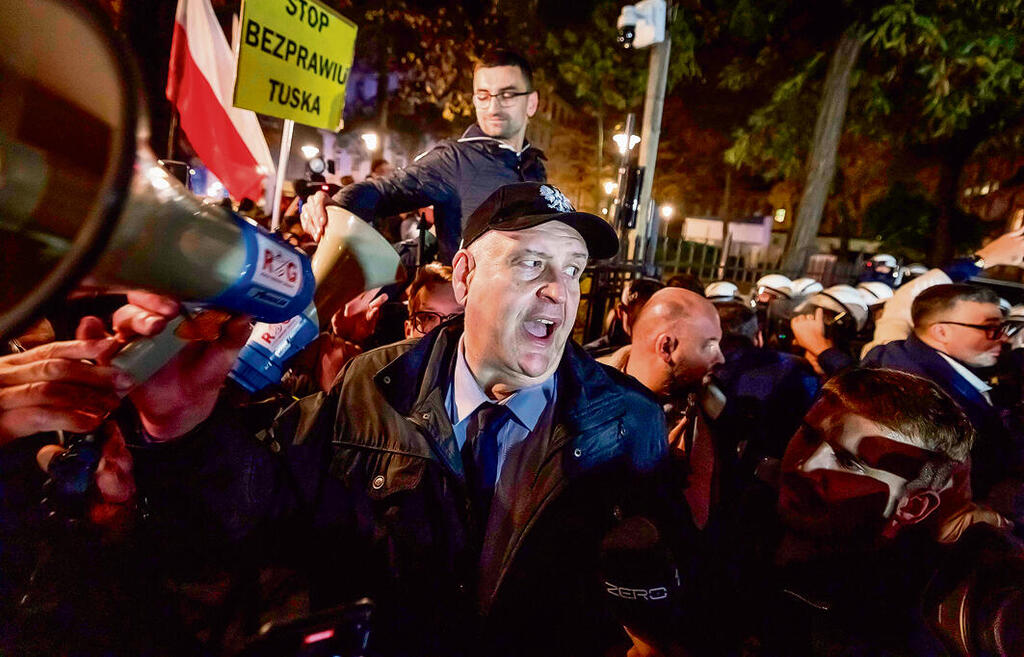
(Photo: WOJTEK RADWANSKI, AFP)
This is not a scene from a young African nation taking its first steps toward the rule of law, nor from a South American country with a history of coups and countercoups. It is happening in the heart of Europe, in Poland, a country that has been held up as a model of liberal constitutional democracy since breaking free from Soviet communism in 1988.
Now, Poland finds itself on the brink of a potentially violent confrontation between its elected government and its elected president, one that could even spiral into civil war.
The roots of the crisis go back to the fall of 2015, when the nationalist-conservative Law and Justice party scored a surprise victory in elections to Poland's parliament, the Sejm. Once in power, the party launched a campaign to bring the country's judiciary under political control.
Thousands of respected judges at every level of the court system were forced into retirement or dismissed on a variety of pretexts. Supreme Court judges were next, followed by members of the Constitutional Tribunal, the body charged with safeguarding the principles of Poland's democratic constitution.
The tribunal's judges were also swept up in the purges. Those removed from office were replaced by political appointees loyal to the governing coalition, judges in name only. They went on to rubber-stamp virtually every government decision, law and regulation, including blatantly illegal wiretapping.
The Law and Justice government also benefited from having one of its own in the presidency. Andrzej Duda, a senior party figure who had been elected president by popular vote, readily signed off on the judicial purges.
Then, in October 2023, the political tide turned. A centrist-liberal alliance led by the charismatic Donald Tusk won the parliamentary elections. Reversing the previous government's judicial overhaul and removing most of its politically appointed judges became a top priority for Tusk and his new administration.
But dismantling the system built by Law and Justice proved a slow and difficult process. The effort faced a major obstacle when the party's candidate, Dr. Karol Nawrocki, was elected president. He used his presidential powers to obstruct the changes, including refusing to swear in newly appointed judges to the Constitutional Tribunal, among them its new president and vice president. Instead, he insisted that their predecessors remain in office, even those suspected of criminal wrongdoing.
Over the past two weeks, violent protests outside the tribunal in central Warsaw have intensified, with the encouragement and participation of neo-fascist, anti-Ukrainian and antisemitic politicians and activists.
Tusk's coalition responded by suspending Constitutional Tribunal President Bogdan Święczkowski and his deputy. It then allowed the court's longest-serving female judge to declare herself the new president and secured parliamentary recognition of her appointment.
That was the spark that set off the latest confrontation.
Poland's far right erupted in outrage, accusing the government of "trampling democratic principles" and leading the country toward "dictatorship."
President Nawrocki, as described earlier, cut short his flight to Africa, returned to Warsaw and intervened in the standoff with a show of force. A meeting he convened Saturday in an attempt to resolve the dispute failed to produce a breakthrough. Prime Minister Tusk's sharply worded speech only underscored how deeply entrenched the crisis has become.
Poland is not yet on the verge of internal bloodshed or a coup against its legitimate government. But it is rapidly sliding into political chaos, with the central battle now revolving around a judicial coup and attempts to undo it.
Poles are beginning to understand that an independent judiciary, free from political interference, is essential to preserving a system of government that respects and protects human and civil rights.
We understand that, too. Their struggle is our struggle.