

Slowly, residents of Israel’s northern border and the Gaza border region are returning to their homes. Most of them are unaware that above their heads, a quiet struggle is taking place, one that involves significant government and philanthropic resources.
For perhaps the first time in years, these border communities are being rediscovered, and even reimagined, as central to Israel’s national mission.
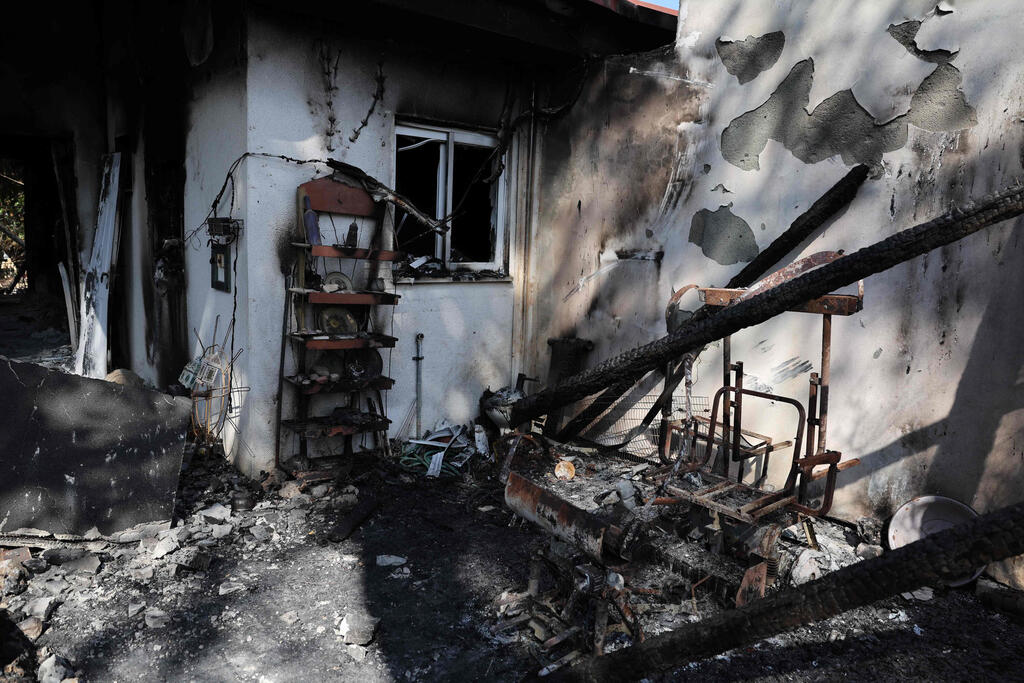
Kibbutz Nir Oz home devastated in the October 7, 2023, Hamas-led terrorist attack
(Photo: JACK GUEZ / AFP)
Kibbutzim near the Gaza border, once perceived as privileged and prosperous, have now, through no choice of their own, become some of the most vulnerable. Until recently, their social infrastructure was often considered a luxury. In 2008, then-deputy defense minister Matan Vilnai stirred controversy by dismissing the concerns of these communities, comparing them to Jerusalem residents during the Second Intifada. “We in Jerusalem suffered hundreds of deaths on exploding buses. Did we say we were abandoned?” he asked.
A decade later, following Operation Black Belt, a resident of Ein Hashlosha reflected on how politicians had diminished their suffering. “They called us crybabies. They said the attacks on us were minor. That infuriated me,” she said. These communities had endured the full spectrum of terrorism: from stabbings and shootings to incendiary balloons and kites, living under constant, tangible threat.
Get the Ynetnews app on your smartphone: Google Play: https://bit.ly/4eJ37pE | Apple App Store: https://bit.ly/3ZL7iNv
Three years ago, I participated in a panel where I struggled to explain why the state should support the community of Nir Oz. Tragically, it took a war for others to understand what these places endure.
As Hezbollah turned the northern front into a battlefield, the damage grew evident. According to press reports, over 15,000 claims were filed with Israel’s property tax office—roughly 10,000 buildings and 2,000 vehicles were damaged, alongside agricultural tools, home contents and more. These figures don’t even account for the loss of life or physical injury.
 Tira El Cohen
Yet one kind of loss cannot be reimbursed: the loss of community. Thousands were evacuated to hotels. For those with resources, these hotels served as temporary shelter. For others, they became reluctant homes. Between distant guest rooms and scattered housing, communities unraveled. Who will rebuild them?
Into this vacuum have stepped government agencies and philanthropic foundations—entities that understand something the property tax office cannot address: the importance of rebuilding social cohesion. Government departments and donors alike have flooded the region with calls for proposals. Social organizations, eager to make an impact, have raced to stake their claim. But in the rush for visibility and funding, long-standing groups working in these communities for years are sometimes overlooked or replaced.
To my colleagues in the third sector, I say: I support healthy competition. But we came here to do good, not to undermine one another. There is room for all of us.
The more we can restore what once was—the same names, the same faces, the same schools, youth programs and communal spaces—the easier it will be to reconnect the past to the present. Rebuilding familiar rhythms in familiar places lays the foundation for healing.
According to psychological theories by Judith Herman and Stevan Hobfoll, the return to familiar routines—daily routines, social ties and rituals—is central to trauma recovery. Before we lay new bricks, we must first restore the social foundation. As “white knights” arriving to help, we owe it to these communities to ask: Who and what was here before? What was lost, and what can be brought back?
- The writer is the founder and president of Kedma, an organization working for the benefit of Israel’s periphery area.