

The supposedly dramatic speeches of Hezbollah Secretary-General Sheikh Naim Qassem no longer appear to command much attention. Not in Lebanon, not in Israel, not across the Arab world and not internationally.
His appearances are announced in advance, he is filmed speaking from a closed room, and two Hezbollah-affiliated channels broadcast speeches that increasingly seem to generate little reaction. There is none of the anticipation or fascination that surrounded speeches by his predecessor, Hassan Nasrallah. Instead, an impression has taken hold that Qassem is little more than a vehicle for senior figures in Iran’s Islamic Revolutionary Guard Corps, with others preparing the messages he delivers.
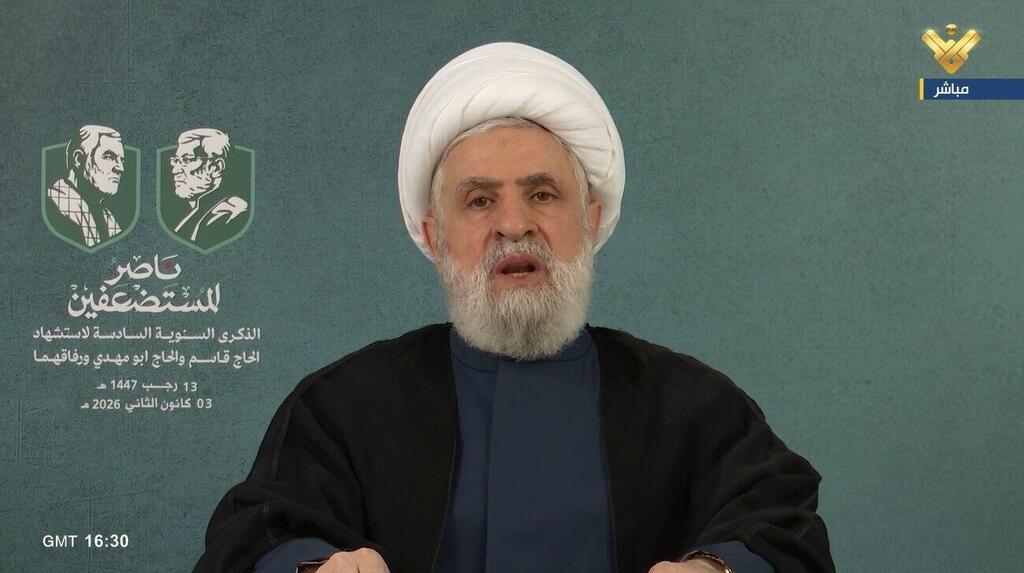
Naim Qassem
Qassem, 73, has served as Hezbollah’s secretary-general since October 2024. He was chosen after Nasrallah was killed in an Israeli Air Force strike on Hezbollah’s underground headquarters in Beirut’s Dahieh district.
Although Qassem was among Hezbollah’s founders, during Nasrallah’s 32 years as secretary-general he was widely seen as a secondary figure, the perpetual deputy.
Now, Lebanese sources say, he receives prepared texts ahead of his speeches and recites them. He remains in hiding, aware that Israel is also seeking to kill him, but even within Hezbollah he is regarded as a far less dominant figure than Nasrallah.
His latest appearance, however, did manage to attract attention, though not in the way Hezbollah may have intended.
In his speech, the secretary-general “quoted” what he described as an “Israeli intellectual” named Moshe Yair, who, Qassem claimed, had published an article in Yedioth Ahronoth praising “the Lebanese delegation to talks with the Israeli delegation in Washington and Rome.”
Qassem waved a piece of paper, suggesting he was quoting from the supposed article, in which the invented Moshe Yair had “written” that the Lebanese delegation was serving Israeli interests and working on Israel’s behalf instead of acting in Lebanon’s interest. He then added that the head of the Lebanese delegation, Ambassador Nada Moawad, “is actually an American citizen,” and that her economist husband also holds only an American passport.
Qassem also claimed that the framework agreement expected to be signed between the delegations had been written “in Israeli ink” and would turn Lebanon into a protectorate that would lose its independence. “The stupidity of the members of the Lebanese delegation is frightening,” he said, stressing that the delegation had nothing to contribute.
The United States was quick to respond sharply, saying in a State Department statement in Washington that “the secretary-general receives strict instructions from Iran and acts under the direction of senior figures in the organization.” According to the Americans, “Hezbollah is the main and only obstacle preventing the development of Lebanon’s economy and ensuring its stability.”
Lebanese businessman Tahseen Khayat, owner of Al-Jadeed, gave news presenter Dima Sadek the green light to attack the Hezbollah secretary-general with biting mockery. “We checked,” she announced, “and there is no Israeli intellectual named Moshe Yair, and no article by him appeared in Yedioth Ahronoth.”
My contacts in Lebanon have already dubbed the secretary-general’s blunder “the trap” and are firing arrows of criticism at him. Two very senior figures in the Lebanese establishment tell me they would not be surprised if contacts are already underway, through Parliament Speaker Nabih Berri, in an effort to replace Hezbollah’s secretary-general. No one can guarantee that the next secretary-general would show greater flexibility, but Naim Qassem himself also knows that he has run out of road.