

This was already the third Iranian missile and drone attack on Aqaba. On Monday night, Jordanian security officials rushed to send alerts to residents’ phones, urging them to take shelter in bomb shelters, of which there are none, or in underground parking areas beneath residential buildings, of which there are few, or simply to “find a safe place.”
Some of the 2,500 workers and hotel employees who cross the border into Israel every morning and return to Jordan in the evening were given permission to stay overnight in Eilat until the end of the week.
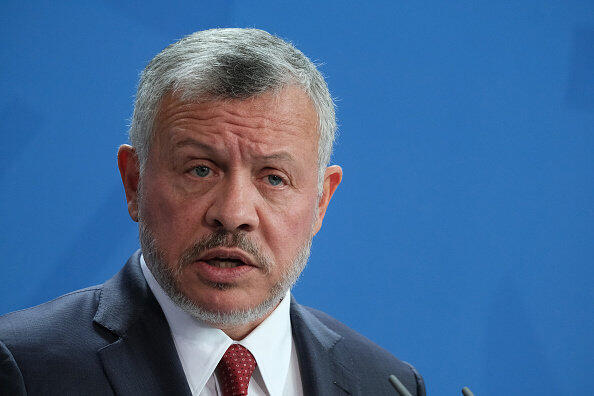
King Abdullah
(Photo: gettyimages)
King Abdullah II and his eldest son Hussein, the crown prince, remained silent this time. They heard Iranian claims that “dozens of American military personnel” had been killed or wounded. Statements from Washington and Amman told a different story: 10 missiles were shot down over the Tinten training base in Aqaba, while another three were intercepted without causing damage.
Notice how none of Jordan’s neighboring countries, Iraq, Syria or Lebanon, has come to its aid. In the Gulf states that continue to absorb Iranian attacks, Kuwait and Bahrain are preoccupied with their own problems. Saudi Arabia is keeping its distance, while the United Arab Emirates is waiting for the moment when mediation between Jordan and Israel can begin.
Senior military officers are not only monitoring Iranian activity but also speaking with their counterparts in Jordan. There are no embassies, no economic or commercial relations and fierce hostility on the Jordanian street, but security cooperation and consultations have managed to survive.
From conversations with decision-makers in Amman, I hear one clear, irritated and unequivocal message: Jordan continues to receive vital quantities of Israeli water for drinking and agriculture, almost as though that water is meant to compensate for Israel’s conscience over a relationship that failed with its “little sister”
One recent example of the strained relationship was Israel’s persistent refusal to allow the Jordanian helicopter intended to carry the new Arab League secretary-general, Nabil Fahmy, to a meeting with Palestinian Authority President Mahmoud Abbas at the Muqata presidential compound in Ramallah. The secretary-general returned to Cairo angry and humiliated.
King Abdullah is dealing with economic crises. He is gritting his teeth and waiting for the results of Israel’s election. If Netanyahu remains in office, the peace agreement will sink at least one more level, with no diplomats, no cooperation and no visits.
At the same time, profiles of Gadi Eisenkot, Naftali Bennett, Avigdor Lieberman, Yair Golan and Yoav Segalovich are already circulating in the kingdom. Mansour Abbas, meanwhile, is well known in Jordan. If there is a change of government in Israel, then, as they say, anything is possible.
In that case, a very senior figure close to King Abdullah told me, the round of consultation visits to the royal palace would begin again. If peace with Egypt is known as a cold peace, the relationship with Jordan can now be described as frozen.
Politically, however, it remains open to surprises, with American-Emirati mediation and after Israel’s election.
If you like, it is a kind of peace that is so close, yet still far away.