

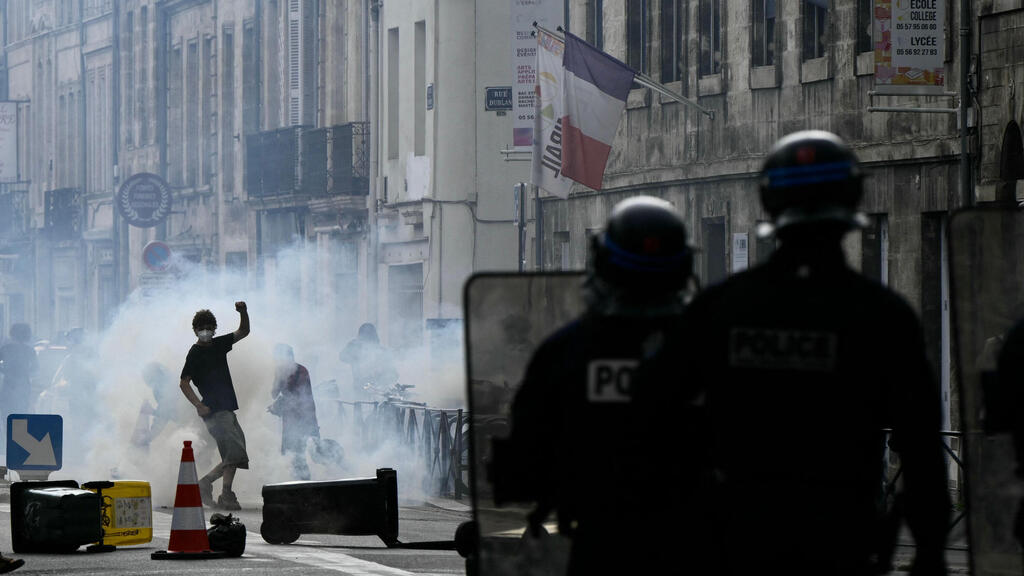
Nelson Mandela High School in Nantes was built as a futuristic model for French education at a cost of 75 million euros. Five architecture firms designed its distinctive timber structure, which includes a boarding school and dormitories, gyms, climbing walls and advanced laboratories. Apparently, even that was not enough. This week, the school was set on fire during riots ostensibly aimed at “improving learning conditions,” part of unrest that affected roughly a quarter of France’s high schools, left hundreds of police officers and firefighters injured, led to thousands of arrests and caused extensive damage.
France is no stranger to riots, but this does not appear to be just another passing round of unrest. According to a leaked police report, the violence amounts to a rehearsal by an organized system capable of overwhelming public order, one cultivated politically by Jean-Luc Mélenchon, leader of the far-left La France Insoumise movement.
The Palestinian cause may explode in Europe’s own hands
(Photo: Philippe LOPEZ / AFP)
Mélenchon has capitalized on the growth of neglected enclaves on the outskirts of France’s major cities, neighborhoods populated by generations of immigrants from North Africa, many of them Muslim, where state authority has steadily weakened and police have long struggled to operate. He has connected the anti-establishment anger found there with France’s long-standing radical left.
Each side brings something the other lacks. The immigrant neighborhoods provide a large pool of potential street activists, while the radical left has deep links to trade unions and extensive organizational experience. Together, they have created an increasingly sophisticated and disciplined mechanism capable of mobilizing unrest on command.
President Emmanuel Macron and his predecessors failed to curb immigration and instead sought to purchase a fragile form of social peace through welfare payments. That system depended on continued economic growth. But as France’s birth rate declined, its younger population shrank and growth weakened, the money began to run out while the deficit soared.
At the same time, the economic contribution of immigrant communities has remained significantly lower than that of the native-born population, while the fiscal and social burden associated with immigration has grown. The result is a political center that is steadily losing ground and could find itself pushed aside when France next goes to the polls, leaving the field to the radical right and radical left.
A victory by the right could trigger the full activation of Mélenchon’s protest machinery, followed by an equally forceful response from the right, producing extreme instability, a severe economic crisis and potentially even civil conflict. A Mélenchon victory could bring a different form of upheaval through sharply higher taxes, expanded welfare spending and hard-left economic policies that could further weaken the French economy.
The mechanism Mélenchon has built gained particular momentum after Oct. 7. The Hamas massacre unleashed a surge of antisemitism around the world, while the Palestinian issue became an especially effective vehicle for mass mobilization.
It became easy to draw people into demonstrations against Israel by combining longstanding European antisemitism with Islamist hostility toward the Jewish state. Hundreds of anti-Israel protests provided not only a political cause but also the infrastructure, networks and organizational experience needed to build a broader protest machine that is now being tested on a much larger scale inside France.
The Palestinian flag has consequently become a unifying symbol across movements that otherwise have little in common. Muslims and Christians, Sunnis and Shiites, elements of the left and elements of the right can all gather beneath it for different reasons. What unites them is hostility toward Israel and, increasingly, hostility toward Jews.
The Palestinian narrative has become an especially powerful political instrument because it presents the destruction of Israel as a struggle for justice, turning the demand for the land on which Israel exists into an international moral cause. Antisemitism dressed up as pro-Palestinian activism has in turn become a platform through which other political objectives can be pursued.
Macron recognized a Palestinian state while struggling to contain his own domestic political crisis. Mélenchon has used the Palestinian issue to help construct a powerful machine for mass mobilization and unrest. European governments spent years financing and cultivating the Palestinian cause as a means of pressuring Israel.
The irony is that the Palestinian political bomb may now explode first in the hands of the European countries that helped build it.