

The Houthis are facing a pivotal moment. Their most immediate challenge is the prospect of a major economic downturn, driven by Israeli strikes on key economic lifelines, tighter U.S. sanctions, declining humanitarian aid, and a population already squeezed by years of heavy taxation. A second challenge will be charting a strategic course after the Israel-Hamas ceasefire, which has halted the central conflict the Houthis relied on for the past two years to rally domestic political support. Third, after years of exploiting advantages over the Saudi-led coalition, the group now faces a determined and capable adversary that in recent months has dealt it some of the most severe blows in its history. The regime’s survival hinges on how it navigates these converging crises.
These three challenges, economic, political and military, are distinct but intertwined. For example, if the Houthis were capable of competent governance, their economic conditions might improve, potentially boosting their popularity and reducing the need for perpetual mobilization. But the regime has gutted the institutions necessary for stable commercial activity while empowering itself and its affiliates to dominate every major economic sector. The failures in governance are built-in to the Houthi system itself because the regime is designed to divert the nation’s resources toward its radical ideological project.
That said, the regime’s tireless pursuit of revenue has shaped its trajectory in recent years. In 2020 and 2021, the group sought to seize Marib governorate, which, in addition to its strategic location as a gateway to the south, enables control over Yemen’s oil industry. When that military campaign failed, by 2022, they turned to coercive diplomacy, attempting to pressure Saudi Arabia into paying them off (“for reconstruction”) to maintain calm along the border. During the Riyadh-Sanaa negotiations, the Houthis repeatedly escalated their demands, and a weary Saudi leadership felt compelled to concede. Riyadh’s weak bargaining position stemmed from its desire to end a costly, open-ended war and was compounded by the Biden administration’s unfounded conviction that ending Saudi involvement in Yemen would resolve the conflict.
Yet Saudi-Houthi negotiations failed to produce results before Hamas’s October 7, 2023 surprise attack against Israel. In the weeks that followed, the Houthis joined the rest of Iran’s “axis of resistance” in a multi-front war on Israel, and their continued attacks on Israel and Red Sea shipping forced Saudi Arabia to suspend its negotiations with Sanaa. Substantive pushback against the Houthis was delayed and staggered but began to pick up momentum in 2025, as the United States launched Operation Rough Rider and Israel launched Operation Drop of Luck.
The Houthis remain ideologically opposed to the United States and Israel but understand that continued escalation will not alleviate their structural weaknesses. Beyond that, Israeli and U.S. airstrikes that the regime provoked have inflicted hundreds of millions of dollars of damage to regime assets and critical infrastructure. This may explain the Houthis’ attempt to shift toward the renewed extortion of Saudi Arabia (a move enabled at present by the lull in Israel-Hamas fighting). In recent weeks, the group has issued a series of threats through its media outlets, warning Riyadh to pay up or face a new wave of attacks.
Although the Houthis have effectively declared that there will either be an agreement or a war with Saudi Arabia, both outcomes seem improbable. While the Houthis derive considerable leverage from threatening a destructive conflict with a kingdom that has far more, an actual attack on Saudi Arabia could trigger a war that further undermines the Houthis’ already fragile position. Confronting Saudi Arabia may offer the Houthis ideological satisfaction and a convenient excuse for northern Yemen’s dire economic conditions, but it generates no revenue and may, in fact, prove incredibly costly.
Although the Houthis may wish to replicate their earlier successes against Saudi Arabia, as the saying goes, you cannot step into the same river twice. This time, global sympathy has shifted sharply against the movement, tens of billions of dollars in humanitarian aid will not flow into northern Yemen, Iran and Hezbollah can offer far less support, and any new diplomatic initiatives will face far greater scrutiny than the failed 2018 Stockholm Agreement. With that in mind, war appears a far riskier proposition than it once was for the Houthis. Moreover, renewed Houthi attacks would make clear to Saudi Arabia that the aggression is part of a deliberate strategy of perpetual coercion and extortion, eroding the kingdom’s incentive to pay off those threatening to attack it.
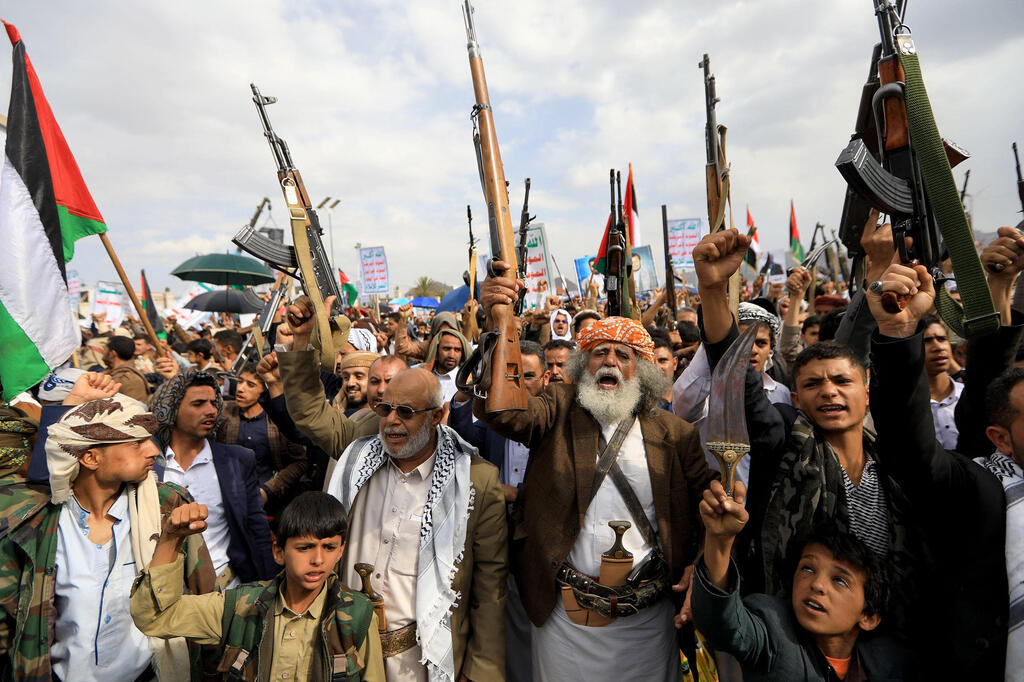
(Photo: MOHAMMED HUWAIS / AFP)
Why not an agreement, then? First, the shift in the balance of power would force the Houthis to accept far more modest terms than those available to them in 2023, an unlikely choice for a group known for continually escalating its demands. Second, if Saudi Arabia assesses that war is unlikely and that it could manage a limited conflict with support from its allies, it has little incentive to enter a deal that would effectively subsidize the threat on its doorstep.
To enhance its deterrence, Saudi Arabia should clearly message that any attack on its sovereign territory will elicit a painful response with broad international support. A military response should be targeted to exacerbate the movement’s domestic challenges. In parallel, Riyadh should clarify that it will not be coerced into an agreement that risks allowing the Houthi threat to metastasize.
As things stand, the Houthis are likely to remain suspended between confrontation and compromise with Saudi Arabia. The regime’s ability to navigate the three abovementioned economic, political, and military challenges will shape its medium-term stability. Despite periodically showcasing new and more advanced weapons, the Houthi regime appears increasingly fragile and adrift. The group is likely to continue limited provocations against external adversaries below the threshold of full-scale conflict, seeking to avoid the risks of a costly war while maintaining domestic morale and deterring its enemies. Its broader strategy may grow to resemble that of North Korea: consolidating absolute control over its territories while diversifying revenue sources abroad through the sale of goods and services to the highest bidder, including criminal and terrorist networks. At the same time, the group’s demonstrated appetite for risk, its highly centralized control by a small cadre of leaders, and its record of strategic surprises make it both unpredictable and susceptible to miscalculation.
Ari Heistein is a research fellow at the Jerusalem Institute for Strategy and Security and a consultant on defense technology.