

A carefully defined division of roles has been set between Lebanon’s president and prime minister. President Michel Aoun maintains direct contact with the country’s military command. Prime Minister Nawaf Salam has declared a “neutral policy” regarding the attack on Iran. In between stands Hezbollah, which has warned that any strike on Iran’s supreme leader, Ayatollah Ali Khamenei, would be considered a “red line,” and has said it will enter the fighting only if it is directly attacked.
Even before the strike in Iran on Saturday, Israel made clear it would continue to “address” Hezbollah bases and weapons depots. Indeed, the IDF struck Hezbollah targets Friday afternoon with the full knowledge of Lebanon’s leadership, which did not intervene. The message was delivered, and the president and prime minister began sending clear signals to Hezbollah: “Do not join, do not endanger Lebanon’s security.”
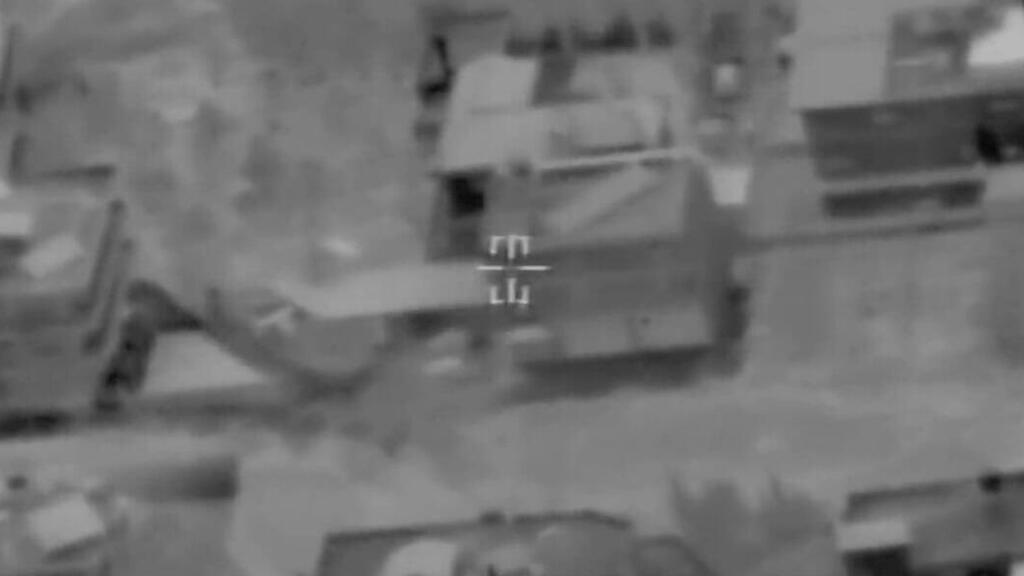
IDF strike on Hezbollah terrorist organization headquarters
(Photo: IDF)
Despite those appeals, residents of southern Lebanon near the Israeli border remain unconvinced. On Saturday they again set out northward, cars loaded with household belongings heading toward central and northern towns. A small number of schools and reception centers were opened for them amid fears Lebanon could be drawn unwillingly into war.
A Beirut resident, who asked to be identified only by his initials, said food shortages have worsened. Hezbollah has taken control of bakeries in the capital and other northern areas, he said, as well as fruit and vegetable markets. Residents wait in the streets for delivery trucks and those who can afford it buy goods at inflated prices. “Fortunately,” he said, “we did a large shopping trip last weekend when prices were still relatively reasonable.”
Lebanon’s leadership is closely monitoring U.S. and Israeli strikes and Iran’s response, keen to avoid appearing aligned with Israel. At the same time, observers say there appears to be an understanding between Israel’s security establishment and the presidential palace. Aoun himself served as Lebanon’s army commander until about a year and a half ago, when he was appointed president, and he maintains close working ties with current army chief Rudolph Haikal. In effect, he holds two roles: president and commander in chief of an army that remains weaker than Hezbollah’s forces.
Hezbollah’s response remains on hold. The group has signaled it will not act, as in the Gaza war, unless there is a major blow against it, and that it will not intervene as long as Khamenei is not harmed. Hezbollah views an assassination attempt against the Iranian leader, who has supplied it with weapons, military equipment and funding, as a red line. Yet even following reports that Khamenei had been killed, Hezbollah did not rush to respond. Sheikh Naim Qassem, the group’s secretary-general, canceled a planned speech Saturday without explanation.
The United States, Australia, Poland and several other European countries have evacuated diplomats’ families and nonessential staff amid fears of a security deterioration in Lebanon.
Between sirens in Israel and the Persian Gulf states, Lebanese army troops have been working to deepen their control south of the Litani River. The army chief has publicly signaled that forces are prepared to move to a second phase of disarmament north of the river. In practice, however, coordination between the Lebanese army and Hezbollah has been reported in some cases regarding disarmament efforts.
The army generally avoids direct friction with Hezbollah given its limited capabilities and the delicate balance between the sides. The situation is particularly complex when it comes to private homes where Hezbollah stores weapons, as the army’s authority is constrained by legal considerations involving private property.
As a Lebanese proverb puts it, no one wants to awaken a wounded wolf, one that since Saturday may have been dealt an even heavier blow. Until the war with Iran began, Hezbollah received funds via Turkey and Iraq. Weapons and military equipment were smuggled overland through parts of Syria outside the control of President Ahmad al-Sharaa, while drones were transferred by sea. Now the group’s immediate question is how, if at all, Iran can continue to provide support.