

Like Izz al-Din al-Haddad and Mohammed Odeh, senior commanders of Hamas's military wing who were killed earlier this year, Ali al-Amoudi, the organization's de facto leader in Gaza and the target of an Israeli assassination attempt a week ago that increasingly appears to have failed, could hardly have imagined on October 7, 2023, that three years later he would step into the shoes of men regarded as the movement's defining leaders, above all Yahya Sinwar.
His rise illustrates, on the one hand, how severely Hamas's leadership has been depleted since the massacre, but on the other, why the organization continues to survive, function and maintain its dominance in Gaza.
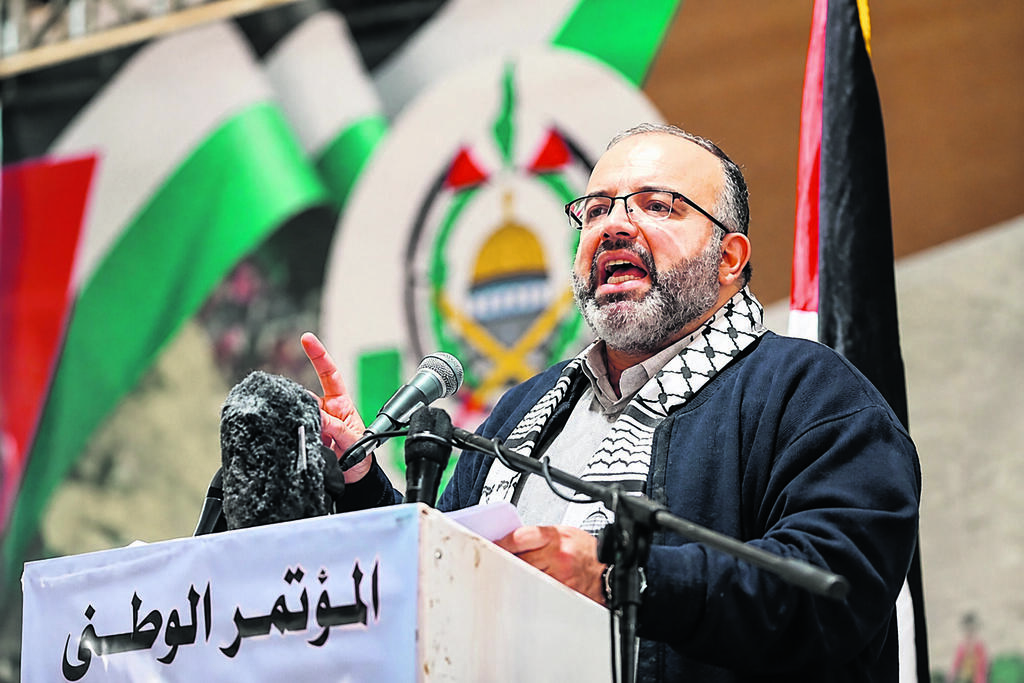
Ali al-Amoudi
Al-Amoudi, also known as Abu Ahmed, is closely identified with Sinwar personally and with the vision he promoted in the decade preceding the October 7 attack. Their backgrounds even share certain similarities. Al-Amoudi was born in Khan Younis in 1975, while Sinwar, more than a decade his senior, was born in the city's refugee camp.
Al-Amoudi joined Hamas during the First Intifada and belonged to a Gaza-based cell that operated in the West Bank. He took part in the February 1994 murder of Shin Bet officer Noam Cohen, known as "Captain Majdi," in Ramallah, an incident that became part of Hamas's mythology. Shortly afterward, he was captured in Abu Dis, near Jerusalem, following a gunbattle that lasted several hours, during which one of the cell's commanders was killed and al-Amoudi was wounded.
Al-Amoudi was sentenced to three life terms and remained imprisoned until the 2011 Gilad Shalit prisoner exchange. "I was the last name to be approved," he claimed after his release, seeking to illustrate how strongly Israel had opposed freeing him. Mahmoud Mardawi, a senior Hamas figure from the West Bank who now lives abroad, supported that account, explaining: "Israel strongly opposed the release of those who had murdered or attempted to abduct security personnel, particularly from the Shin Bet, and al-Amoudi was at the top of that list."
During his years in prison, which he described as an "educational summer camp," al-Amoudi developed a close relationship with Sinwar that continued after their release. "He was one of the people closest to Abu Ibrahim [Sinwar], both inside and outside prison," a senior Fatah official who was previously imprisoned in Israel said.
Between 2015 and 2017, al-Amoudi headed the propaganda department of Hamas's military wing. From 2017 to 2021, he served as Sinwar's chief of staff, and since 2021 he has headed Hamas's propaganda apparatus in Gaza.
In numerous interviews before October 7, al-Amoudi hinted at the approaching attack, and it is likely that he was involved in its planning. "We are preparing for the decisive and imminent battle to liberate Jerusalem," he declared on one occasion. In another, he warned: "We will capture IDF soldiers until the last prisoner is released."
Two days before the attack, he declared: "Our people have begun the greatest campaign for Jerusalem, and total war is the most powerful weapon for defending our lands."
Al-Amoudi is one of the few remaining figures from the Hamas leadership that governed Gaza on October 7. He serves as a link between the military wing and the political leadership and enjoys a favorable reputation in Gaza, both because of his military background and long years in Israeli prison and because he has lived through the three years of war in the Strip and continued operating there.
Since October 7, he has headed Hamas's emergency committee, overseeing the activities of the organization's governing institutions in Gaza. Following Sinwar's killing in October 2024, al-Amoudi was appointed deputy Hamas leader in the Strip, a position previously held by Khalil al-Hayya before he succeeded Sinwar. Since then, al-Amoudi has focused on rebuilding Hamas and its governing apparatus in Gaza, particularly through appointments to key positions.
Al-Amoudi's activities reflect a pattern that has emerged throughout Hamas over the past three years and helps explain its resilience: Organizational vacancies are filled almost immediately by ideologically committed members, even when those replacements lack the abilities, experience and public standing of their predecessors. This allows Hamas to maintain operational continuity and preserve its dominance in Gaza, where no alternative has emerged capable of seriously challenging its rule.
On the eve of the assassination attempt, al-Amoudi was at the center of an internal political struggle within Hamas. He was competing for the leadership of the organization's political bureau in Gaza against Nizar Awadallah, a representative of the older generation who came close to defeating Sinwar in Hamas's 2021 internal elections. The first round ended without a decisive result, and a second was expected soon, although it remains unclear when it will take place.
The contest reflects a broader factional struggle within Hamas. Awadallah is backed by Khaled Mashaal, another veteran leader who has criticized the Gaza leadership for launching the October 7 attack without consultation and argues that the decision imposed a devastating cost on the organization.
Al-Amoudi, by contrast, is supported by al-Hayya, who defeated Mashaal in the contest for Hamas's overall leadership. He represents a more hardline approach focused on rebuilding Hamas's military strength and continuing the struggle against Israel.
Researcher Mustafa Ibrahim described the internal debate: "In light of the severe blows Hamas has suffered, an intense debate has developed within the organization over whether it should focus on survival and reconstruction or on managing a prolonged crisis."
Three years after the October 7 massacre, Israel continues to confront a sharp contradiction between its impressive military achievements and the heavy blows it has inflicted on its enemies, and the unfulfilled promises to eliminate them through total victory.
Nowhere is this contradiction more pronounced than in Gaza, where Israel's military campaign has been particularly intensive, its freedom of action and influence are greatest, and the damage inflicted on its enemy has been most severe.
Israel controls more than 60% of the Gaza Strip, but not the approximately two million Palestinians who continue to live under Hamas rule. It continues to eliminate Hamas members, including senior figures, through operations defined as the "removal of an immediate threat," a designation intended to secure American approval.
Hamas has lost most of the military capabilities it possessed on October 7. Yet despite the enormous damage it has suffered, the organization remains the dominant force in Gaza. It is rebuilding its institutions and, according to reports, planning new attacks.
These developments, alongside warnings of possible offensive actions by other adversaries, raise difficult questions about Israel's ability to restore deterrence and erode its enemies' motivation to continue fighting.
Within Palestinian society, a debate is emerging over the historic course set in motion by the October 7 massacre. According to one argument, Hamas and the Palestinians have suffered devastating blows, but the struggle is far from over. Israel's growing international isolation and deepening internal divisions, proponents of this view argue, suggest that Sinwar's long-term vision may ultimately be realized.
In the year since the ceasefire, Gaza has remained in a state of paralysis shaped by an Israeli-American compromise.
Trump, who imposed the ceasefire following Israel's failed strike in Qatar, has prevented Prime Minister Benjamin Netanyahu from resuming large-scale fighting and conquering the entire Gaza Strip. At the same time, he has allowed Israel to continue striking Hamas targets and gradually expanding its territorial control.
Washington has also refrained from pressing for the establishment of a technocratic government in Gaza, reconstruction, an Israeli withdrawal or the deployment of multinational forces.
It cannot be ruled out that Trump is currently giving Netanyahu political leeway until Israel's elections. Afterward, regardless of who wins, Israel may face pressure to change its policy and perhaps even abandon its insistence on the full and immediate disarmament of Hamas as an absolute precondition.
Even if al-Amoudi is killed in the near future, it is unlikely to bring about Hamas's collapse. A replacement will probably be found quickly. That successor may be an unremarkable or even virtually unknown figure, but could still be capable of ensuring the organization's continued hold on Gaza.
Three years after October 7, it is time to confront an uncomfortable reality: Israel's enemies, however badly weakened, cannot simply be made to disappear. That applies to Iran, Hezbollah and Hamas alike, despite what Israelis may wish and what their leaders have repeatedly promised.
Confronting these adversaries will be a long struggle. But it must be guided by a realistic strategy, including an acknowledgment that military force alone cannot achieve Israel's objectives and must be accompanied by diplomatic action.