


"The war has changed Gaza forever, and the transformation is far from over. Israel may find it difficult to return to full-scale fighting, but Palestinians are unlikely to rush back to conflict either.” So said Palestinian journalist Mohammad Ayash this week, expressing a cautious hope felt by many in Gaza — alongside the grim understanding that the new reality remains fragile and volatile.
At the heart of this uncertain moment lies what locals call “the yellow line” — a near-imaginary boundary separating areas under Israeli control (roughly half the Strip) from those where Hamas remains active. The line is frequently breached by Palestinians, including Hamas members, as in the incident two days ago in Shuja’iyya that left five Palestinians dead. That dynamic may shift if and when the ceasefire agreement advances.

Gaza today stands in the shadow of a bloody effort to restore order. Hamas is under far more pressure than it was during the last ceasefire earlier this year. Since fighting resumed on March 18, the group has lost thousands of fighters, faces mounting internal challenges — including armed tribal militias — and contends with massive destruction across the territory. Yet Hamas, driven by its hardline ideology and still-functioning command structures, has reasserted its dominance through sheer force.
Since the ceasefire, Hamas' first move has been to reestablish its presence — this time more discreetly. Gone are the bold parades. Today, fighters wear civilian clothes and move in small, coordinated groups. “Israel sees the ceasefire as an opportunity to finalize its target bank,” warned Hamas’ intelligence-affiliated Telegram channel on Wednesday.
Meanwhile, efforts to restore civilian life have begun. Hamas-run municipal authorities are clearing rubble — where many Palestinian bodies still lie buried — and reopening roads.
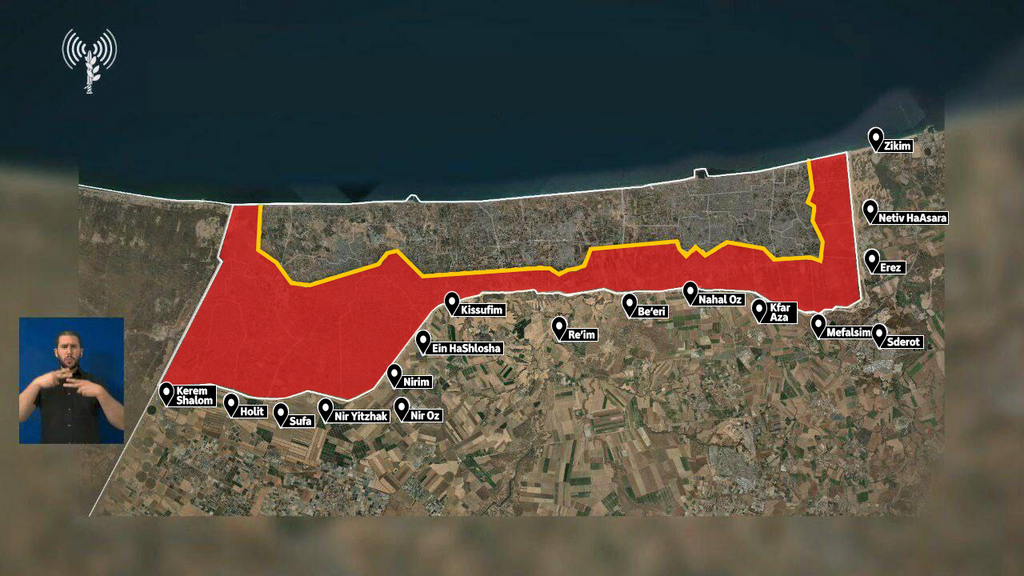
The Gaza yellow line
(Photo: IDF)
The most pressing challenge Hamas now faces is internal: a violent confrontation with a patchwork of armed clan-based militias that emerged amid Hamas’ weakening. Some of these groups have openly defied Hamas, attacked its operatives and carved out enclaves — some with reported Israeli backing. These include the al-Mansi clan in the north, the Dormush group in Gaza City's Sabra neighborhood, the Majayda clan in Khan Younis, and the most prominent group — Abu Shabab in Rafah — which declared itself a kind of mini-republic and claims to offer an alternative governance model.
In response, Hamas launched a brutal crackdown. Its Sahm (“Arrow”) and Rad‘a (“Deterrent”) units executed dozens of militia members this week and fought pitched battles, seizing weapons and funds reportedly supplied by Israel. The offensive against the Dormush clan was particularly violent and included the killing of Salah al-Jafarawi, a well-known social media figure aligned with the militia. Rejecting criticism, Hamas’ Sahm unit issued a statement declaring: “No mercy for agents who stole food from the people of Gaza. Their execution is justice.”
The message was received. The Majayda clan quickly pledged allegiance to Hamas, followed by the self-proclaimed “Council of Tribes and Clans in Gaza.”
“Many Palestinians see the executions as justified,” says Samir, a journalist in the Strip. “Public attendance at the executions is massive, with chants of 'Allahu Akbar'. People remember how these militias looted aid and abused civilians during the war. Many see them as criminals.”
According to Samir, some in Gaza even believe that former President Trump gave Hamas a green light, citing his recent statement in support of restoring order in the Strip. Whether that reflects actual U.S. policy or just local interpretation, the perception on the ground is that Hamas is regaining control — by any means necessary.
The so-called “clan fantasy” is just one of several risky ventures Israel has pursued in Gaza over the past six months. These include attempts to implement the Trump-era vision of depopulating Gaza and transforming it into a Mediterranean Riviera — a plan that led to the creation of a special Defense Ministry directorate tasked with persuading other nations to absorb Gazans. There was also the heavily funded but ultimately abandoned Gaza Humanitarian Foundation (GHF), once hailed by Minister Bezalel Smotrich as a “strategic shift,” and the planned construction of a humanitarian city in southern Gaza.
All of this raises troubling questions about whether Israel is truly learning from past failures — such as its experience with the South Lebanon Army in 2000 or the controversial “Village Leagues” in the West Bank. Now, Israel faces a painful dilemma: on one hand, it must protect the clans it has cultivated ties with, knowing the broader Middle East is watching closely and drawing conclusions about Israeli credibility. On the other, offering such protection risks reigniting conflict with Hamas.

The collaborators are the nail that made Gaza bleed
Among Gaza’s broader population, the word on everyone’s lips is “Awda” — the return. It reflects the basic, desperate movement of hundreds of thousands of displaced people back to the ruins of their former homes. Hamas has tried to frame this as an act of defiant endurance, or sumud, but the reality is grim: more than 500,000 housing units have been destroyed or severely damaged, 80% of schools and higher education institutions lie in ruins and literacy rates are dropping after two years without a functioning education system. Unemployment and poverty are nearing 100%, and 75% of the mosques have been leveled. Roads, water and electricity infrastructure have also been largely obliterated.
“Many Gazans feel — or more accurately, hope — that this ceasefire will hold, mainly because of American involvement and pressure from Arab and Turkish states,” says Mahmoud, a UNRWA employee in Rafah. “No one expects rapid or dramatic change, and news of about 150 Palestinian Authority personnel arriving at the Rafah crossing doesn’t generate much excitement. Still, people hope the ceasefire holds and change will come gradually.”
A recent poll by the Palestinian Center for Public Opinion (PCPO) illustrates the mood: 71% of Gazans believe neither side won the war, and the prevailing sentiment is one of “skeptical relief” (54%), compared to 27% who report mainly sorrow.
The situation remains murky and highly charged. Phase One of the ceasefire agreement has not officially concluded, as Hamas has yet to return the bodies of Israeli soldiers. Phase Two has technically begun, with negotiations underway, but its many landmines — including decisions about Gaza’s future governance — remain unresolved. Egypt has announced that a 15-member leadership council will be formed to govern Gaza, though the names have not been released. The proposed demilitarization of Hamas, disarmament of the Strip and creation of an international force to oversee Gaza’s restructuring are all non-starters for Hamas.
Israel must be wary of drifting into an extended limbo — one where the agreement stalls, friction on the ground intensifies and a return to combat becomes politically and diplomatically difficult, especially in light of Trump administration guarantees. Rather than clinging to rhetorical “red lines” or damaging illusions, the focus should now shift to Israel’s core strategic interests: ensuring operational freedom similar to what it maintains in Lebanon, deploying foreign teams to neutralize threats — especially along the Philadelphi Corridor — and avoiding the costly missteps of the past six months.