

Iran's leadership may be determining its own approaching end with its own hands.
At some point, President Donald Trump will be left with no choice. Trump, a man whose business empire was built in part on casinos and glittering real estate, understands better than most that eventually the croupier calls out: “No more bets.”
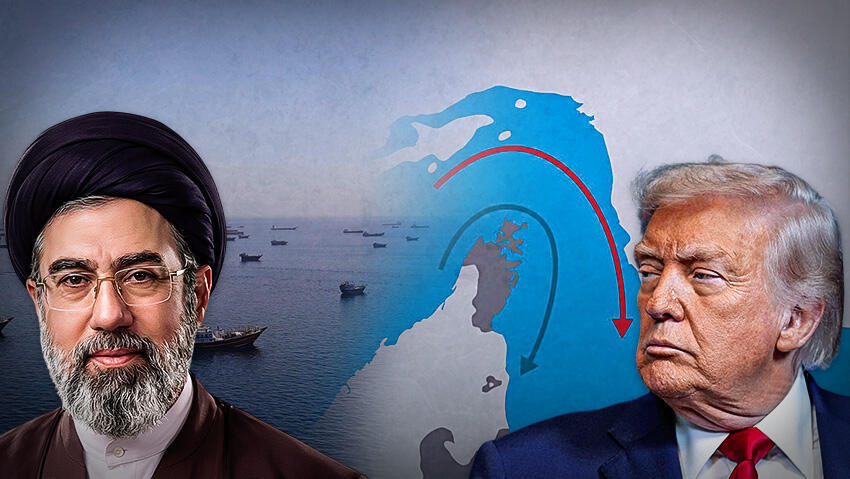
(Photo: shutterstock, AP/Alex Brandon, REUTERS/Stringer)
The game is over. The wheel stops. Everyone discovers what fate has dealt them.
Remember the previous agreement signed on June 17? It was supposed to reopen the straits, calm regional tensions and allow container ships and oil tankers to return to their routes.
Before the ink was dry, Iran was already attacking ships, threatening countries and destabilizing the region once again.
For Tehran, this has become a familiar strategy: Sign in order to buy time. Attack in order to dictate reality.
This time, however, the Americans were better prepared.
Some 80 million barrels of oil were moved out of the Gulf, helping drive oil prices sharply downward and calm nervous markets. At the same time, an economic process began examining the possible release of Iranian funds frozen around the world.
But the ayatollahs, seemingly addicted to chaos, could not restrain themselves.
Alongside renewed attacks on tankers and regional states, Tehran returned to its loudest jihadist rhetoric and religious-war narrative. Iranian leaders continued to taunt and insult the world's most powerful Christian nation while refusing to return seriously to negotiations, apparently hoping that greater pressure would improve their bargaining position.
Only Trump's threats of devastating consequences for Iran brought Tehran back to the negotiating table, and another seemingly futile spin of the geopolitical roulette wheel.
Perhaps another agreement will soon be signed. Commentators will announce the beginning of a “new era.” Diplomats will smile for the cameras. And, if the pattern continues, the ink will barely have time to dry before Iran tests its limits again.
Tehran's strategy appears straightforward: frustrate Washington, embarrass the president and undermine Trump's image as leader of the free world.
Iran's leaders understand something important about American politics. Gasoline prices may fall and markets may stabilize, but the perception of presidential weakness can become a bleeding political wound.
In Washington, weakness carries a heavy price.
If Trump reaches the elections appearing bruised and humiliated by Iran, it could cost him politically even if the American economy remains relatively stable.
Even Vice President JD Vance — a proud American patriot, a supporter of Israel and someone who appears to believe that there remains a possibility of persuading Iran's regime to surrender its nuclear capabilities — may eventually find that position impossible to sustain if Iranian violations and provocations continue to escalate.
Instead of creating the quiet necessary to convince Western public opinion that Tehran can be trusted, Iran repeatedly undermines its own case.
That is the regime's blind spot.
And it may become its fatal mistake.
Trump knows the principle from his casino days: When the main player believes he can outsmart the house while publicly humiliating its owner, eventually the game ends.
And the house expects to win.
If Trump concludes that every diplomatic avenue has been exhausted while his international standing continues to erode, political and strategic pressure for military action will intensify dramatically.
At that point, he could turn to Israel for participation in a broader campaign — one aimed not merely at another “signal” or another round of deterrence, but at the survival of the Iranian regime itself.
Such a confrontation would represent something entirely different from the limited exchanges of the past. Its objective would be to cripple the infrastructure on which the regime depends — its energy, transportation, economic and logistical networks — and sever the supply lines that allow it to continue operating.
The Gulf states understand the stakes particularly well. They have no desire to spend decades living beside an unpredictable regime capable of launching a single drone and threatening critical infrastructure in the middle of the desert.
The collapse of the Iranian regime, in my view, would transform far more than the Middle East.
 Rami Simani
It could push global oil prices dramatically lower, strengthen Trump heading into the November elections and potentially usher in decades of conservative American geopolitical dominance — precisely as Washington confronts an increasingly powerful China in the East, which has its own reasons to fear the collapse of Shiite Iran.
Iran's leaders apparently believe there is always time for another wager.
They may soon discover otherwise.
No more bets.
The games are ending. The betting window is closing.
And Tehran may have gambled away the one thing it cannot win back: time.
First published: 07:57, 08.10.26