

In the weeks leading up to the High Holidays, Rachel’s Tomb becomes one of the most visited pilgrimage sites in Israel. Since antiquity, Jews have flocked to this sacred place in Beit Lehem, seeking our matriarch Rachel’s protection and blessings for the year ahead.
Those who have been there know that the tomb is surrounded by a massive 10-meter-high concrete barrier, part of the security wall Israel built decades ago to thwart terror attacks and suicide bombings. The wall is a stark reminder of the country’s precarious security situation, where barriers are sometimes necessary to protect against looming threats.
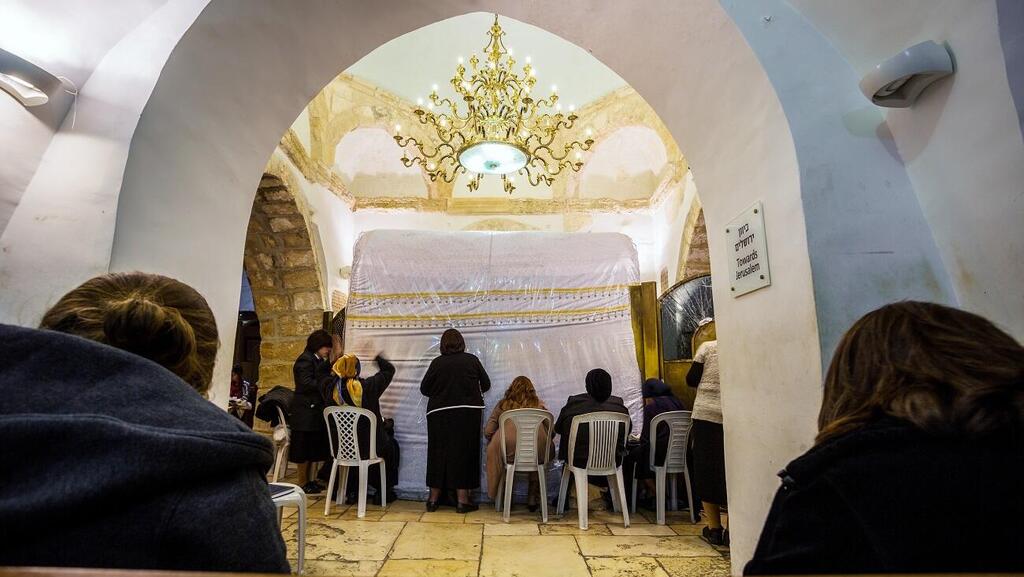
Rachel’s Tomb
(Photo: Shutterstock)
What most visitors never notice, however, are a series of small holes at the top of the wall. When I visited earlier this year, I learned about them. They were intentionally designed by Dan Tirtza, the architect of the barrier, who calls them “holes of hope.” Tirtza envisions a day when cranes and hooks will use those holes to lift away the slabs. The wall, he says, is a temporary necessity, built to be removed once true peace comes to the land.
Standing before those tiny holes carved into so much concrete, I had an epiphany. The wall and its “holes of hope” are a metaphor for the process of teshuva—repentance and spiritual growth—we undertake before Yom Kippur. The defenses we build around our hearts, minds and egos are temporary. The holes within them are not flaws, but intentional openings for transformation.
The Kotzker Rebbe, a 19th-century Hasidic master, once taught: “There is nothing as whole as a broken heart.” A Hasidic story illustrates this.
One year, the Baal Shem Tov asked Rabbi Ze’ev Kitzes to blow the shofar on Rosh Hashanah—a great honor and a great responsibility. Kitzes studied the mystical meditations associated with each blast, writing them down to consult during the service. But when the moment came, his notes were gone. His mind went blank. In despair, unable to recall a single formula, he broke down in tears. He blew the shofar with tears streaming down his face.
After the prayers, the Baal Shem Tov approached him. “Gut Yom Tov, Reb Ze’ev! That was the most extraordinary shofar we heard today!” Seeing him distraught, the Baal Shem Tov explained: “In the king’s palace there are many gates, each with its own key. But there is one master key that opens them all—the broken heart. You blew the shofar with your broken heart, and every door of God’s palace burst open.”
This teaching of brokenness as the master key echoes throughout Hasidic thought. The third Chabad Rebbe, the Tzemach Tzedek, in his commentary on Psalms “Yahel Or,” notes how the verse “Lo Anachnu”—literally “We are not,” but traditionally read as “We are His”—teaches that the more we diminish our egos (“We are not”), the closer we come to God (“We are His”). Humility and brokenness allow us to empty ourselves, creating space for divine forgiveness.
The Lubavitcher Rebbe once illustrated this with an image of a syringe: blood is not drawn through the needle, but through the vacuum inside. The emptier the vessel, the stronger its pull. So too, the cracks in our defenses—our tears, heartbreak, and repentance—create a vacuum into which God can enter. The emptiness we fear becomes the very space that draws in the divine.
This principle of sacred brokenness extends beyond personal repentance to our relationships and communities. If our own cracks make room for God, perhaps the fractures in our collective life can open channels for connection.
The internal rifts in today’s Jewish world—how to confront antisemitism, how to approach the war in Israel, how to imagine the community’s future—are real. But instead of letting them divide us, we can look for the openings within them.
The Maggid of Mezritch taught that the Hebrew word for community, tzibur, forms an acronym for tzadikim (the righteous), beinonim (the average), and resha’im (the wicked). Real community includes everyone, regardless of status or observance.
This Yom Kippur, as we stand before God with our imperfections exposed, we might ask: What holes are we creating? Are they cracks we fear, or intentional openings for change? Are our walls designed to stand forever, or—like Dan Tirtza’s—built to be lifted away when the time comes?
The answer may shape not only our personal teshuva, but the future of Jewish community itself.