

A few weeks ago, I received a text message saying that a parcel was waiting for me. It looked completely genuine. The courier's logo was familiar, the wording was professional, and all I had to do was click on a link to arrange delivery. So I clicked. Big mistake!
Within minutes, my phone was compromised. For the next few days, I was locked out of essential apps and spent hours trying to restore them. The message itself hadn't damaged my phone. The damage only began at the moment I clicked the link and unknowingly invited malicious software into my device.
(Photo: Shutterstock)
Everything happens for a reason, so I thought, “Perhaps this event is teaching me something about my feelings about people that “make” me question myself?” Those who are more learned than me, those who are more financially successful than me, those who have more reason to be proud of their contribution to this ongoing war.
Then I questioned myself further: “Is it possible that other people are gaining control over my emotions because I am “clicking" on what they say or do?” Just as malware cannot infect my phone without my permission, could it be that other people are determining how I feel because I have allowed my interpretation of their words or actions to enter my heart.
When someone wrongly criticizes me, my whole day is ruined. When someone ignores me, I feel rejected. If someone is more successful than me, I become jealous. I tell myself that they "made" me feel angry, rejected or inadequate, and for that I start to dislike them. But was it really them?
What if, like the virus and the phone, no one can force insecurity, resentment or anger into my heart? Other people's words and actions are only the message. The damage only begins when I "click" on them; when I accept their wrongful criticism as defining me, or allow their actions to determine how I feel. They only wound me because I have let them through my personal firewall.
This analogy has changed how I think about relationships.
I used to believe that the secret to better relationships lies in changing the other person. If only my child were more considerate, my colleague more respectful, my neighbor more thoughtful, my life would be easier.
Our Sages observed, "Kol haposel, bemumo posel"—"One who disqualifies another does so with his own blemish" (Kiddushin 70a). In other words, the faults we see most readily in others often reveal our own wounds and insecurities. The quality of my relationship with other people depends first on the quality of my relationship with myself.
When I feel secure, I do not need constant approval. I am less threatened by criticism. I do not need to tear others down to build myself up. I am less likely to feel diminished by another person's success. But that raises a deeper question: “Where does genuine self-worth come from?"
If my identity depends on my career, my wealth, my appearance, or what others think of me, then I will always be vulnerable. My emotional firewall will always have cracks.
Real security comes from knowing that my true value comes from Hashem. I am not valuable because I am successful. I am valuable because I was created b'tzelem Elokim - in the image of God. I am a spark of Divine light, a fragment of the Infinite.
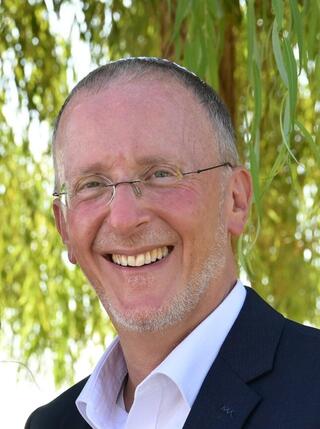 Rabbi Leo DeePhoto: Netanel Tevel
That is why Rosh Hashanah kicks off with us repairing our relationship with, and acknowledging, the King of Kings. And why it also kicks off ten days of working on our relationships with others.
When we repair our relationship with Hashem, we can begin to repair our relationship with ourselves. And when we repair our relationship with ourselves, our relationship with everyone else begins to change as well.
As we approach another election in Israel, we can already hear familiar voices insisting that all our problems are caused by the people on the other side. But Rosh Hashanah asks us to begin somewhere else.
Instead of asking "How can I change “them”?" it asks "How can I change myself?"
The person who truly changes the world is rarely the loudest critic. More often, it is the person who has the courage to first transform themselves.
May this Rosh Hashanah strengthen the firewall of our souls. May we spend a little less time criticizing others and a little more time introspecting. By repairing our relationship with Hashem, may we repair our relationship with ourselves, and in doing so, heal our relationships with one another. Shanah Tovah!
- Rabbi Leo Dee is an educator living in Efrat, whose wife, Lucy, and daughters Maia and Rina, were murdered by terrorists in April 2023. His latest books - “The Seven Facets of Healing” and “The Business Case for Israel” - are both available to order from Amazon and in Israel from Bookpod.