

While IDF and U.S. Air Force aircraft operate around the clock in the skies over Iran, attacking strategic targets and destroying missile launchers, a no less fateful campaign is taking place in parallel — the campaign for the perception of victory.
Success in this cognitive campaign is not measured by the destruction of enemy targets, but in likes, shares, and the adoption of the narrative presented on social media among voters in Oklahoma and businesspeople investing in the United Arab Emirates.

The campaign for the perception of victory carries critical weight, which may determine the timing and final outcome of the second, and perhaps last, Iran war.
The average American citizen’s connection to a war that takes place thousands of miles away is expressed primarily through the high price they may pay to fuel their car. When they want to understand the reason for this, the image they receive in the media and on social media will present a "war of choice" costing a billion dollars a day at best, and a war the U.S. was dragged into because of Israel at worst.
This trend is reflected in social media videos, such as one that went viral showing a Marine veteran bursting into Senate hearings shouting, "No one wants to fight for Israel." This narrative is also reinforced by opinion leaders with millions of followers, like media personality Megyn Kelly, who said that "American soldiers did not die for the U.S., but for Iran, or for Israel."
On the other side of the Persian Gulf, the picture is more complex. Gulf states continue to suffer significant Iranian strikes, but their response remains cautious and limited to statements, out of a desire to maintain security and stability that will ensure economic prosperity at the end of the war. Iran exploits this and continues to attack so that heads of state and those close to Trump and his circle will pressure the administration in Washington to stop the war.
However, within the Iranian attrition lies an opportunity if Gulf pressure changes direction. If regional leaders are convinced that Iran’s capabilities are being eroded beyond repair, they may push Washington to continue the campaign until the Iranian threat is removed for good.
The perception of victory is the common denominator that will mobilize both the American public and the Gulf states to support the continuation of the fighting. In practice, as the image painted in the media and social media displays more military achievements and fewer casualties, support for continuing the strikes will increase.
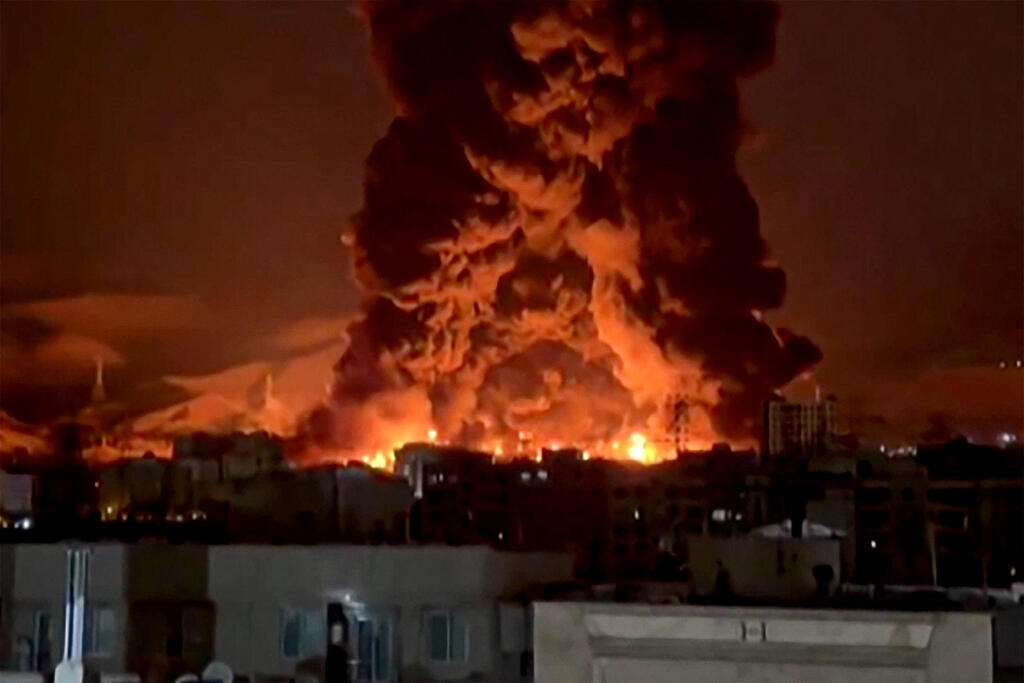
Oil depot in Tehran engulfed in flames after an Israeli airstrike
(Photo: AFP - SOURCE: UGC / UNKNOWN)
In this arena of consciousness, Iran has a built-in advantage. While there are no significant restrictions or enforcement on filming strikes at civilian sites in Israel and the Gulf states, the Iranian terror regime excels in enforcement and shutting down the internet to prevent the spread of information about its damages. Videos showing drone strikes on luxury towers in the UAE, the Dubai airport, and the return of fallen American soldiers wrapped in the U.S. flag significantly harm the Israeli-American perception of victory.
In addition to these, the Iranian regime does not hesitate to spread disinformation, mainly by creating videos using generative artificial intelligence. The more credible videos present the extensive destruction caused in Israel following missile strikes, as well as false imagery of shoot-downs of fighter jets.
Ali Larijani, one of the few surviving members of the Iranian leadership, went as far as sharing a fake video on his X account taken from the war in Ukraine, supposedly showing the downing of an American plane. Furthermore, pro-Iranian media make sure to emphasize every injury (real or fabricated) to innocent people to undermine the moral legitimacy of the campaign.
Unclassified footage showing US strikes on Iranian hardware
(Video: CENTCOM)


On the other hand, military-civilian advocacy, both Israeli and American, releases generic videos every day showing strikes and the destruction of Iranian military equipment in black and white, in poor quality, which fail to compete with the "sexy" videos of the enemy. Photos of smoke plumes rising over Tehran reflect damage and destruction, but do not provide reliable information on exactly what was hit or destroyed.
To upgrade the cognitive warfare of the IDF and the U.S. military, they must adopt a new visual-digital language that projects power and confidence.
First, there should be an increase in showcasing regional cooperation between the U.S. military and the Gulf states to project a solid regional alliance. An example of this is the video showing the American pilot whose plane was downed receiving a warm welcome in Kuwait.
Second, instead of blurry black-and-white videos, dynamic edits with music and effects should be distributed, highlighting the achievements of the campaign and resonating with the MAGA narrative and the "unconditional surrender" set by Trump.
Such videos have begun to surface in recent days, distributed through the accounts of the U.S. Central Command and the White House. The edited videos present the strikes in Iran and American power through a promotional video for a B-52 bomber, as part of achievements in a computer game and also within a football game, creating identification for the average American viewer.
Third, there must be a focus on numbers, presenting the large quantity of casualties of the Iranian regime through infographic designs that emphasize the depth of the achievement.
Finally, the message behind the digital products must be strengthened in a way that presents the purpose of the war for those target audiences: long-term security and prosperity: "We Fight Now, to Ensure Peace and Prosperity Forever."
A military victory in Iran is an achievable goal, but it requires a solid public backbone in the U.S. and the Gulf states. The ability to generate a convincing perception of victory can turn public pressure from stopping the fighting to "finishing the job."
- The author is an expert in digital influence and a lecturer in the Department of Politics and Communication at the Jerusalem Multi-Disciplinary Academic College.