

After two weeks of sustained airstrikes, the expectation that the Iranian regime might collapse quickly has begun to fade. Despite the scale and intensity of the aerial campaign, Iran has not shown signs of immediate political collapse. Early hopes that the leadership might flee—similar to what eventually happened to Bashar Assad in another conflict—are giving way to a more sober conclusion: this war is unlikely to be resolved rapidly.
This raises a critical strategic question: can a state as large and complex as Iran be defeated through air power alone, or would any decisive outcome ultimately require forces operating on the ground?
Israeli F-35i jets en route to Iran
(Video: IDF)


In theory, modern air warfare offers an appealing path to victory. Advanced fighter aircraft, cruise missiles and drones can penetrate deep into enemy territory and strike critical infrastructure with precision. Military bases, command centers, air defenses and economic assets can all be targeted without deploying soldiers on the ground. With modern intelligence and precision-guided munitions, it sometimes appears possible to weaken a regime to the point of collapse without launching a full-scale invasion.
History offers examples where air power played a major role in shaping political outcomes. One of the most prominent cases occurred during the NATO bombing of Yugoslavia. For 78 days, NATO aircraft conducted an intensive air campaign against Yugoslavia, targeting military facilities, infrastructure, bridges, factories and government institutions. The goal was to force Belgrade to halt its repression in Kosovo.
Thousands of sorties placed enormous pressure on the country’s economy and military capabilities. Eventually, Yugoslavia’s leadership agreed to a political settlement and withdrew its forces from Kosovo. Notably, this outcome occurred without a large-scale ground invasion, demonstrating the potential effectiveness of sustained air and economic pressure.
A second example emerged during the 2011 military intervention in Libya. When civil war erupted against the regime of Muammar Gaddafi, NATO launched a major air operation to destroy Libya’s air defenses and weaken regime forces. Hundreds of aircraft struck military targets, command centers and armored formations.
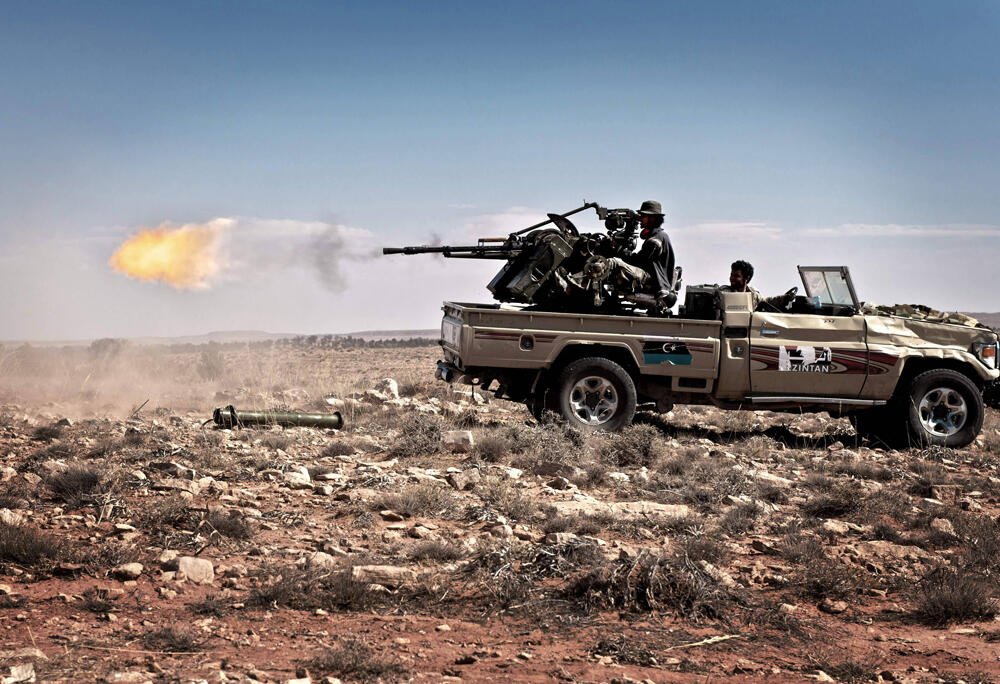
Libyan rebel fighters fire on forces loyal to Muammar Gaddafi during the civil war on June 15, 2011
(Photo: AFP)
Within a relatively short period, Gaddafi lost control of Libyan airspace and much of his ability to deploy military power effectively. However, while NATO’s air campaign proved decisive, local rebel forces advancing on the ground ultimately played a critical role in overthrowing the regime.
These historical cases highlight an important reality. Air campaigns can cripple military capabilities, damage economies and erode political stability. Yet even when air power dominates the battlefield, some form of ground pressure—whether internal or external—usually completes the process of regime collapse.
Applying these lessons to Iran reveals why the situation is far more complex.
First, Iran is vast in geographic scale. Its territory is larger than France, Germany, Italy and the United Kingdom combined. Such size provides strategic depth, allowing military infrastructure and leadership networks to disperse and survive even sustained bombardment.
Second, Iran has spent decades preparing for exactly this kind of confrontation. Military facilities are often hardened, hidden or distributed across remote areas. Underground installations, redundant command systems and mobile missile platforms make it extremely difficult for airstrikes alone to completely dismantle the country’s military capacity.
Israeli aircraft eliminate a drone squad in western Iran
(Video: IDF)
Finally, regime survival does not depend solely on military strength. Political control, internal security forces and ideological networks can allow governments to withstand prolonged external pressure even while suffering severe military losses.
For these reasons, while air power can severely weaken Iran’s military and economic infrastructure, history suggests that aerial bombardment alone rarely produces decisive regime change. Ultimately, wars are not decided only in the skies. They are shaped by political pressure, internal dynamics and—often—events unfolding on the ground.
- Rami Al Dabbas is a writer/commentator known for opinion pieces on Middle East politics, critiques of Islamist movements, advocacy of political realism and engagement and a controversial presence on social media