

“Hamas has never operated in the West Bank.” Coming from almost anyone else, the statement might have been dismissed as naivety or ignorance. But it came from French President Emmanuel Macron at the UN General Assembly, during what is expected to be his final appearance there as president.
Macron, whose domestic record is unlikely to define his legacy on favorable terms, has increasingly turned to foreign policy. He positioned himself at the forefront of European support for Ukraine and has sought an equally prominent role in the Middle East, where Palestinian statehood has become one of his signature diplomatic initiatives.
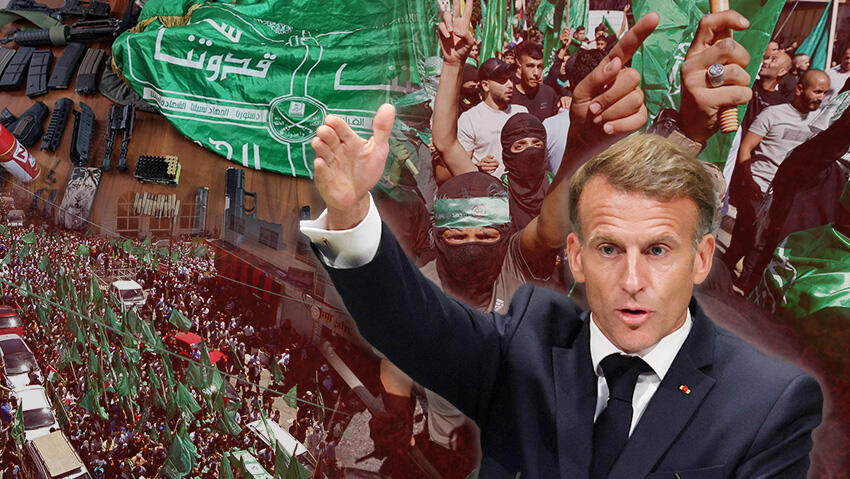
Macron wants a Palestine without Hamas, but reality is more complicated
(Photo: TIMOTHY A. CLARY / AFP, Jaafar ASHTIYEH / AFP, IDF)
French diplomacy is known for its careful wording, and Macron’s choice of the verb sévir became part of the dispute over his remarks. The word can carry meanings ranging from operating aggressively to exercising control. The distinction allowed for two readings: that Hamas had never operated in the West Bank, or that it had never ruled there.
Macron has repeatedly described Hamas as a terrorist organization and has not expressed support for terrorism. But his broader diplomatic approach depends on removing Hamas from the equation and treating the Palestinian Authority as the legitimate political framework for a future Palestinian state.
That creates its own contradiction. Excluding Hamas from consideration may simplify the diplomatic formula, but it does not erase the group’s place in Palestinian politics. It can also deepen the conceptual separation between Gaza and the West Bank, even as France promotes a single Palestinian state encompassing both territories.
France’s own framework calls for a Palestinian state governed by one government under one legal system, with Hamas excluded from governance and disarmed.
The distance between rhetoric and reality
The premise behind Macron’s approach is that Hamas can be separated from Palestinian national identity and that doing so can strengthen the case for a two-state solution.
That vision also has an obvious humanitarian dimension. Israelis have suffered from Hamas terrorism, while Palestinians themselves have also paid a heavy price for the group’s rule and its decisions.
Macron hoped France’s recognition of a Palestinian state in 2025 would help produce a new political reality. Yet recognition itself has not resolved the central obstacles on the ground.
France has continued to condemn Israeli policy in Gaza, settlement expansion and rising settler violence in the West Bank, while promoting meetings between Israeli and Palestinian civil society. Such dialogue can create direct human contact, but it does not by itself alter the political balance. Earlier this month, France, Britain and Canada announced further measures aimed at defending the two-state solution.
The French initiative also depended on a series of commitments by the Palestinian Authority.
Paris has repeatedly pointed to changes in the PA’s system of payments to Palestinian prisoners and their families as evidence of progress. But questions remain over whether alternative mechanisms allow money to continue reaching some of the same recipients.
Other promised reforms remain works in progress: rejuvenating the aging Palestinian leadership, changing antisemitic material in school textbooks, tackling corruption and holding long-delayed national elections.
The election timetable is at least now concrete. The Palestinian Authority has set legislative elections for November 28, 2026, with a presidential election planned for early 2027, commitments welcomed by France.
Those steps matter, but they also highlight the distance between the Palestinian political system Macron wants to see and the one that currently exists.
France’s strategy depends on a Palestinian Authority capable of renewing its leadership, completing institutional reforms, winning democratic legitimacy and eventually governing both the West Bank and Gaza without Hamas.
That is an ambitious diplomatic vision. The test is whether the political reality can be made to match the language used to describe it.
For now, Macron’s elegant formulations cannot resolve the core contradiction: Hamas cannot simply be written out of Palestinian politics, while the Palestinian Authority cannot be treated as fully reformed before the promised reforms are actually completed.