

When I saw the new election slogan from Benjamin Netanyahu and Likud, "Right or Palestine," I had to rub my good eye. Three simple words, apparently presenting a clear choice. On one side stands the right, promising security, strength and protection for Israel's citizens. On the other stands any alternative, which we are supposed to believe will inevitably put our security at risk.
Sadly, we have grown accustomed to blatant political incitement. We even managed to explain away the absurdity of the October 7 massacre taking place under an entirely right-wing government with the excuse that nobody had woken Netanyahu up.
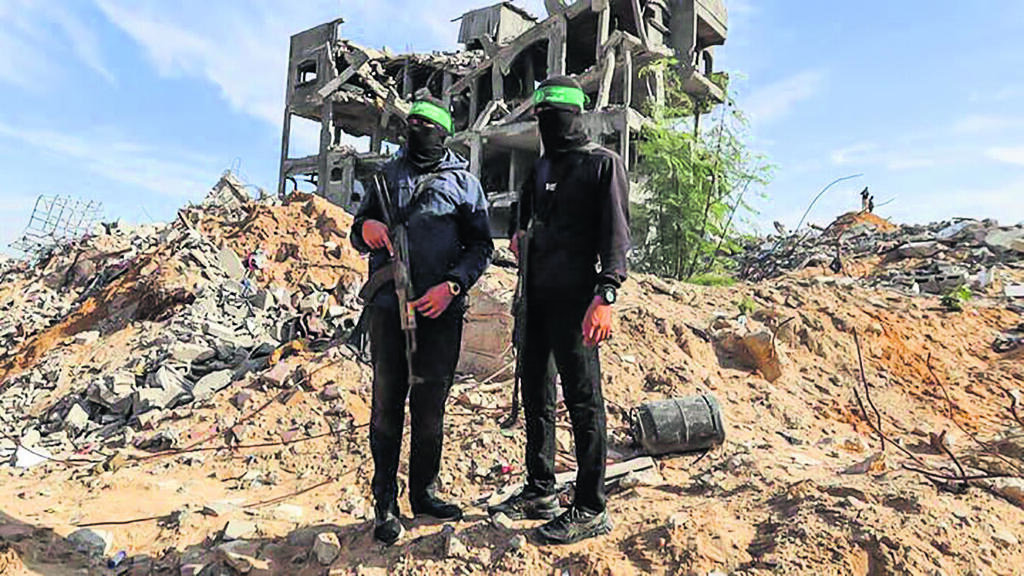
Hamas terrorists in the Gaza Strip
But there is a more fundamental problem. The government that has overseen the war intended to eliminate the Hamas threat from its very first day is a right-wing government. And yet, recent intelligence prompted Israel's entire security establishment to raise its alert level over fears of another attack. Twice.
That happened just two weeks after the defense minister warned that if Hamas abducted even one Israeli soldier, all of Gaza City would be evacuated. Even Channel 14, the champion of "total victory," reported earlier this week that Hamas was building up its forces in preparation for an attack.
In other words, the very "right" invoked in the campaign slogan, without which we supposedly face "Palestine," needs to explain why the security situation under its leadership remains so troubling. And why another term would somehow bring greater security. Spoiler alert: "Ben Gvir as defense minister" is not an answer.
Of course, none of this means another government would necessarily have done better. It might have failed just as badly, perhaps even worse. That is precisely the point. We cannot know what would have happened under different leadership. What we can do is compare promises with reality.
Psychologically, however, that is easier said than done. Security promises are remarkably difficult, perhaps even impossible, to disprove. When politicians succeed, they claim to have fulfilled their promises. When they fail, they argue that things would have been even worse under someone else.
This is what psychologists call counterfactual thinking. Instead of judging what actually happened, we judge what might have happened. And because an alternative reality cannot be tested, failure becomes impossible to establish. The politician who made the promise can always claim success.
Our existing beliefs only reinforce this tendency. Someone convinced that only one political camp can provide security will naturally prefer explanations that protect that conviction. The elimination of a senior terrorist commander becomes proof of success. The possibility of another kidnapping becomes evidence that things would be even worse under the opposing camp. Somehow, every outcome supports the same conclusion.
And to seal the deal, we are reminded not to forget: If we don't vote for the right, we'll get "Palestine."
But how does that argument square with the reality of the past three years? We have lived through a prolonged war in which a right-wing government deployed enormous military force against a terrorist organization that numbered approximately 30,000 fighters before the October 7 attack. Yet the threat has not been eliminated, and Israel is still preparing for possible infiltrations and kidnappings.
Such an operation would be extraordinarily complex. It would require intelligence, planning, coordination and the ability to confront well-trained, heavily armed military forces, potentially even returning to Gaza with an abducted Israeli soldier. Even if relatively limited in military terms, such an operation could deliver an enormous strategic victory for Hamas.
I sincerely hope Hamas never succeeds. But it is difficult to argue that the danger is negligible, particularly when the defense minister is issuing threats and repositioning forces, and when so many Israelis continue to fear another massacre. Ben Gvir has even made an election campaign video built around that fear.
This should trouble us as citizens far more than any campaign slogan. After all, the central objectives of the war were to eliminate Hamas' military threat and ensure that October 7 could never happen again. The return of the hostages was added as an objective later.
There is no question that the government and the IDF have achieved significant military successes. Senior commanders have been killed, infrastructure has been destroyed and large quantities of weapons have been eliminated. Hamas no longer controls the territory between the Israeli communities bordering Gaza and the Yellow Line inside the Strip.
But achievements are not objectives. They are the means by which objectives are supposed to be accomplished. You can win almost every battle and still lose the war. A good friend of mine even wrote an article with that exact title.
And military assessments indicate that Hamas still has tens of thousands of armed fighters and continues to control parts of the Gaza Strip. Israel maintains substantial military forces up to the Yellow Line to prevent the organization from threatening communities near the border.
Think about that. Israeli soldiers are still deployed in Gaza to defend civilians against the very threat the war was supposed to eliminate. And yet the IDF chief of staff says Hamas has been defeated, a formulation that sounds uncomfortably similar to the old "conception," the assumptions about Hamas that preceded October 7.
 Prof. Guy HochmanPhoto: Yuval Tubul
That is perhaps the biggest problem with Likud's election slogan. It does not merely present a divisive and distorted picture of reality, promoted by a sitting prime minister. It asks us to choose without thinking.
Instead of examining whether we actually received the security we were promised, we become trapped in arguments about imaginary alternatives. But as the old saying goes, if my grandmother had a beard, she'd be my grandfather.
I don't know which government could provide greater security. I'm not even sure that, under the present circumstances, any government can promise there will be no more terrorist attacks or attempted kidnappings.
What I do know is that security cannot be measured by the number of times politicians promise it. Certainly not by their party's campaign slogans.
Three years after the October 7 massacre, it is time to stop asking who promises security and start asking whether those promises have been fulfilled.
If, after the longest war in Israel's history, conducted under an entirely right-wing government, the security situation remains so troubling, perhaps we should consider giving a chance to alternatives that are supposedly less capable of providing security.
Because if the political right does not necessarily guarantee security, the alternative does not necessarily mean "Palestine."
Not because of politics. Because of the laws of logic.