

Zionism never had a straight path. It did not emerge as a single, agreed-upon and clear idea but developed through disputes, compromises and competing possibilities that sought to offer solutions to the “Jewish question.” Precisely at this current Israeli moment, between the military draft crisis, political divisions and a public debate already turning toward the next elections, it is worth remembering that the realization of the Zionist idea was never inevitable but the result of choice.
This discussion is not merely a historical exercise. It speaks directly to Israel in 2026. Israeli society is debating today not only policy but the very meaning and character of its shared project: the status of Judaism in the state, the nature of civic partnership and what binds together Judaism, sovereignty and democracy. The issue of military conscription reveals that the disagreement in Israel is not only about security but about the character of the state and the nature of Zionism itself.
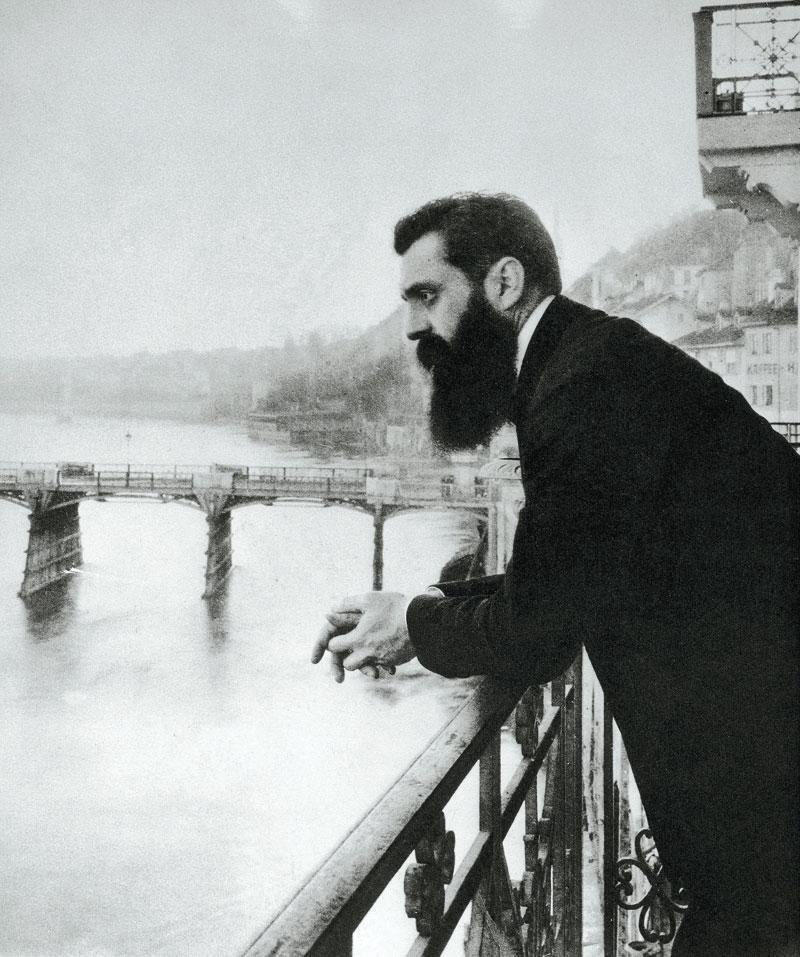
Theodor Herzl
(Photo: Ephraim Moses Lilien)
This is where historical research makes an important contribution. It reminds us that Zionism was not “the only solution” to the Jewish question and not the only path available to Jews at the end of the 19th century. Alongside the idea of establishing a Jewish state in the Land of Israel, other alternatives also existed: Jewish autonomy within existing states, Jewish nationalism in the diaspora, territorial solutions outside the Land of Israel and approaches that advocated full integration into the societies in which Jews lived. Even among those who supported the establishment of a state, different views developed regarding its character and purpose. Each of these options was seriously considered and each could have been realistic in its time.
Zionism itself emerged from a turbulent and multi-directional Jewish reality. In the 19th century, processes of modernization, urbanization, mass migration and the disintegration of traditional communal structures shook the Jewish world and gave rise to the “Jewish question,” not only in terms of how Jewish life would look but how Jews could integrate into the modern world without losing their identity. Zionism was one answer to this question but not the first or the only one. Alongside it and before it came the movements of the Enlightenment, Reform Judaism, modern Orthodoxy and Jewish socialism, all of which sought to offer Jews a new path forward. Even the Land of Israel itself was not initially viewed as the exclusive destination.
Zionism did not “invent” the Jewish connection to the land
Looking further back, one can see that even before the organized Zionist movement there were settlement initiatives in the Land of Israel, early waves of immigration, Sephardic and Ashkenazi communities and local economic activity. Zionism therefore did not “invent” the Jewish connection to the land but reshaped it in national and political terms. The First Aliyah, later described as a pioneering revolution, is also presented as part of a broader continuum of Jewish migration rather than a definitive starting point.
 Guy Meron Photo: Gal Haim
Within the Zionist movement itself, there was no consensus. Theodor Herzl saw Zionism as a clear political solution, while Ahad Ha’am sought a spiritual and cultural center that would serve most Jews who would continue living around the world rather than necessarily forming a state. The Uganda debate (refers to a significant 1903–1905 controversy within the Zionist movement over a British proposal—the British Uganda Programme—to offer a portion of East Africa as a safe haven for Jewish people fleeing persecution) demonstrated how contested the question of destination was, not only the path.
The fact that the route that led to the State of Israel was ultimately chosen and succeeded does not make it the only possible one. This may be the most important lesson for Israel today. Even in the past, in moments of fear, division and uncertainty, it seemed as though there was no alternative. History teaches otherwise. Zionism has always been a framework of debate, not uniformity, of decision, not necessity. Precisely for this reason, even today it is legitimate and perhaps necessary to ask again not only how to defend the state but what kind of state we seek to defend.
Prof. Guy Miron is a co-author of "Zionism - a New History: The Beginnings of Jewish Nationalism", published by the Open University’s Lamda Press, and an expert in modern Jewish history and the study of antisemitism at the Open University of Israel.