

The term al-Wa’d (“the Promise”) refers to Allah’s commitments to the faithful, a cornerstone of Islamic belief and doctrine. The fanatical ayatollah regime appropriated this religious concept as a label for its terrorized missile attacks against Israel, seeking to shore up its dwindling base of support. This time, however, President Trump’s promise to aid opponents of the regime has turned back upon it, and is being fulfilled for its own.
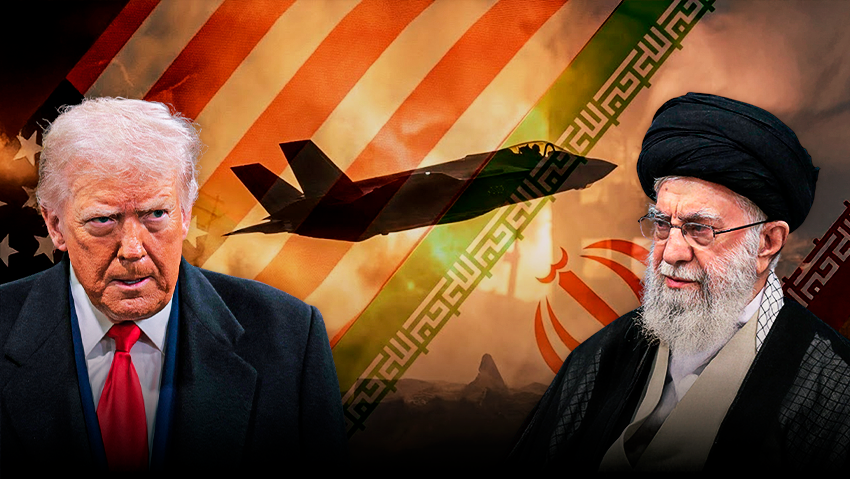
Trump’s transformative presidency reaches a defining moment with the launch of the combined Israeli-American air campaign, aimed at reshaping the regional architecture. Beyond the dramatic force multiplier of integrated, state-level precise intelligence and firepower, deployed at an unprecedented scale and quality - the objectives of the emerging campaign are fundamentally different, broader and far more ambitious than ever before.
Whereas the “12-Day War” focused on dismantling the nuclear program and degrading supporting military domains, the first hours of the current campaign indicate that its core purpose is to undermine the regime’s stability and generate internal dynamics that could topple the ayatollahs and drive deep political transformation. In this sense, and in contrast to the negotiations unfolding in Geneva - both Trump and Prime Minister Netanyahu have an opportunity to shape and control the narrative, not only of the campaign itself but also of the day after.
It is no secret that President Trump favours swift and decisive victories. Yet the challenges in this arena are of a different magnitude. The regime still retains significant capacity to harm the U.S, Naval international routes at the Persian Gulf and attacking regional allies. Regime change cannot be achieved through a single special operation, unlike the outstanding extraction of Venezuela’s President Maduro from Caracas. As the military philosopher Carl von Clausewitz observed: Everyone knows how a war begins, but no one knows how it will end.
The careful, coordinated planning underlying this operation indicates that Trump seeks a tightly contained confrontation—limited in duration, geography, and collateral impact—rather than another open ended U.S. entanglement in the Middle East after the costly and divisive wars in Iraq and Afghanistan. That boundary is one he is unlikely to cross, constrained both by the outlook within his own party and by declining public support at home.
Operationally, sustaining a long and protracted ground campaign across vast territory is not feasible. American, and to a large extent Israeli air and naval firepower enables a high-tempo campaign of days, capable of dismantling air, sea and ground formations, Air-defense platforms, command-and-control (C2) systems and regime assets, while employing electromagnetic capabilities and maintaining total dominance over Iranian airspace. In the coming days, special emphasis will be placed on destroying the regime’s most lethal offensive capabilities, foremost its ballistic missile cluster, alongside the complete attrition of what remains of Iran’s long-standing nuclear program.
In this context, the timing of the IAEA report on the eve of the assault stands out. The report revealed that the nuclear site in Isfahan houses highly enriched uranium - serving both as justification for renewed strikes and as a basis for additional actions in the theatre. This practice of exposing intelligence through IAEA has precedent, having previously underpinned actions against the nuclear program, including following the exposure of the underground secretive facility in Fordow some 15 years ago.
The campaign against the ayatollahs is not another round in a chain of confrontations. It is a formative and historic struggle over the character of the Middle East - a region fundamentally transformed since the ayatollahs seized power in 1979. It is a confrontation meant to shatter the illusion that terror can shelter beneath the umbrella of sovereign statehood.
When the dust settles over a changing Middle East, it may become clear that “the promise fulfilled” does not belong to those who sowed destruction, but to those who dared to stand against it - and to act decisively against the head of the snake.
First published: 15:37, 02.28.26