


The government is facing mounting opposition from the city of Rishon LeZion over plans to build a large prison complex on some of the most valuable land in the central region, near major employment zones and commercial centers.
City officials say the plan, first approved more than 40 years ago, does not reflect the city’s rapid growth and would squander rare public land that could be used for jobs, transportation and government offices.
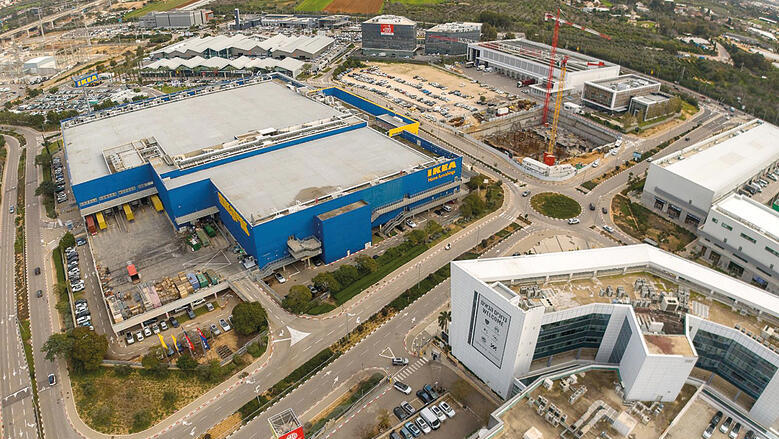
The proposed prison complex is slated for about 260 dunams behind the IKEA store and near the Sorek industrial zone, an area now surrounded by office towers, transportation corridors and business districts. The site sits close to major highways, rail lines and national infrastructure.
The project is part of National Outline Plan 24, first advanced in 1982 to regulate prison facilities. An updated version was approved in 2020 to address incarceration needs through 2040. The plan allows for the construction of a prison cluster housing up to 3,000 criminal inmates and includes sites approved decades ago, before large scale urban development transformed the area.
In September 2025, the National Planning Council approved a detailed plan for the Rishon LeZion site despite objections from the municipality. In its decision, the council said the project should advance with a forward looking approach to meet incarceration needs in the southern region while addressing security, operational and rehabilitation considerations.
Mayor Raz Kinstlich has launched a public and political campaign against the project, sending letters in recent days to Finance Minister Bezalel Smotrich and National Security Minister Itamar Ben-Gvir. In the letters, obtained by local media, Kinstlich said the decision would have “serious consequences” and was made despite the municipality’s “consistent, reasoned and clear opposition.”
“I have served as mayor for nearly seven years, and I examine public spending as if it were my own money,” Kinstlich wrote. “Every shekel spent by the municipality is carefully weighed. Here, the state appears to have made a decision lightly, without proper consideration of the public interest or public funds.”
According to an independent appraisal commissioned by the city and conducted by the Danos Lahet real estate appraisal firm, the land designated for the prison has an estimated value of 2.25 billion shekels before VAT in potential state revenue. The report said a comparable prison complex could be built on alternative centrally located agricultural land owned by the Israel Land Authority at an estimated land cost of about 7 million shekels.

(Photo: Alex Kolomoisky)
The appraisal report noted that the site was first approved in 1982, when the Sorek industrial zone was outside the urban area. Today, the report said, the decision appears unreasonable given the surrounding development and the daily use of the area by residents from Rishon LeZion and the wider coastal plain.
Kinstlich said the land holds high economic and employment potential and could be developed into a major employment hub or even a government district.
“How can the state justify effectively wasting land worth about 2 billion shekels on a prison that could be built elsewhere, on less valuable and more isolated land?” Kinstlich wrote. He said private developers would be willing to pay more than 1 billion shekels for the site and added that the city itself would consider purchasing the land to prevent what he described as a misuse of public assets.
The mayor stressed that the city does not oppose the national need for prison facilities and regularly absorbs national infrastructure projects. He rejected claims that the opposition is driven by “not in my backyard” considerations, saying the plan represents a broader national planning failure that would harm residents and eliminate thousands of potential jobs.
In a separate letter to Ben-Gvir, Kinstlich said the project represents a missed national opportunity to use rare public land for urban development, employment, transportation and housing.
The Prison Service, which operates under the National Security Ministry, said it is advancing several plans to expand prison capacity to meet future incarceration needs and to comply with a Supreme Court ruling on minimum living space for inmates. The service said prison locations are determined by planning institutions based on a broad set of considerations, as reflected in National Outline Plan 24, which was most recently amended in 2020.
The Prison Service said it is reviewing the mayor’s objections and the appraisal report.
The Finance Ministry did not respond to a request for comment.