

A national planning appeals panel on Sunday rejected three challenges filed against the Jerusalem District Planning Committee’s approval of a high-rise project in the Epstein complex in the city’s Kiryat Yovel neighborhood, clearing the way for a tower widely nicknamed the “Jerusalem Burj Khalifa.”
The appeals subcommittee of the National Council for Planning and Construction said it found that both the local and district committees had properly reviewed alternatives for the site. The panel, chaired by attorney Moran Brown, wrote that while the chosen plan creates a prominent visual presence, it is preferable to options such as several lower towers or a block-style massing.
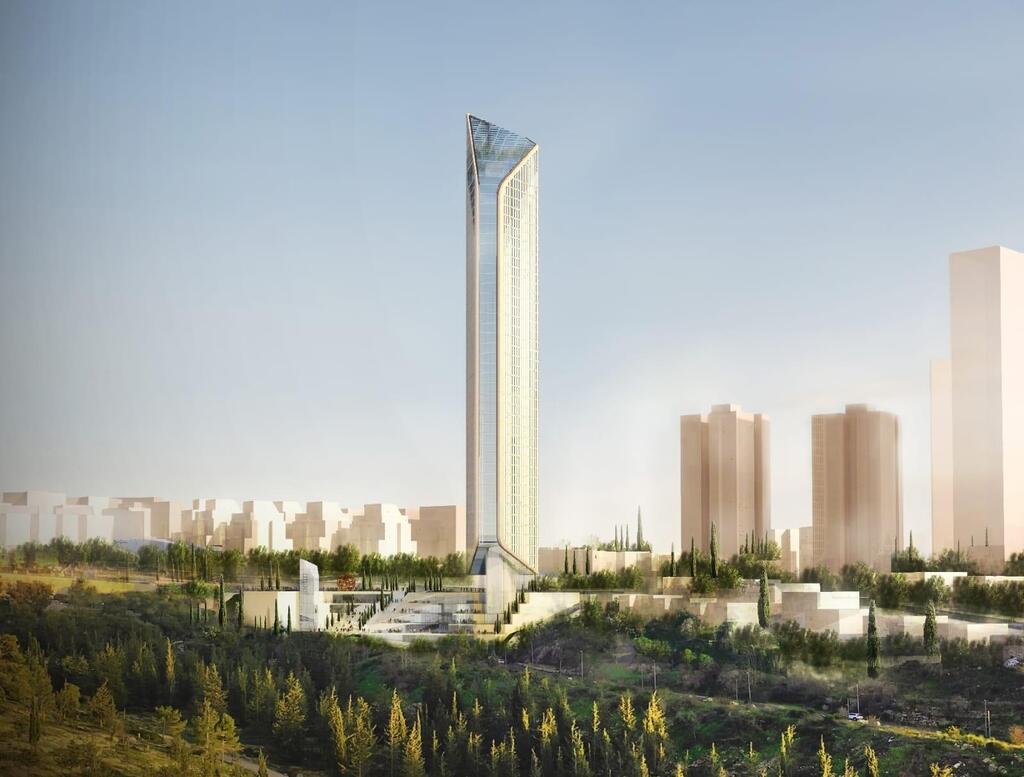
(Photo: AS+GG Architect)
The district committee approved the redevelopment plan in September 2024 after considering 196 objections. The plan, filed in January 2024, calls for a residential, office and commercial tower on a seven-dunam (about 1.7-acre) lot along Herzl Boulevard and Hentke Street, overlooking the Ein Kerem area. Ein Kerem is a historic Jerusalem neighborhood known for its churches, medical center and hillside views.
The original proposal envisioned a 197-meter tower, but the local committee recommended lowering it by 30 meters. The number of floors will remain nearly unchanged because the plot slopes sharply. The tower will rise 40 stories above the Kiryat Yovel street level instead of 43, with four additional floors facing Ein Kerem and another four below ground.
The three appeals were submitted by Jerusalem Deputy Mayor Yossi Havilio; Dr. Yuval Shpiner, head of the Yovelim community administration (local neighborhood governance body); and the Association of Architects and Urban Planners in Israel. Respondents included the district and local planning committees and the project developer, M.O. Epstein Ltd. The national appeals panel heard arguments in May and published its ruling Sunday.
The National Council voiced unequivocal support for the deposited tower plan. It said proposals for two 30-story towers or lower standard-design buildings offered no advantage and that at a point “where the city meets its edge,” an architecturally distinctive statement is appropriate. The panel said planning bodies should encourage architectural quality rather than treat it as a drawback.
The council added that the tower’s design quality stemmed from the distinctive landscape of the Epstein site. It emphasized that the project is not intended as a landmark but as architecture that respects its setting and allows visitors in its public areas to experience the area’s character.
The panel also rejected claims that the tower would visually overshadow Mount Herzl or harm the feelings of bereaved families whose relatives are buried at Israel’s national cemetery. It said it understood the sensitivity of building near Mount Herzl but found that the district committee had reached an appropriate balance. The council wrote that, with full respect for the families, the concerns raised did not justify overturning the professional planning judgment.