


The Knesset Interior and Environmental Protection Committee, chaired by acting committee head MK Ya'akov Asher, on Thursday held its first discussion ahead of preparing the proposed War Damage Rehabilitation Through Urban Renewal Law for second and third readings. The bill is intended to address the rehabilitation of buildings damaged by Iranian missile barrages.
Despite broad agreement on the urgency and necessity of rehabilitation and the stated goal of advancing fast-track legislation, the proposal has sparked significant controversy, raising concerns that the legislative process could be prolonged.
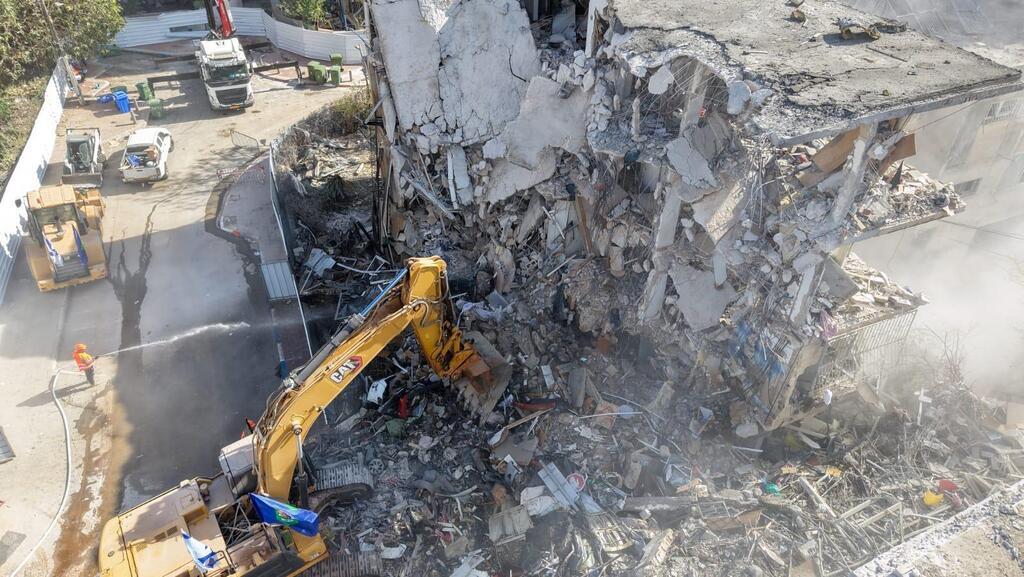
Demolition of buildings in Ramat Gan damaged by an Iranian missile
The roughly four-and-a-half-hour debate included, among others, Housing and Construction Ministry Director General Yehuda Morgenstern; Deputy Attorney General for civil affairs Carmit Yulis; Chief Government Appraiser Gil Balulu; Deputy Budget Director at the Finance Ministry Matan Yagel; Ashkelon Mayor Tomer Glam; Acting Bnei Brak Mayor Menachem Shapira; Vice President of the Builders Association of Israel Tomer Tzlich; and representatives of the National Urban Renewal Authority.
The proposed legislation focuses on rehabilitating residential complexes damaged during Operation With the Strength of a Lion through urban renewal. It seeks to significantly shorten renewal processes, which currently take an average of nine years from start to completion.
According to the bill’s explanatory notes, its goal is to establish a dedicated mechanism enabling the accelerated promotion of urban renewal projects in affected complexes while maintaining planning principles, protecting residents’ rights and ensuring adaptation to on-the-ground realities.
The proposal is based on a draft law prepared by an interministerial team led by the Finance, Justice and Housing ministries, in cooperation with the National Urban Renewal Authority and the Planning Administration. It is designed to apply to entire complexes rather than individual plots.
The bill aims to safeguard residents’ rights through compensation mechanisms, including a ‘buyout’ track, under which apartment owners could choose between participating in the urban renewal project or receiving immediate compensation to purchase a replacement home.
However, the proposal allows up to 25% of apartments in a designated rehabilitation complex to be included even if they were not destroyed by missile strikes. It also lowers the required consent threshold for advancing evacuation and reconstruction projects to about 51%, down from the current 66% majority required under existing law.
In a position paper submitted ahead of the debate, the Builders Association of Israel argued that ‘the proposal is not sufficiently efficient or clear.’ The association said the fastest, most effective and least costly approach for the state would be immediate compensation to all affected homeowners, enabling them to purchase new homes wherever they choose if they do not wish to pursue urban renewal. In return, the state or developer would acquire the rights to the complex, fast-track planning through the National Planning Committee for Preferred Housing Sites or a special committee, and sell the planned land to developers via competitive tenders.
Several organizations oppose the draft law, including the Forum for Urban Renewal and the advocacy group Bimkom. In a letter to the committee chair, forum chairman David Sonnino wrote that a close review of the proposal reveals ‘severe flaws with far-reaching implications that go well beyond the economic assistance presented publicly.’ He warned that alongside compensation mechanisms for businesses, the bill introduces what he described as draconian provisions that undermine fundamental property rights in urban renewal projects, laying the groundwork for a ‘dangerous slippery slope.’
Sonnino pointed in particular to the reduced consent threshold of about 51% among apartment owners. If that level of agreement is not reached, he wrote, the government seeks to exercise expropriation powers against dissenting owners, calling it an exceptional and disproportionate measure that directly violates constitutionally protected property rights.
Opposition has also been voiced by Bimkom and the Association for Civil Rights in Israel, which have labeled the proposal ‘forced urban renewal.’ The organizations argued that the evacuation and reconstruction track presented as a rapid solution does not provide an immediate response to residents whose homes were suddenly destroyed in war. They said it is especially unsuitable for vulnerable populations, including the elderly, public housing residents, immigrants and people with disabilities or language barriers, who require particularly sensitive handling.
The groups further warned that lowering the required consent rate to 51% constitutes a serious infringement on the rights of residents who oppose the project and could compel them to accept what they termed ‘forced rehabilitation.’ They said the proposed measures, including expropriating rehabilitation zones, appointing state-backed developers and imposing uniform agreements on all residents, contradict sound planning principles and fail to address the complex social challenges in these areas. Extending these measures to buildings that were not damaged at all, they added, deepens the harm to residents’ rights and renders the entire process coercive and disproportionate.