


He is a Canadian Haredi billionaire and a colorful personality with an extraordinary life story: Hershey Friedman, the largest producer of kosher meat in North America, has turned Azorim into one of the strongest real estate companies in Israel. He has plenty to say about the challenges of doing business in Israel (“You can invest huge sums of money here, only to discover years later that, because of bureaucracy, the project will never happen”), about the coming aliyah wave driven by rising antisemitism worldwide, and about his support for drafting ultra-Orthodox men who are not engaged in religious study. In a joint interview with Azorim’s CEO, Adi Dana, the two push back against predictions of falling housing prices: “It’s a myth - it won’t happen.”
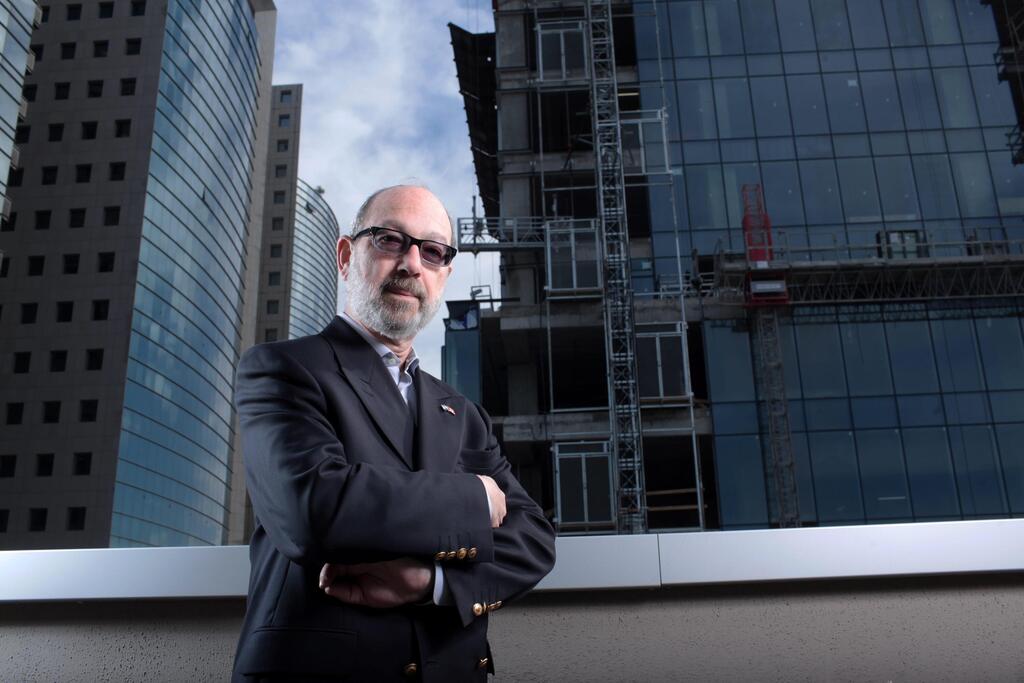
Hershey Friedman, 75, lands in Israel at least once a month. The Canadian Haredi businessman, a passionate Zionist born and raised in Montreal, travels across the globe - from Canada, New York and Miami - to manage Azorim, the real estate company he acquired in 2011. Under his ownership, the company was transformed from a struggling business valued at 470 million shekels ($141,400,000) into one of Israel’s largest development firms, now worth an estimated 4.2 billion shekels (nearly $1.3 billion) with some 40,000 apartments in the pipeline.
Over the past 15 years, Friedman has witnessed the ups and downs of Israel’s real estate sector - both as chairman and controlling shareholder of an Israeli company, and as an international businessman with a long track record of successful ventures. He arrives at the company’s Tel Aviv headquarters on Ha’Arba’a Street straight from Ben-Gurion Airport, following a 22-hour flight from Miami - and extends his hand in greeting. “Do you mind if I smoke?” he asks politely, just before we begin our conversation. This month’s visit focuses on launching the company’s flagship projects in Jerusalem and Herzliya.
With a career that began at age 17 in the family textile business - which he grew into a local industry leader - Friedman has long stood out for his ability to steer struggling companies back to success. Among his notable achievements are transforming a food-packaging company he founded into North America’s dominant player in its field, and turning Agriprocessors into the largest producer of kosher meat in the United States. His companies manufacture packaging for leading global brands such as Pepsi, Nestlé and Elle candy.
“It all started when I had a teenage son whom I sent to study at a yeshiva in Jerusalem at age 18,” recalls Friedman, who has been married for more than 50 years and has six children, and grandchildren and great-grandchildren. “I used to visit him regularly, and then I thought to myself: You know what? Since you’re already here, you might as well invest in Israel. That’s what a good Jew does.” But his early experiences were anything but smooth. “The first time, you lose everything,” he remembers. “Not only did I not get back the interest, I lost the principal as well. I was focused mainly on Beit Shemesh and Ashdod - this was 30 years ago.”
Antisemitism will not disappear. Jews abroad are waiting for the war to end so they can move to Israel. We already have Jerusalem projects sold in advance to Americans
He founded CBD, named after his three granddaughters - Chani, Bessie, and Devorah. “It was a small company where we managed two or three projects a year,” says Friedman, who is deeply involved in his children’s lives while also maintaining close ties with Jewish communities worldwide. His sights were set on Azorim two years before the acquisition, when the company was still owned by ultra-Orthodox real estate magnate Shaya Boymelgreen. “We almost reached an agreement, but at the last minute he backed out. At the time, I had a strong relationship with Mizrahi Bank. When they took his shares, the CEO called me and said they were available. The bank solicited several offers - and mine turned out to be the best.”
“Azorim was practically on the verge of bankruptcy at the time,” Friedman recalls. “In the initial acquisition, I bought about 64% of the company for 300 million shekels, and then the stock price dropped. I didn’t want to lose my stake, so I kept investing. The company was active in India, South America, Canada, the U.S. - almost everywhere except Israel. We decided to scale back the global spread and return to the basics - real estate in Israel. We managed to exit the overseas investments without losing money. Then we began improving the company’s performance, step by step.”
During Moshe Kahlon’s tenure as finance minister, Azorim joined the government’s Mechir Lamishtaken (Buyer’s Price) housing program. But according to Friedman, “We discovered it wasn’t right for us. To scrape any profit out of those projects, the company would need to act as a construction firm - but we’re not builders, we’re a development company.” That was the turning point when Azorim entered the field of urban renewal (pinui-binui, or demolition-and-reconstruction) and became one of the largest players in that sector. At the same time, it also moved into long-term rental housing.
“We entered this new concept at a time when interest rates were low, and it made a lot of sense,” Friedman says of the long-term rental market. “We told ourselves - we won’t profit from the project in the first 5-10 years; the gains will come from the property’s appreciation. But when interest rates went up, the sector came under pressure and real estate values dropped.” Today, almost all of the land Azorim acquired is under construction, and Friedman cautiously predicts that the Bank of Israel will lower rates soon - “and then the situation will be even better.”
Between Canada and Israel
But the situation is far from good - both in Israel and abroad. Even Friedman admits it, noting that antisemitism has reached every corner of the world. “Even Canada - the situation there is very serious. I’m the chairman of a school in our area, and someone shot into its windows twice. In other neighborhoods, Molotov cocktails have been thrown at synagogues,” he says.
For him, the silver lining is that this fragile situation will prompt many Jews to leave and immigrate to Israel. “It’s true that some are leaving their countries because of the situation, but I think even more will come,” he adds. “Everyone is waiting to see when the war will end. The sooner it ends, the sooner people will arrive in Israel - whether to Netanya, Tel Aviv, Jerusalem, Bat Yam, or Nahariya. It’s already happening, and with the holidays approaching, we expect sales to rise.”
And what about you? Do you want to live here?
“The truth? We already own many apartments. But for myself, I’ll probably buy something in the future. It’s important for me to be comfortable - I don’t want to deal with errands or chores. When I come, I want help with home maintenance and general services. For the past 25 years, I’ve stayed at the Hilton in Tel Aviv whenever I visit Israel - I’m practically part of the furniture,” he says with a smile. “They know me there, treat me like family. It’s convenient, it’s my second home.” Even within his own family, this is already happening: “I have married grandchildren living here with their children, and they love it. Some have even said they want to move here permanently.”
And you’re not worried?
“I have no objections. If it makes them happy, everyone knows - Israel is Israel. It’s a way of life, and if they’re happy here, why not live here? You have to remember, in North America antisemitism isn’t going away anytime soon. I want to hope we’re close to the end of the war. People ask me: You travel to Israel so often, aren’t you afraid? And I tell everyone - life in Israel is life itself. That’s how it’s been since 1948, it hasn’t changed, and it won’t change. I was here during attacks, even my father was here. The beauty of Israel is that even when the country is bombed and the market closes, within hours or days it’s open again and functioning normally. You wouldn’t even know anything happened. That’s life here - it’s crazy.”
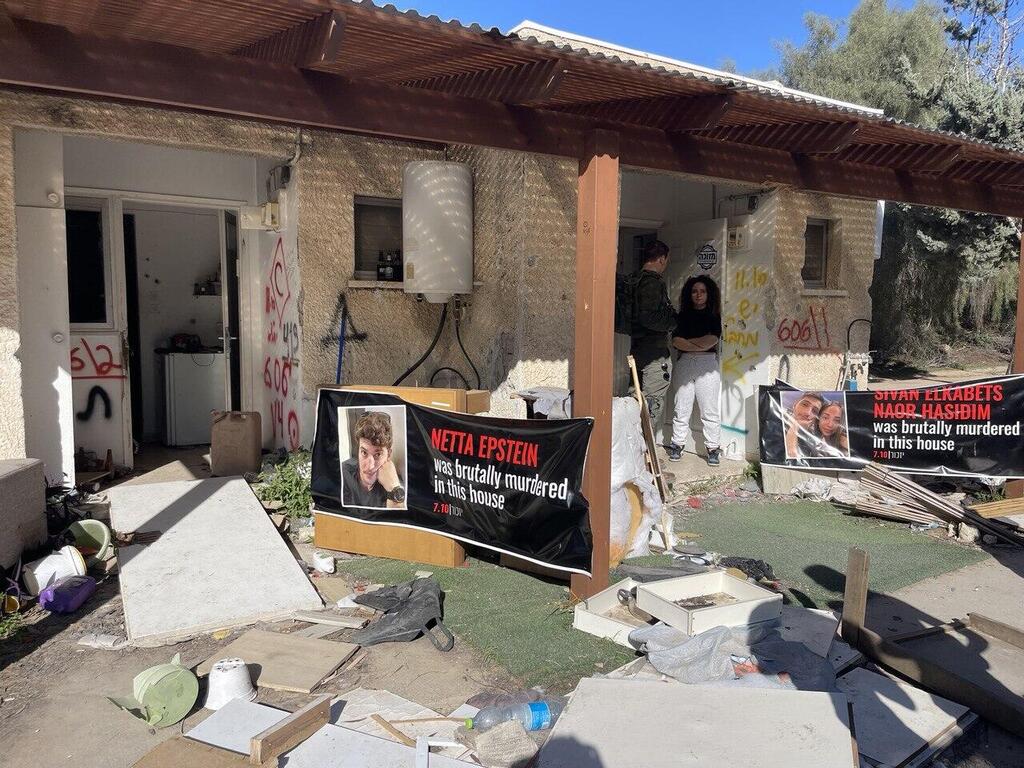
Kfar Aza: “I wanted to see it with my own eyes, and it was horrific.”
(Photo: Ofir Yonatan)
A few months ago, he traveled to visit “Kfar Aaza.” “They said to me: Are you crazy? I replied: No, I want to see what really happened. I wanted to see it with my own eyes, and it was terrible. If you don’t see it yourself, just hearing about it isn’t enough to fully connect to the story. I wanted to see the place with my own eyes. I spent a whole day there, and I have to say - aside from the horrors, you also see the good that has grown from it. For example, someone opened a restaurant that cooks for soldiers. We went to visit - it was amazing. Soldiers and commanders came for lunch or dinner, and we decided to donate to them. They wanted books, so we sent them books. And that closeness in Israel between civilians, whether there’s a war or not - it’s simply unbelievable.”
There is closeness, but also disagreements, to say the least
“I see it, I hear about it when I come here - the main roads are blocked, there are protests, and there are countless opinions. On one hand, everyone wants the hostages back, but unfortunately it seems far off; that’s basically the only leverage they have. And sadly, the issue has also become unnecessarily political. We won’t get into politics. But as an ordinary person, I can empathize with the citizens who are protesting. They want their families back, alive or deceased.”
'Everything Takes Time Here'
The year Friedman acquired Azorim coincided with the Tents Protest in Israel, at the end of 2011. “I remember it clearly,” he says. “Did it help? Not really. The truth is, if you really want change, it depends entirely on the government. If you want to help citizens, the government needs to intervene. The Mechir Lamishtaken (Buyer’s Price) program, for example, was a good idea, but in practice it didn’t work. By the time someone’s number came up in the lottery, the apartment they wanted was already gone. Those who wanted a two-room apartment were left only with four-room units, which they couldn’t afford. We had many projects like that, but for us, it was like exchanging four quarters for a single dollar.”
Is the government managing to intervene in the current crisis?
“One of the main problems today is the lack of manpower. There simply aren’t enough workers in Israel, and it’s the government that needs to solve this. In the U.S., in a room the size of the one we’re sitting in, there would be five bulldozers ready to work. In Israel, on an area 10 times that size, there’s only one bulldozer. Everything takes much longer here and stretches out over several years - from acquiring the land to getting excavation permits. And even when you start the process, you don’t know if you’ll ultimately get a building permit or if your plans will be changed.”

“The mission now is to ensure that people displaced from their homes have a roof over their heads.”
(Photo: Jack Guez/ AFP)
Beyond the workforce shortage, Friedman points to Israel’s complex bureaucracy as another obstacle to advancing projects, especially in urban renewal (pinui-binui). “You can invest huge sums of money, and ten years later discover the project won’t happen at all because, in the final stages, new challenges arise with the authorities or government. They promise you everything, and then suddenly demand new roads, infrastructure, things that weren’t planned, sometimes even unreasonable requests. Israel is very different from Canada or the U.S. in this respect. In the U.S., you can complete a project in a year and a half; here, it takes five years.”
Thousands of apartments were damaged by Iranian missile attacks - we don’t have the luxury to waste time.
“After the missiles launched from Iran hit Israel, I visited various sites across the country. The damage was far worse than the government publicly admitted. I saw the extent of the destruction with my own eyes - it was terrible. Now the next mission is to ensure that people displaced from their homes have a roof over their heads. One night during my visit, we went to Bat--Yam to see the damage there. It was simply horrifying, and all I could think about was that these people, whose homes were hit, now need to find somewhere to live, even in the middle of the night.”
So what’s the solution? Open the gates to Palestinian workers despite the volatile security situation?
“Palestinian workers do excellent work. The Chinese mostly specialize in infrastructure and less in finishing work. I am aware that there are attacks - it’s painful. So there’s a dilemma, even if you place a security guard at every site. We saw it recently in an attack in Jerusalem, and it’s a real dilemma.”
The Challenge of Construction Costs
Friedman splits his time between Israel and Canada, managing the company remotely for many years.
“I’m used to running several companies at once - it’s in my genes,” he explains. “I have a love for Israel, and the businesses here are part of me. I manage everything successfully; I have excellent people working with me, for example, Adi is one of them. Every company has key players, and my role is to work with them and support them so the companies run smoothly.”
Adi refers to Adi Dana, CEO of Azorim, who assumed the role about three months ago after five years as CEO of Isras. Dana, 51, lives in Tel Aviv, is married with three children, and brings over 20 years of experience in real estate. Among the notable projects he led are the establishment of the new Government Complex and the Court Hall in Petah Tikva.
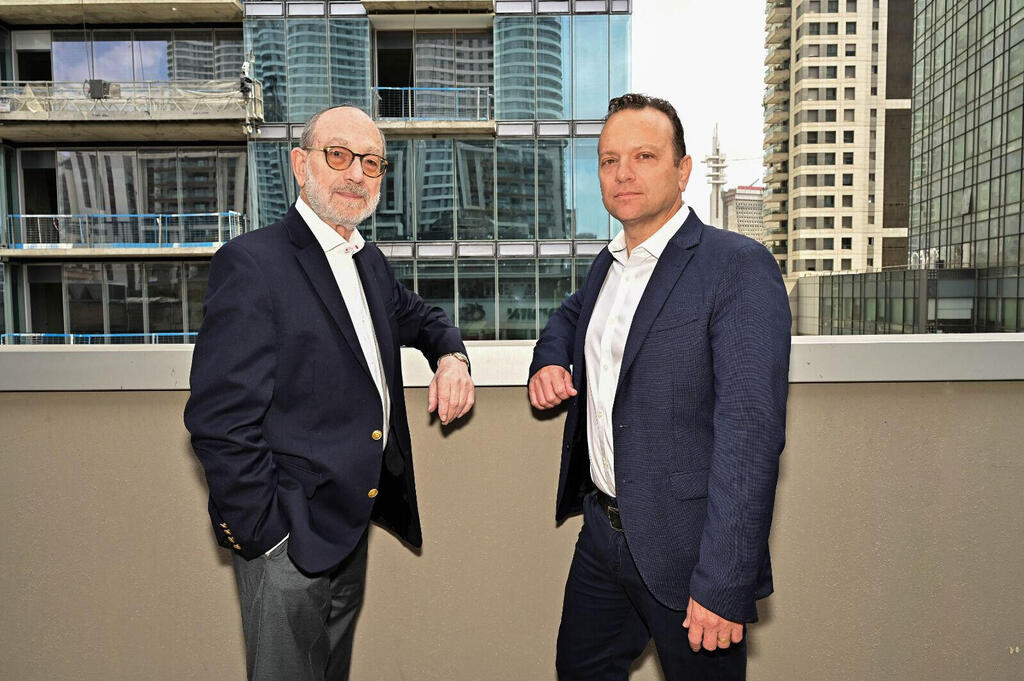
Hershey Friedman (left) and Adi Dana
(Photo: Tamar Matsafi)
When asked whether he expects housing prices to continue falling, against the backdrop of recent reports from the Central Bureau of Statistics and the Treasury’s chief economist about a decline in transactions and apartment prices in recent weeks, Friedman replies firmly: “It’s a myth - it won’t happen.” A few days before the interview, the Housing and Construction Ministry CEO, Yehuda Morgenstern, urged buyers to “purchase apartments if you have money in savings - but negotiate.” Shortly after the interview, even Prime Minister Benjamin Netanyahu presented a graph of falling housing prices at his economic press briefing following the Super-Sparta speech.
But Friedman insists: “During the summer months, there was a strong surge in apartment sales - almost like a whole six months’ worth. Then the pace of sales slowed again when the government called up another 100,000 reservists.” Dana, who joined the interview, adds: “During a war like this, the fact that the real estate market is still so active is almost a miracle. After two years of war, to see such a small drop in sales volume and for the market to continue functioning so steadily is an extraordinary economic event.”
Back to Friedman, he addresses the surge in construction costs:
“In recent years, contractors have been saying, ‘We lost money on your project, you need to pay us back.’ Additionally, when there’s a labor shortage, workers can move from project to project and demand higher wages. You also have to remember that after Operation Rising Lion, a lot of damage was done to buildings, and in some cases we had to not only repair but replace the damaged parts. You can’t just put a bandage on it - it wouldn’t be fair to buyers. So we decided to order all the parts anew, even though it’s much more expensive and takes more time.”
Dana reinforces the point: “There’s not enough forward planning for raw materials; the main obstacle is the production cost of apartments. Licensing procedures also need to be shortened - it’s complex work, but doable. This is much better than trying to reduce prices through restrictions. You can already see it happening: while construction costs rise, land prices at auctions are falling. But when will that land actually become apartments? In 7, 8 or 9 years. Addressing construction costs now helps immediately. This is the most urgent issue.”
Returning to the Phantom Apartments
When asked how he deals with the issue, Friedman responds as someone with extensive experience navigating business crises.
“Honestly, there are good times and bad times. You have to run a company knowing that cycles always come around. Roughly every ten years there’s a crisis, whether you like it or not. Until COVID, things were good. Once it started - one crisis after another. First the pandemic, then interest rates rose, and now the war began. The government must first lower the investor tax. Every investor brings money into the country, including foreign investors - that’s good for the economy.”
Referring to investment apartments for foreigners:
“They used to call the “ghost apartments” - empty units owned by foreigners who come during holidays or vacations. We have the same in Miami. My wife loves spending time there, and fortunately there are direct flights from Miami to Tel Aviv, so it works out. For example, we spent last weekend in our apartment there, and today I landed here, and I’ll return this weekend to celebrate Rosh Hashanah with her [the interview took place a few days before the holiday]. If you went to my apartment now, you’d see 80% of the building is empty. The municipality earns a lot from property taxes - it’s profitable.”
“We have projects in Jerusalem with waiting lists of Americans. We build projects in areas suitable for religious, ultra-Orthodox and general Israeli populations - every target audience,” he continues. “But you have to allow foreigners to come, bring money, and stimulate the economy here, especially now with all the expenses and reserves the government has to pay. Wars cost a fortune, so the government needs to think broadly and understand: ״yes, many apartments are being built, but not randomly. They are built for different populations, in different areas. Too many apartments? Lower the tax, allow foreign currency in.”

Melach Ha'aretz,Jerusalem
(Project visualization: Division)
Dana also addresses the ״ghost apartment״ issue: “We see many buyers in neighborhoods like Melach Ha’aretz or Arnona in Jerusalem, where the buyers are foreigners. When I sat in a café in Arnona, two-thirds of the people spoke English. So it’s not just ghost apartments - these are people genuinely changing their lives and coming to live here.”
Friedman adds: “Even in Beit Shemesh, there are many foreign residents - it’s all English-speaking.”
Dana: “Exactly, and we feel it. Many are wealthy businesspeople who visit Israel regularly. We plan some projects specifically for this population - the apartment sizes they want, a synagogue within the complex if they require it. It’s a productive population, most of them with a religious background. I’m not sure anyone in the government is really thinking about what to do with this immigration wave.”
Your Jerusalem buyers mosty come from religious or ultra-Orthodox backgrounds. What do you think about military service for Haredim?
“I believe everyone should serve in the army. Either you study seriously, or you go to the army. I have a son-in-law - I tried to involve him in business, but he struggled with management because he was too much of a ‘student.’ I realized it was simplest for him to come to the office and study all day. Regarding kollels, there are rabbis who say: either you study seriously, or you go to the army. Of course, many oppose this, creating a dilemma. You can’t arrest everyone, but you can implement checks: in the morning, mark attendance; leave for lunch - sign out; return - sign back in. Like in my business. I don’t see it as a problem, but there’s resistance. They don’t view it as honorable.”

“Everyone should serve in the army”
(Photo: IDF Spokesman)
Friedman continues: “I truly believe the IDF should expand. I’ve seen Haredim going into the army. It’s happening slowly. You see Haredim soldiers with long sidelocks and big beards, weapons in hand, in Gaza. It’s starting. How much will it grow? It depends on how seriously the government invests in this. Either they study properly, or they go to the army. I think we’ll see more Haredim enlisting. Even today, I see more, based on the pictures I receive. Unfortunately, some Haredim soldiers have been killed - this is a war with a heavy price. I believe in the future we’ll see more Haredim in the army. That’s my view.”
Before we finish, I want to ask you: you’ve been in this field for so many years - what still motivates you to get up every morning? And what do you wish for the new year?
“It’s simple: I’m a motivated person, I can’t sit still. I’m always looking for what else can be done. I love growing companies, I think about future plans, including for Azorim. I’ll tell you more - we’re already demolishing projects built by Azorim over 50 years ago and rebuilding them.
“For the new year, I wish for peace in Israel. That all hostages return home. What’s happening in the war no longer concerns me. All I truly wish for is that all the hostages come back, that they’re returned home - that’s the most important thing. The hostages must be freed. This is my wish - that all parents and families are happy; this must end. This is my greatest wish - that there will be peace in Israel. I can’t wish for more than that. That everyone returns to a normal life.”