


The war with Iran has underscored the enormous importance of civil‑population reinforcement (sheltering and protective construction) and, alongside it, the need to address the risk of earthquakes. Recently, the government approved a law to reconstruct buildings destroyed since October 7 within an urban‑renewal framework — a measure that would allow rapid rebuilding and fortification of structures.
However, further legislation is still required to advance it; at this stage no Knesset debate has been scheduled. Sources familiar with the matter say the bill is expected to be put to a vote in the future, but admit that no date has been set.
Gallery
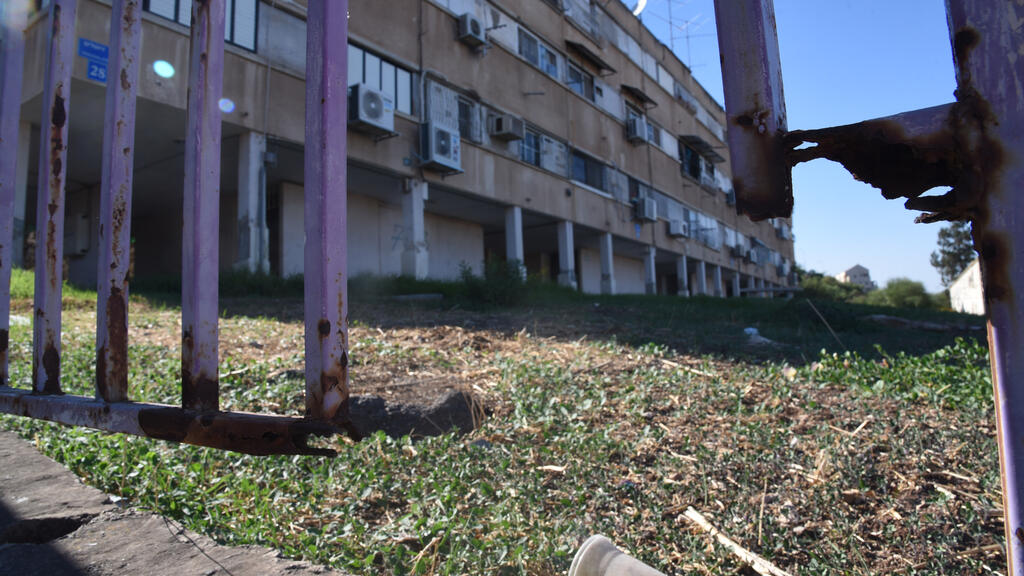
In a magnitude‑7 earthquake there will be 1,830 deaths in Tiberias, its mayor said
(Photo: Avihu Shapira)
Meanwhile, in a hearing held Tuesday by the Knesset’s Interior and Environmental Protection Committee, participants warned of a horrifying scenario: a magnitude‑7 earthquake could kill nearly 2,000 people; and at a real‑estate conference held Wednesday in Tel Aviv, engineers and infrastructure experts cautioned that there are hundreds of thousands of apartments in Israel that do not meet seismic standards.
“The state does not deal with engineering resilience. There are in Israel some 800,000 housing units that do not meet the earthquake‑resistance standard, and this is a figure that cannot be ignored,” said Igal Govrin, chairman of the Israeli Association of Construction and Infrastructure Engineers, at the union’s conference. He added that the results of the last year in population protection and the serious implications are now clear, not only from a security standpoint but also in terms of earthquakes.
“When you consider that about 800,000 housing units do not meet standards, you understand where we could be headed. A large share of them are in regions that are among the most seismically sensitive — such as Kiryat Shmona and Beit She’an,” he explained.
In the Knesset discussion held Tuesday, the head of the Urban Renewal Forum, David Sonnino, presented a policy paper warning that: “The State of Israel stands on the brink of an unprecedented national failure. Operation Iron Swords exposed the collapse of the nation’s management, control and emergency apparatus at the decisive moment. That same pattern is expected to occur with the next earthquake — only this time the threat will not come from an external enemy, but from the collapse of infrastructure and entire cities.”
Members of the Urban Renewal Forum assert that the lack of a central coordinating authority, the fragmentation of responsibilities among ministries, and a patchwork policy in urban renewal will lead to a national collapse in the event of a quake of magnitude 7.5 or greater. According to the forum’s data, about 97% of local authorities have not completed a mapping of dangerous buildings, and some 600,000–800,000 buildings do not comply with Standard 413 (Design of structures for earthquake resistance)and are at risk of collapse.
Their policy proposal calls on the government and the Knesset to establish — by legislation — a national authority for building reinforcement and earthquake preparedness: a central body with execution, budgeting and oversight powers; to anchor urban renewal within a national‑security strategy; and to allocate funding according to geographic risk level, not economic feasibility.
“The hearing in the committee was a big circus. In a three‑hour debate not a single ministry was willing to coordinate the state’s preparedness for an earthquake," Sonnino told Ynet. "The state has not included the matter of public instruction and awareness for earthquakes. There is no body that instructs the average citizen what to do in an earthquake. The forum asked committee members if they know what the earthquake alarm sounds like — no one knew. The greatest danger to the citizen is hiding under a table or chair; the danger is much greater and one must go to open space. Bottom line: the citizens of the State of Israel are left abandoned by the state in the face of earthquakes.”
At the hearing, the mayor of Tiberias, Yossi Neveah, said: “According to forecasts, in a magnitude‑7 earthquake there will be 1,830 deaths in Tiberias, and even the municipal building will collapse. Urban renewal for us is not economical — I don’t sleep at night.”
The mayor of Kiryat Shmona, Avichai Stern, warned that over 50% of the city’s buildings are in immediate danger of collapse and need reinforcement.
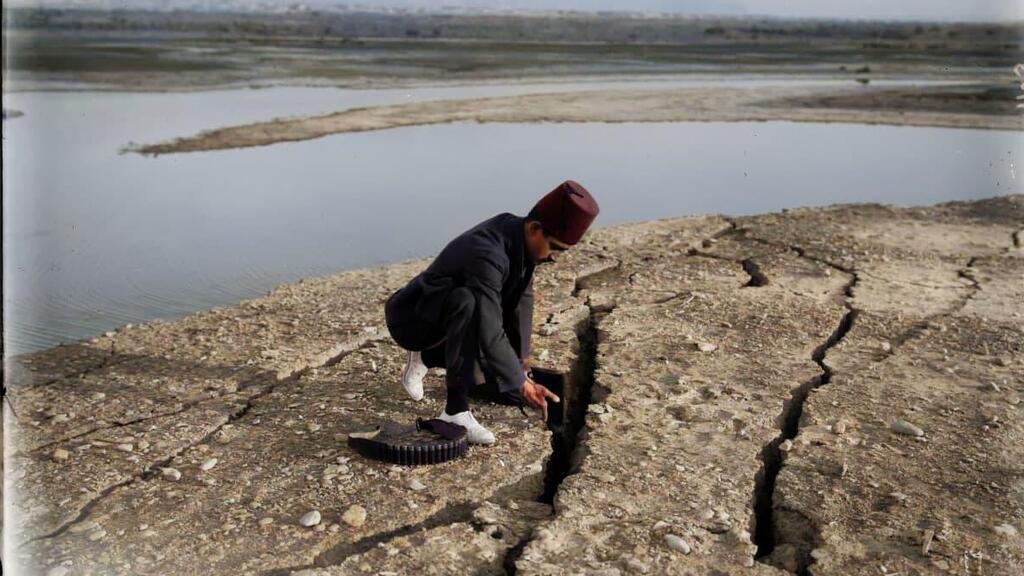
A man examines the earth that cracked in the Dead Sea as a result of the July 11, 1927 earthquake
(Photo:: MyHeritage)
Amir Yahav, a representative of the National Planning and Resilience Authority, said he knows of no central body that coordinates the state’s overall preparedness for building reinforcement.
“An earthquake can happen at any moment, and the state is not ready. It involves not only buildings — but dangerous materials, economy, society and public health,” he said.
A document submitted to the committee by the Environmental Protection Ministry noted that there are 1,267 factories in Israel holding hazardous materials, but oversight of them is “almost impossible.”
“We have only one inspector responsible for all such factories across the country — we do not have the capacity to handle it,” Lilach Fadlon from the ministry explained.
According to the document, at the current pace of progress full earthquake‑preparedness compliance among hazmat plants would only be achieved in around 60 years.
“There is a lot of responsibility but no authority," Knesset lawmaker Yitzhak Kroizer, chair of the committee, said. "The committee demands from the Prime Minister’s Office a work plan to establish a single body that will centralize national earthquake preparedness, with full powers and a budget. The government’s commitment must be to strengthen weak periphery regions and municipalities. In the center there is economic feasibility — in the periphery there isn’t, so additional entrepreneurial solutions are needed beyond the state budget.”