


For the first time in approximately 50 years, the Planning Administration is examining the integration of innovation into construction methods in Israel and revising the standards for industrialized building technologies, ynet and Mamon have learned.
Currently, a professional review of the building framework regulations is underway, partly in response to the shortage of skilled labor following the Israel-Gaza conflict, and partly due to the need to reduce construction costs, which have risen sharply in the past two years, leading to higher housing prices and deepening the housing crisis.

The Planning Administration notes that the combination of a persistent labor shortage and accelerated technological progress in construction worldwide requires a renewed examination of the regulatory framework, which has barely been updated in any meaningful way for decades. This despite dramatic changes in engineering knowledge, building materials, construction methods, and execution technologies.
Past attempts and challenges
In recent years, government ministries and representatives of the Builders’ Association of Israel have tried to increase the use of industrialized construction and innovative building technologies, which can shorten construction time and reduce the need for labor. However, industrialized construction methods are often considered more expensive. The government has not invested enough resources over the years in development and implementation, and innovators in construction technologies have admitted that it has been difficult to present new methods to Israelis.
For about a decade, the Association has worked with the Construction Industry Promotion Fund and the Ministries of Interior and Housing to develop new technologies. In 2017, the Contech startup incubator was established, supporting a community of technology developers. This includes robots replacing masons and painters, drone-based systems for planning and supervision, crane systems replacing crane operators, underground work detection and planning systems, helmet cameras, and location-tracking systems to prevent workplace accidents.
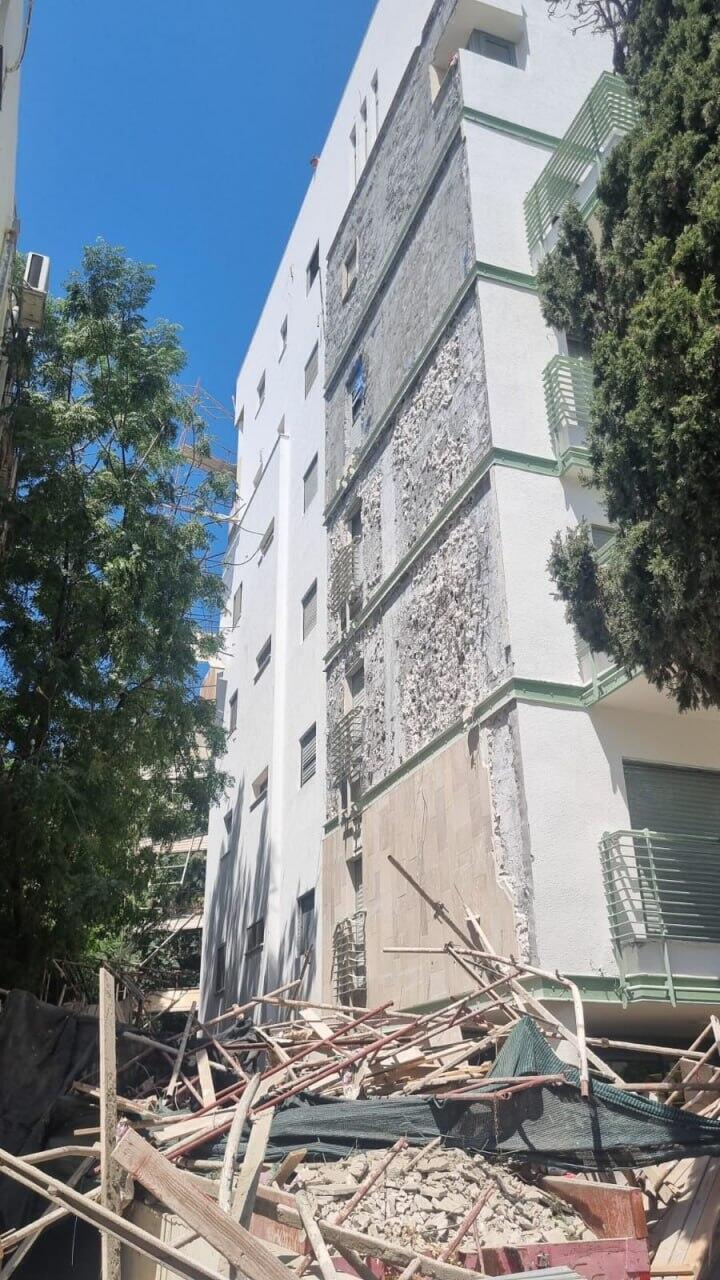
Preventation is the agenda. Aftermath of a scaffolding collapse, Tel Aviv
(Photo: ZAKA)
Within the industry, it was noted that in the past two years following the war, there has been more openness to the topic, but the path to fully integrating these innovative technologies is still a way ahead. The current review is led by the Planning Administration’s Regulation Division in collaboration with engineer Israel David. It includes technical headquarters work, a review of international standards, and an analysis of potential impacts on safety, construction quality, timelines, execution costs, and long-term maintenance.
Learning from global practices
As part of the initiative, a delegation of government officials and professionals recently visited the World of Concrete exhibition in Las Vegas. They were exposed to advanced construction methods, innovative materials, and industrialized building technologies already implemented in many countries, across various construction sectors - from high-rise buildings to infrastructure to maritime restoration. At the same time, global trends are being examined, including industrialized construction, advanced structural systems, and digitally controlled construction technologies.

A printed house, the Netherlands
(Photo: AP)
Among other things, the possibility of controlled integration of advanced materials is being examined, including fiber-based materials evaluated as an alternative or complement to steel, as well as methods that reduce dependency on labor, shorten schedules, and improve engineering precision and uniformity. The goal is to adapt the building framework regulations to technological developments and allow safe and controlled implementation of innovation.
The regulations are also being examined for suitability to future technologies such as 3D concrete printing, which allows significant time reductions, provided that all safety and strict regulatory standards are met.
The Planning Administration emphasizes that this is not a broad regulatory relaxation or an immediate change in the rules, but rather a professional and gradual process. "Israel’s construction sector is at a significant crossroads," Rafi Almaliah, CEO of the Planning Administration, told ynet. "The shortage of labor, alongside a technological leap, requires a renewed review of old regulations. Our responsibility is to enable professional, safe, and controlled assessment and implementation of innovation, which will improve construction quality, streamline execution, and benefit the economy and the public."

Rafi Almaliah
(Photo: Eli Dasa)
Yamit Cohen, Deputy Director of Regulation at the Planning Administration, emphasizes that the amendment of the regulations is not purely technical but a conceptual change. "We are building a regulatory path that will allow the integration of new materials and methods based on proven performance and a structured methodology, including industrialized solutions and advanced, sustainable materials," says Cohen. "The goal is to streamline processes, reduce labor dependency, and simultaneously maintain safety, professional responsibility, and long-term economic foresight."
Industry perspective: manual work vs. industrialized methods
In an interview with ynet, Ariel Pokotinsky, CEO of Eco Wall Tidhar (ECOWALL), which specializes in innovative building cladding technology, described the challenging situation on construction sites in Israel. According to Pokotinsky, many contractors still use outdated construction technologies while the rest of the world has moved on to industrialized methods.
"Israel's construction sector is one of the most technologically underdeveloped industries," Pokotinsky says. "Israel is a super-technological country - its high-tech and defense industries are global leaders. All other sectors have industrialized - agriculture, dairy - everything is automated. But construction has engraved conservatism on its flag, and work on construction sites remains manual. Workers arrange rebar in molds, build blocks by hand, carve them, lay electrical piping, and plaster manually.

Ariel Pokotinsky
(Photo: Liat Mandel)
"Because the process is manual, it is neither controlled nor precise. This means that if we start a new project today with 100 apartments and measure something as basic as the distance of a toilet from the wall, the results in each apartment will differ. Moreover, when ordering windows, instead of ordering 100 windows of the same size, almost 100 different measurements are required because construction is uneven. This increases both costs and construction time."
Labor costs are also high: "A Chinese construction worker earns about 1,500 shekels per day. If we switched to industrialized construction, we could reduce construction costs by 10%-15%."
Yamit Cohen summarizes: "The goal is to streamline processes, reduce dependency on labor, and simultaneously maintain safety and economic foresight."
Pokotinsky concludes: "All other sectors have industrialized, yet the construction sector continues to build as it did decades ago. It is one of the most primitive industries, clinging to conservatism."