

A court has rejected a request by a Tel Aviv couple to dismiss criminal charges filed against them after they placed a small portable bomb shelter in their backyard to protect their family from missile attacks.
In her ruling, the judge wrote that the couple’s claim of no adequate protection available in their neighborhood “touches the heart,” but said it does not justify canceling the indictment.
“The difficulty described by the defendants is inconceivable, and I understand how deeply this worries them,” the judge wrote. “However, despite the understanding of their situation, I cannot order the cancellation of the indictment and thereby grant approval for construction carried out unlawfully.”
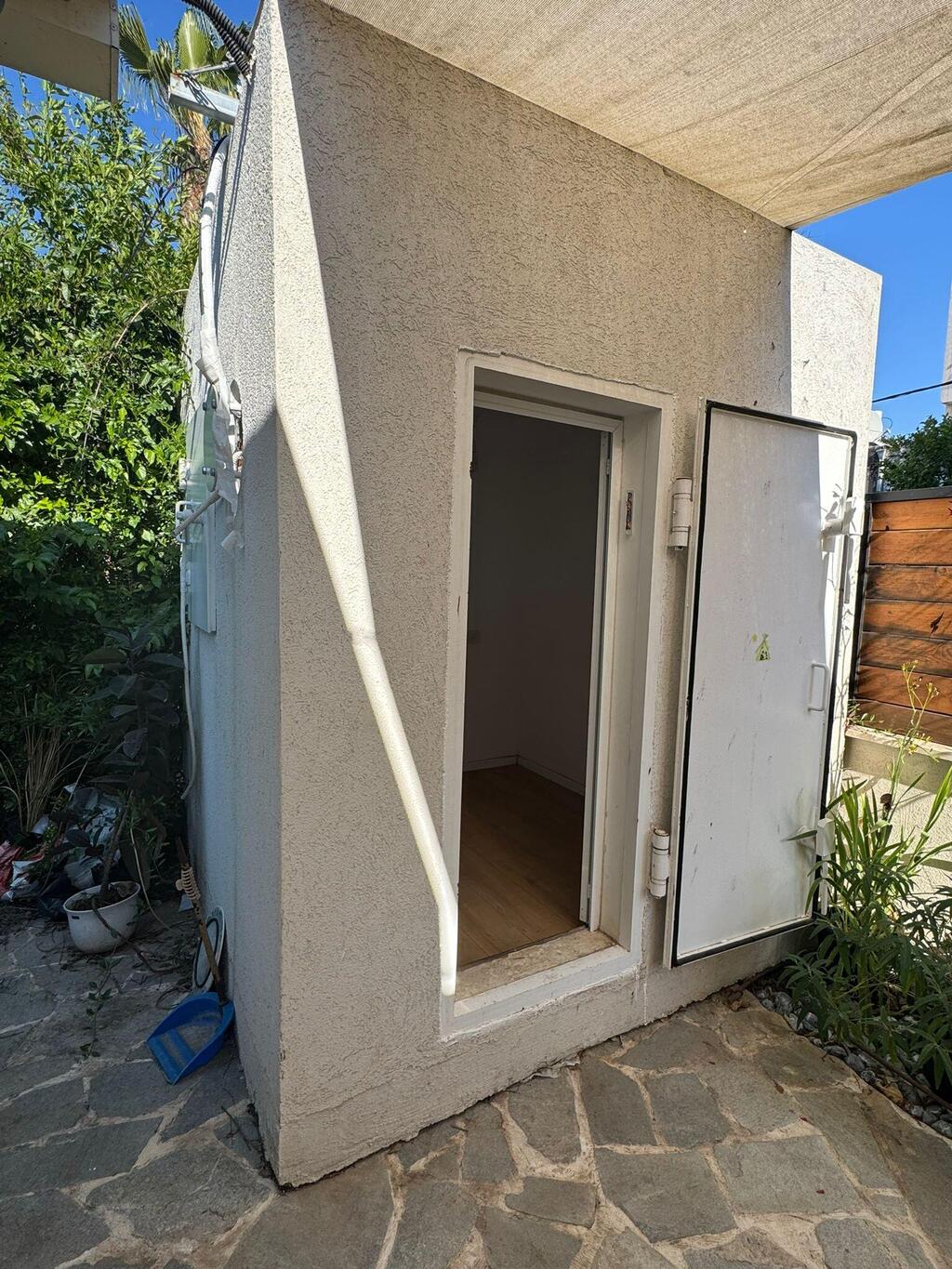
The small portable bomb shelter installed in the backyard in Tel Aviv
The decision, issued January 18, came before the current military operation against Iran. It refers to an indictment filed in October 2025, accusing the couple of erecting a structure without a permit on a 6.3-square-meter area in the yard of their single-story home.
"Commendation instead of prosecution"
The couple, who live in Tel Aviv’s Hadar Yosef neighborhood and are parents of two young children, argued that the structure is not a building but a small portable bomb shelter meant to protect their family during missile attacks and wartime emergencies.
They said the shelter has occasionally been used by neighbors as well, partly because there is no public shelter or protected room nearby.
Represented by retired judge and attorney Daniel Ernst and attorney Hayuta Rubinstein, the couple asked the Tel Aviv Municipal Court to dismiss the indictment on the grounds of “protection from injustice.” They argued that even if the placement of the shelter technically violated the law, pursuing criminal proceedings against them contradicts principles of fairness.
In their filing, the couple accused the municipality of failing to provide adequate protection for residents against missile threats. “In the absence of a nearby shelter or other protective solution for residents, placing a bomb shelter in a private yard should not be grounds for prosecution,” they wrote. “On the contrary, it deserves commendation.”
They also argued that building a reinforced safe room requires a construction permit and a minimum space that their yard does not have. By contrast, they said, placing a portable shelter does not require a permit and is sometimes allowed by local authorities, including Tel Aviv, in similar situations.
The Tel Aviv Local Planning and Building Committee, which filed the indictment, acknowledged that the structure is a small shelter and said it had even offered the couple a conditional arrangement due to its modest size.
 Ret. judge and attorney Daniel ErnstPhoto: Itzik Biro
However, prosecutors argued that the installation still constitutes construction requiring a permit under Israel’s Planning and Building Law.
According to the municipality, the couple could have avoided prosecution by removing the structure and paying a fee to the local committee. Instead, officials said, they ignored the authority’s requests and continued committing a planning violation.
Earlier this year the couple again stressed to the court that the shelter is extremely small and located near what they described as strategic sites in Israel that could become targets for enemy missiles. They said dismantling the shelter during a period of heightened security tensions would endanger their family.
Judge Noga Blickstein-Shchori ruled that the request to dismiss the indictment must be rejected. She said there is no dispute that the structure was installed without a permit and therefore appears to violate planning and construction law.
“I am willing to assume, as the defendants claim, that this is a portable shelter and that its construction, even if it constitutes an offense, was intended to ensure safety,” the judge wrote. "The question whether this construction was carried out to protect the defendants’ home, parents of young children, in the absence of an alternative protective solution, establishes a defense of justice. In my view, the answer is no.”
She said the court cannot allow the construction by canceling the indictment, warning that doing so could create a legal loophole that bypasses planning authorities and undermines established enforcement policy.
She also rejected the couple’s claim of selective enforcement, saying it was raised in general terms without pointing to specific shelters allegedly installed by authorities in violation of planning regulations. A further hearing in the case is scheduled for June 2026.
In a statement, the Tel Aviv municipality said the city has hundreds of protected spaces, including about 286 public shelters and 161 underground parking garages approved as protected areas.
“The Tel Aviv-Yafo Municipality places great importance on protecting buildings in the city,” the statement said. “However, in this case the issue is illegal construction that requires a building permit, as the court also determined.”
First published: 15:57, 03.05.26