

At least 27,000 apartments are now in the planning pipeline of a special Israeli committee tasked with converting office developments into housing. About 7,000 are included in 10 plans already under discussion, while planners estimate another 20,000 homes could be built in 15 newly identified sites still at an early stage. The surge follows a change in the way the Planning Administration has operated the committee over the past year, after several years in which its work made little headway.
The most advanced project, now approaching the formal deposit stage of the planning process, would build two 32-story towers containing 400 apartments above five floors of commercial and office space in Givat Shmuel, just east of Tel Aviv.
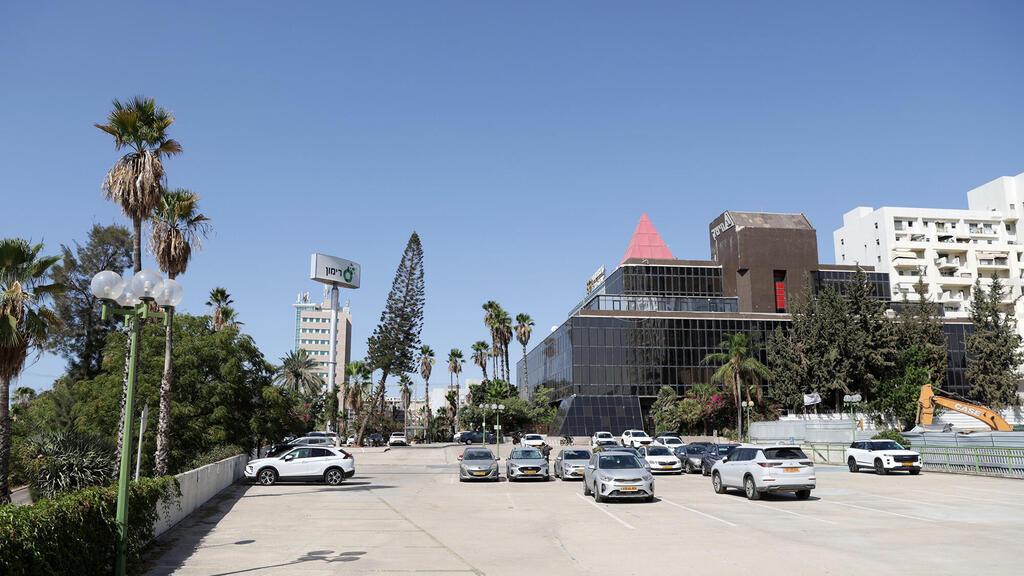
Residential development site in Givat Shmuel. 400 apartments will replace 52,000 square meters of office space
(Photo: Orel Cohen)
The project is planned for the Amitech complex, owned by the Ezri Group, alongside Highway 4 near the Givat Shmuel interchange and opposite the Coca-Cola plant. It would replace an earlier approved plan for 52,000 square meters of office space that the company never developed.
One factor helping unlock the project is a nearby infrastructure plan to place a section of Highway 4 between Bnei Brak and Givat Shmuel underground in a tunnel, freeing land for construction.
Half the apartments in the project are defined as micro-units, each measuring about 50 square meters. They are intended primarily for younger households without children, which planners say would reduce the financial burden on the Givat Shmuel municipality compared with larger family apartments.
The company’s office building is visible from Highway 4, although the Ezri Group itself has maintained a relatively low public profile. It was founded by Meir Ezri, Israel’s first ambassador to Iran, who died about a decade ago. The company is now headed by his son, Yoram Ezri.
CEO Avi Buchschreiber said the main advantage of working with the special committee was its ability to coordinate the process among the many agencies involved.
“The major advantage of working with the special committee is its ability to create cooperation and coordinate the process with the various relevant bodies, such as the National Infrastructure Planning Committee, the local authority and Netivei Israel, and thereby reach an optimal planning framework,” he said.
The project and others like it reflect a major change in the committee’s operations over the past year.
The temporary subcommittee for detailed plans converting land designated for employment uses into housing was created under legislation approved in January 2022.
Its purpose was to address two planning problems at once: an enormous surplus of approved but unrealized plans for office construction and an urgent need at the time to expand the housing supply as home prices climbed sharply.
The idea was to allow land originally designated for offices to be used for residential construction.
Municipal leaders, however, strongly resisted the move because office and commercial properties generate significantly more municipal property-tax revenue than housing. They feared that replacing planned employment areas with residential projects would erode local government revenues.
As a result, the committee struggled during its first years, dealing with only a handful of projects involving at most several hundred apartments and frequently clashing with mayors.
That approach changed following an organizational restructuring this year at the Planning Administration, which created a Housing and Urbanism Division headed by Deputy Director General Sigi Be’eri. Be’eri previously served as chief planner for the national committee responsible for fast-tracking large housing developments.
Under Be’eri, the committee shifted from a body that primarily responded to proposals into one that actively identifies potential developments.
It was also decided that the committee would focus only on large, strategically important sites: generally at least 50 dunams, about 12 acres, or 15 dunams and above when located near light-rail stations or planned metro stations.
Priority is being given to sites adjacent to existing residential neighborhoods and to locations where major obstacles are unlikely to prevent or significantly delay construction.
Perhaps the most important change is that a committee once characterized by confrontation with municipalities is now working with mayors and local authorities.
The goal is to create a mix of uses that can turn long-stalled plans into viable projects.
Over recent decades, often at the urging of municipalities, Israel approved plans for tens of millions of square meters of office space. Local governments hoped the developments would generate substantial tax revenue.
But supply has outpaced demand. Land values for some planned office sites have fallen, and companies are increasingly reluctant to locate outside the most desirable employment districts or away from major transportation corridors.
The plans now being promoted by the committee therefore generally involve mixed-use developments combining offices and retail space with housing.
Adding apartments increases the economic value of the projects for developers and creates an incentive to actually build them.
The emerging policy favors a combination of uses rather than simply replacing offices altogether, meaning apartments may be added alongside previously approved office space rather than built entirely in its place.
Following legislative changes made after the Knesset was dissolved, the committee was authorized to continue operating through the end of 2029 and was also granted authority to convert land designated for commercial development into housing.
The committee has therefore been given more time and broader powers. Its real test, however, will be how many of the roughly 27,000 apartments now in the planning pipeline ultimately move from plans on paper to construction sites.