

Four years ago, Ruti Amar became her own construction supervisor. “I watched over the construction every day, from 7 a.m. to 5 p.m., with the plans in my hand,” she says. “One day, the workers built a wall and forgot to put a window in it. I told the man working there, ‘There’s supposed to be a window here.’ He answered, ‘No, there isn’t supposed to be a window here.’ I turned to the contractor, who checked it and admitted I was right. The workers had to take down five rows of blocks they had already built to fix the mistake.”
Amar, 75, a bookkeeper, divorced and a mother of two, is not someone easily deterred by challenges. Today, she can sit back with satisfaction in the 81-square-meter, or about 872-square-foot, home she built in the community village of Lavon in the Upper Galilee, within the Misgav Regional Council.
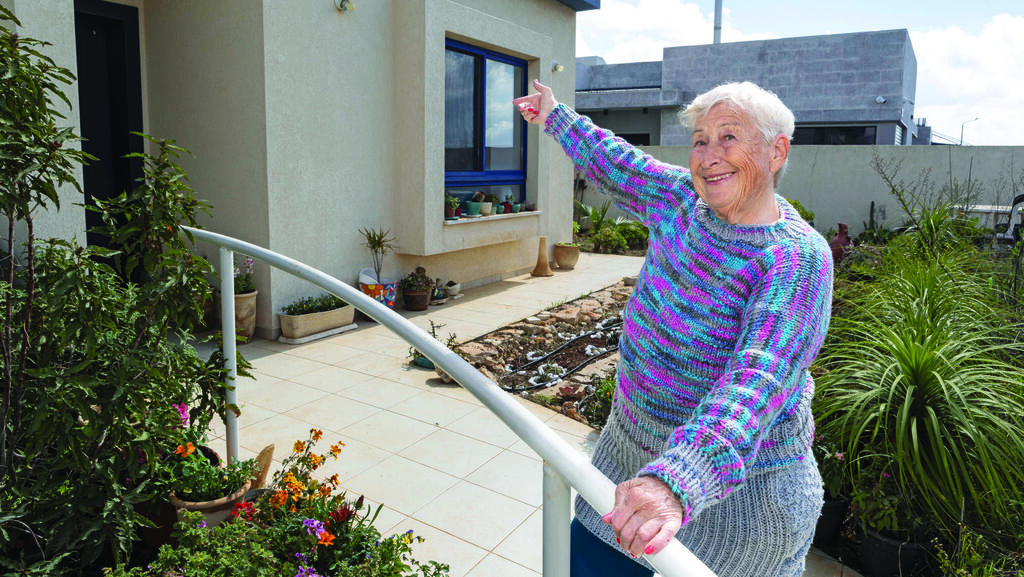
Ruti Amar
(Photo: Gil Nechushtan)
Childhood in the village: She was born Ruti Greenfeter in Moshav Mishmeret in the Sharon region, the eldest daughter of a couple who fought in the Jewish Brigade during World War II. Her parents’ farm had a chicken coop, lemon orchards and peanut fields, and her father also worked as secretary of one of the moshavim in the area.
When she was 11, he was killed in a car accident, leaving her mother with four children.
“It was a traumatic event that turned my life upside down,” Amar says. “A major crisis that stayed with me for many years. I took it upon myself to maintain one of the chicken coops on the farm. Every day before school, I collected eggs and fed the chickens. I helped my mother take care of my younger siblings, and once a week I cleaned the whole house. My mother worked hard to support us. She was heroic and brave.”
Starting a family: Amar married at 25 and became a mother at 34. “We had difficulty conceiving, and there were no fertility treatments then,” she says.
She worked as a bookkeeper. She and her husband bought an old house in Tel Mond and renovated it. Fourteen years later, they bought a plot for construction in nearby Moshav Ein Sarid and moved into a 19-square-meter, or about 205-square-foot, trailer on the land until the house was completed.
“My ex-husband is a welder, and he made all the windows and shutters in the house himself,” she says. “I supervised the rest of the professionals. The process gave me a lot of strength. I felt strong. Friends even asked me to supervise the building of their home, but I refused because it is a 24-hour-a-day job, and my children were most important to me. In hindsight, I regretted it. If I had turned it into a profession, maybe I would be in a different place financially today.”
A new beginning in the north: In 2013, the Amars divorced and sold the house in Ein Sarid. With the money she received, Ruti began looking for a new home, a ground-level house with a garden.
“Most of my life I have lived that way,” she says.
She decided to move north, following her daughter, who lives in the community village of Abirim.
“I made myself a list of all the things I wanted in the community where I would live, including a synagogue, because I am traditional, and people my age. In the end, I found the ‘Build Your Own Home’ project in Lavon, 40 minutes from Abirim. When I entered the place, I felt it was my home. Because I joined the project through the community secretariat, I felt I was going the safe route. In any case, I did not have the budget to buy a finished house, which costs 50% more than a self-built home.”
Planning the house: With the help of an architect and an architectural practical engineer, plans were prepared for a large house that would include an attached rental unit. But as building material prices rose, Amar realized she could not afford it and settled for the current house, only 81 square meters.
“In hindsight, I regret not at least building the frame for the rental unit,” she says. “Maybe I would have managed later to raise the money to complete construction. I wanted a single-story house, and I had a clear vision of what it would look like, how many rooms it would have, what kind of light would flood the living room and what rocking chair would be on the back porch.”
The construction process: “I moved into a rental in Kfar Vradim and came to the site every day. I sat here from morning until night and did everything I could to make the construction move quickly. I chose professionals carefully. I did not settle for recommendations, but went to see their work. Sometimes there were mishaps. One waterproofing contractor was a failure, and I lost 3,000 shekels because of his poor work. I ordered the materials myself, and as an experienced bookkeeper, I monitored the costs so I would not exceed the budget. Within a year, the house was standing.”
Housewarming: In 2022, she moved into her new home.
“I was very proud and patted myself on the back,” she says. “It was a great joy. I believe I succeeded in the mission because of the difficult childhood I went through and character traits such as assertiveness.”
By the way, the rocking chair on the porch still does not exist, but that, too, will come.
Tips for building your own home
Building a house by yourself requires not only money, but also emotional strength.
To save costs, you can hire an architectural practical engineer instead of an architect.
Even when you plan the budget precisely, you need to expect the unexpected. If you do not have a financial reserve, do not start building.
Before buying building materials, compare prices among several suppliers.
To avoid price increases during construction, it is worth buying all the equipment needed for the build, such as bathroom fixtures, at the beginning of the process and paying a deposit.
Building a house in the Galilee? Buy all the materials there. They are cheaper. I also recommend investing in underfloor heating, because it is very cold here in the winter.