


Jerusalem is changing its face: The capital has declared a quiet war on the “ghost apartments” of investors and foreign residents, who tend to prefer small apartments, and is shifting its focus to families. A special review by Magma Real Estate Marketing for ynet and Mamon reveals that in 2025, the number of construction starts for four-room apartments jumped by about 50%, and they now make up the city’s main market segment.
Some 15,240 housing units were approved over the past year as part of urban renewal. According to the data, over the past three years, from 2023 to 2025, construction starts for four-room apartments accounted for 38% of all construction starts in the city, compared with three-room apartments, which accounted for about 27%. Five-room apartments accounted for about 15%, one- and two-room apartments for about 14%, and large apartments of six rooms or more for about 5% of all construction starts in the city.
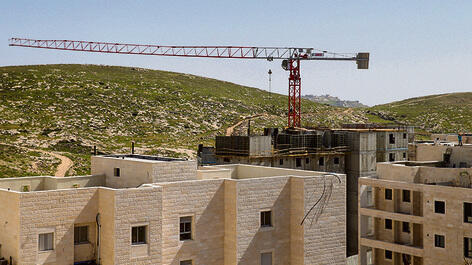
Building four-room apartments and larger; construction in Jerusalem
(Photo: Amit Shabi)
Zohar Shriki, partner and Jerusalem regional director at the company, explains that the urban renewal boom in Jerusalem is the main factor affecting construction starts. “Most of the old apartments are 2.5 to 3 rooms, while most of the replacement apartments are four-room units, which explains the data. The municipality is also limiting the number of small apartments in order to prevent the creation of ghost neighborhoods intended mainly for investors. It prefers four-room apartments and larger units that encourage permanent residency.”
Over the past year, construction began on 3,056 four-room apartments, an increase of about 50% compared with 2024. Five-room apartments fell by about 17% compared with 2024, and three-room apartments dropped by about 6%. The sharpest decline was recorded in small apartments: units of up to two rooms plunged by about 30% compared with 2024, to just 733 housing units that began construction, a finding that may point to a slowdown in construction for investment and rental purposes.
 Zohar Shriki Photo: Liana Bransky
According to Assaf Boyar, vice president of marketing at ISA Group, which operates in Jerusalem, among other places, “We are seeing a preference among buyers for four-room apartments. This is the size that suits the average Israeli family, and many buyers would rather compromise on size as long as the apartment is in Jerusalem. One interesting figure is the decline in demand for two- and three-room apartments. Investors also understand today that the right investment in Jerusalem is in larger apartments, because small apartments do not provide stability. As for the larger apartments, the strengthened Zionist affinity is affecting the nature of investments. Foreign residents are looking for stable assets that will serve them or their children in the future, and are therefore turning to larger apartments.”
According to data from the Government Authority for Urban Renewal, the number of approved plans under the evacuation-construction framework jumped from 37 plans in 2023 to a record 61 in 2024. In 2025, the number of plans fell to 54. However, in terms of the scope of the plans, 2025 showed a 129% jump over three years in the number of approved housing units, from 6,657 units in evacuation-construction projects in 2023 to 15,240 housing units, as noted, in 2025.
The gap between paper and concrete
But the figure that truly tells the capital’s story is the gap that has narrowed between paper and concrete. In 2023, only four projects actually received building permits, a tiny number out of dozens of approved plans. By 2025, that number had risen to 11 permits. In terms of the number of housing units that received permits, 1,378 apartments were approved for construction in 2023, compared with 4,092 apartments that received building permits over the past year, nearly three times as many.
 Attorney Roy Gilad Doron Photo: PR
Attorney Roy Gilad Doron, CEO of Dan Real Estate Urban Renewal, which is building, among other places, in Jerusalem’s Katamon neighborhood, offers a view from the field. “The Katamon neighborhood is undergoing a historic renewal process, with nearly 20 evacuation-construction complexes being advanced simultaneously, some of them already in advanced stages of construction. The neighborhood is expected to double its number of housing units by 2040, and by 2030 it will already include more than 10,000 housing units.”
Doron explains that “the high number of permits is the result of several factors, including an unprecedented concentration of nearly 20 active evacuation-construction complexes, which creates constant planning pressure; proximity to the light rail route, which gives the neighborhood priority in the eyes of the authorities; and enormous density potential, with old buildings being replaced by towers of up to 40 stories. Added to this is especially high market demand, with prices exceeding 30,000 shekels per square meter, attracting financially strong developers who are able to advance planning and licensing procedures quickly and efficiently.”
An analysis by real estate appraiser and economist Gabriel Rabani, chairman of the Jerusalem District and chairman of the Urban Renewal Committee at the Real Estate Appraisers Association, presents the scope of housing units in demolition permit proceedings in urban renewal projects that are in advanced stages of promotion. In these cases, demolition permits have already been approved, while actual building permits have not yet been received. The analysis also presents the demographic change taking place in Jerusalem’s older neighborhoods as part of these projects in 2025.
 Gabriel Rabani Photo: PR
According to the analysis, the Talpiot neighborhood leads with about 1,950 housing units planned in relation to 418 existing apartments undergoing evacuation and demolition proceedings. This figure reflects an average multiplier of about 4.6. Right behind it is the Katamon neighborhood, where about 1,400 new housing units are being advanced through demolition permit proceedings in place of 347 existing apartments, reflecting an average multiplier of about 4. In third place is the Kiryat Menachem neighborhood, with about 340 new housing units being advanced in place of 81 existing apartments, reflecting an average multiplier of about 4.2.
Rabani explains that the impact of urban renewal on the local rental market is significant. “When the actual evacuation process begins, a rigid and concentrated demand is created in the rental market. This involves a mass of residents — apartment owners who move into rentals during the interim period, alongside existing tenants who are forced to find alternative housing — all looking for housing solutions within the same geographic radius. In the absence of a parallel and available supply in the neighborhood, this dynamic directly leads to rising rental prices in the area.”