


More than a century after Joseph Trumpeldor arrived in the Galilee and declared that “where the last Jewish plow passes, there the border will run,” a group of young residents of northern Israel is seeking to update that legacy. Alongside the plow, they say, “where the last startup is established, there the border will be set.”
Next month, they are set to inaugurate HUBayta, an innovation and entrepreneurship hub built on the ruins of the former Agamon Market complex — a high-profile commercial project constructed several years ago in the Galilee Panhandle, near the migrating cranes of the Hula Valley. The site was abandoned during the war and left empty in an evacuated area.
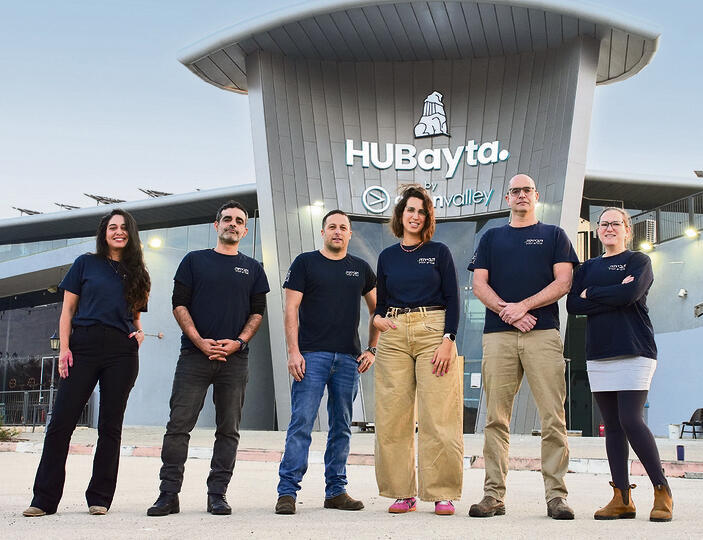
“We decided not to wait for the government. We are implementing Trumpeldor’s practice: last furrow, last border. Last startup at the last border,” said Nisan Ze’evi, 42, a third-generation Galilee resident who previously served as an investment manager at the JVP venture capital fund. After a year of reserve military service, he joined friends to launch the initiative.
The project is not being led by government ministries but by a local residents’ group called “Habaita — Returning to the Galilee,” which chose to take the region’s fate into its own hands while the war was still ongoing. The group raised initial funding of 8 million shekels (about $2.5 million) and renovated a 1,500-square-meter (16,000-square-foot) complex designed to resemble Tel Aviv office towers.

Renovation at the compound
(Photo: Habaita — Returning to the Galilee)
The immediate result is 85% occupancy even before the official opening. In partnership with the OpenValley coworking network, about 20 companies are expected to move in by January, including 12 startups, some of them relocating operations from central Israel to the Galilee. The move is expected to create 80 jobs immediately, with projections of 200 jobs within two years.
According to Ze’evi, the business model behind HUBayta is straightforward and built around opportunities created by the current situation. “The value proposition for companies that come here and are eligible for support from the Israel Innovation Authority has three layers,” he said. “Infrastructure at the level of New York and Tel Aviv, assistance in recruiting technological talent and human capital, and help in securing state grants for opening operations along the confrontation line.” He said some companies have already received grants of hundreds of thousands of shekels for opening activity at the site.
 Nisan Ze’evi Photo: Dror Artzi
The complex will also include meeting rooms, an entrepreneurship center and classrooms. A partnership with Google and the Employment Service is expected to bring artificial intelligence training courses to the site as early as next month.
“The goal is for this place to be a home not only for the Galilee’s productive class, but also for its creative class,” Ze’evi said.

Nisan Ze’evi
(Photo: Gallilon)
Ofri Eliyahu-Rimoni, 39, a resident of Yesud HaMa'ala, left a senior position as a spokeswoman for El Al during the war and has now returned north to manage the movement’s regional branding project.
“I left the Galilee after my military service, like most young people from the region who enlist,” she said. “Then the war came. I watched from afar what was happening to my home and the lack of concern, and I realized I wanted to come back. Settlement is the most important civilian mission right now.”
 Ofri Eliyahu-Rimoni Photo: Dror Artzi
Eliyahu-Rimoni stressed that the group’s guiding principle is complete independence. “We’re no longer waiting for anyone,” she said. “We believe in working with organizations and partnerships, but we don’t wait for them to join us. In the Galilee’s DNA there are people who ran forward — Baron Rothschild, Trumpeldor and others. The lesson of the war is that we have to work regionally, not each local authority on its own.”
One of the first companies moving into the complex is Kando Drones, which develops autonomous drones and so-called air taxis. The company, which employs about 60 people, decided to relocate its software development division from central Israel to the new hub, just 4.5 kilometers (about 2.8 miles) from the border with Lebanon.
“We’re a company that operates at multiple sites around the country, and as part of this move we transferred the entire software development department to the north,” said Moshe Kipnis, the company’s chief technology officer, who is originally from Mahanayim.
The shift, he said, is also bringing professionals back home. “Our head of software development is from Kiryat Shmona and had moved to Tel Aviv to work with us,” Kipnis said. “Now he’s coming back to work in the Galilee.”