

The crisis in the U.S. real estate market is hitting even some of Israel’s most established developers. Calcalist has learned that in recent months, two U.S. banks, Merchants Capital Corp. and Merchants Bank of Indiana, have begun foreclosure proceedings on three properties owned by Israeli company Valore. The properties are valued at an estimated $28 million.
A fourth property, worth about $10 million, is also under discussion with its lender after the bank froze funds generated by the property amid difficulties between the parties.
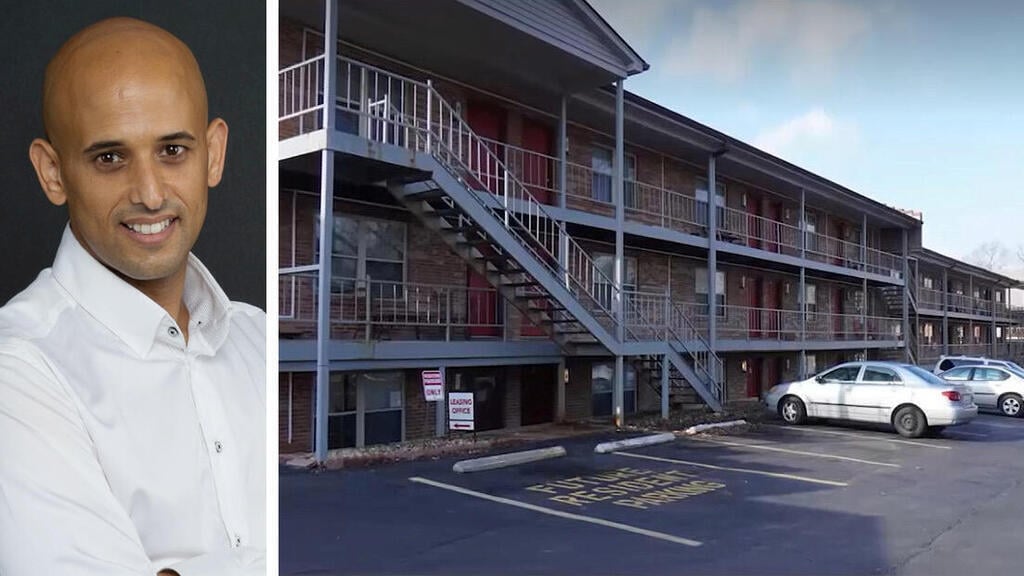
Valore controlling shareholder Roei Maudi alongside one of the company’s rental projects
(Photo: Pik Media Group)
Valore, whose name means “value” in Latin, was founded by controlling shareholder Roei Maudi. The company has hundreds of investors and owns properties worth $330 million, nearly NIS 1 billion, according to its website.
The banks began foreclosure proceedings on the three Valore properties after the company struggled to meet its payments amid persistently high U.S. interest rates and lenders’ desire to “cut their losses,” as one senior company official put it.
All three properties facing foreclosure are in Indiana, two in Evansville and one in Indianapolis. Regarding another Evansville property, company management has asked investors to inject additional capital in an effort to save it and prevent control from passing to the bank. Talks between the company and the lender are still underway in an attempt to avert that outcome.
Valore, founded in 2011 and marketed as a real estate company in which Israeli high-tech workers invested, operates in the U.S. multifamily rental housing sector. Over the years, the company raised capital from Israeli investors and used it to acquire residential complexes, mainly in the southern and Midwestern United States.
Its business model combined investor equity and bank debt with apartment improvements, rent increases and the sale of properties after several years.
Looked great on paper
Valore’s case illustrates the severity of the blow to real estate developers who acquired properties using leverage during the low-interest-rate era.
The deals were made on the assumption that developers would be able to improve the properties, increase their income and later refinance the loans or sell the assets at a profit. But since 2022, U.S. interest rates have risen sharply. Financing costs increased at the same time as capitalization rates rose, a combination that reduced property values even when apartments remained occupied.
The business plans of Israeli developers looked excellent on paper, but quickly became irrelevant as borrowing rates climbed from 3.5% to 9%. The more risk a developer took, the harder it is now to operate and the more vulnerable that developer’s investors have become.
Another senior industry figure criticized Israeli developers, saying current losses stem from their failure to build in sufficiently large safety margins. Israeli developers tend to operate with very little conservatism, he said, and anyone prepared to invest with them needs to understand how risky such investments can be.
In addition, in nearly all these investments, developer fees are collected at the beginning of the deal, when it closes, regardless of the return it ultimately generates or whether it succeeds. Valore documents show that the investment fund manager through which properties are acquired is entitled to an acquisition fee of up to 3%.
Valore investors told Calcalist that unlike some other developers, Maudi assumed personal guarantees. Investors who suffered losses also conducted checks with financial investigators, who found no evidence supporting allegations of irregularities.
That means that when the properties lose money, Maudi also suffers personally and could be required to repay bank debt. In other words, the deals he managed have caused investors losses totaling tens of millions of dollars.
A person close to Maudi told Calcalist: “Maudi has been through a year from hell, during which he had to deal simultaneously with the banks, property operations and investors who lost their money.”
A senior investment professional who previously worked with Valore and says he now advises clients against direct investment in the U.S. real estate market added that the case demonstrates that “investors in American real estate believed in easy money.”
“Unfortunately, they discovered that this is a complex business that requires a great deal of expertise and moves sharply with market volatility. Working with a developer, however professional, does not reduce the risk. Even if a developer succeeded in eight out of 10 deals, there are still dozens of people involved in the other two who did not succeed and lost all their money. It is a field best avoided, both its rewards and its risks.”
‘Investors become enemies’
According to a senior industry official, the challenge could intensify in 2027, when additional loans come due for refinancing.
Even property owners who currently enjoy positive cash flow because they are still benefiting from older, low-interest loans could suffer significantly when those loans are replaced, particularly if U.S. interest rates do not fall again over the coming year.
“Not only have interest-rate conditions in the U.S. real estate market changed, but the approach has changed as well,” he said. “In the past, banks would allow loans to be rolled over on the assumption that interest rates would decline and the properties could later be sold at a high enough price to ensure repayment of the debt. Today, the thinking is different.
“The regional banks that lend to Israeli developers have lost patience and are looking to cut their losses, so they are taking control of properties and selling them at any price. There is $1 trillion in loans reaching maturity, and the banks now have to recognize their losses.
“When a loan matures, the developer has to refinance it at a much higher interest rate, inject additional equity or hand the property over to the lender. The expectation is that in the coming months, many Israeli real estate developers, like Maudi, will give up properties. At that point, the investors become business enemies.”
‘A market-wide financing crisis’
Valore’s difficulties join a series of crises involving Israeli companies that marketed U.S. real estate investments.
As Calcalist reported last month, Realco, founded by Tomer Hay and Guy Raguan, sold an office building in Ohio for just $2 million, five years after it was purchased for $17 million.
Some $7 million had been invested in the building by 42 investors, with the balance financed by a bank, which was the only bidder in the sale process. Dozens of Realco investors have joined forces in an attempt to gain control over properties and their investments, and three additional properties are expected to be sold at a loss.
At its peak, Realco reported about 1,000 investors and a property portfolio worth around NIS 3 billion.
An even more serious case is the collapse of Vision & Beyond, or VNB, founded by Stas Greenberg and Peter Gizunterman.
At its peak, the company held properties worth about $250 million, with most of the money raised from the public, particularly former military personnel. Hundreds of Israeli investors, including active-duty and reserve military personnel, lost nearly all the capital they invested in properties and apartments in Ohio and Texas.
Legal proceedings are underway against the two founders, with allegations including fraud and the falsification of mortgage documents.
Maudi said in response: “Macroeconomic changes and the surge in U.S. interest rates between 2021 and 2023 created an unprecedented, market-wide financing crisis in commercial real estate. In the transactions in question, the situation does not stem from an operational failure but from the banks’ refusal to extend the loan terms and their demand for full repayment of the debt, at a time when refinancing is impossible because of a market-wide decline of about 30% in property values.
“Throughout all its years of operation, the company has never encountered an event of this kind. Throughout this process, we have acted and continue to act according to an exceptional set of values: In the transactions in question, we did not withdraw a single cent in management fees and never issued capital calls to investors. I personally injected all the millions of dollars required to stabilize these properties and deal with the banks, as the largest investor and as someone who personally signed full guarantees to the lending banks.
“When the investors are my community, and some of them are members of my immediate family, their capital comes first. The unequivocal proof that this is a market failure rather than a management failure is the ‘Hidden Hills’ deal, a property I own privately with no outside investors, which is facing exactly the same bank repayment demand and refinancing difficulty.
“We will continue to act transparently and responsibly in managing the challenges posed by this complex market.”