

Bob Pettit, the Hall of Fame forward who became the NBA’s first Most Valuable Player and led the St. Louis Hawks to the franchise’s only championship, has died at 93.
LSU, Pettit’s alma mater, announced Thursday that he died a day earlier. The university did not disclose a cause of death.
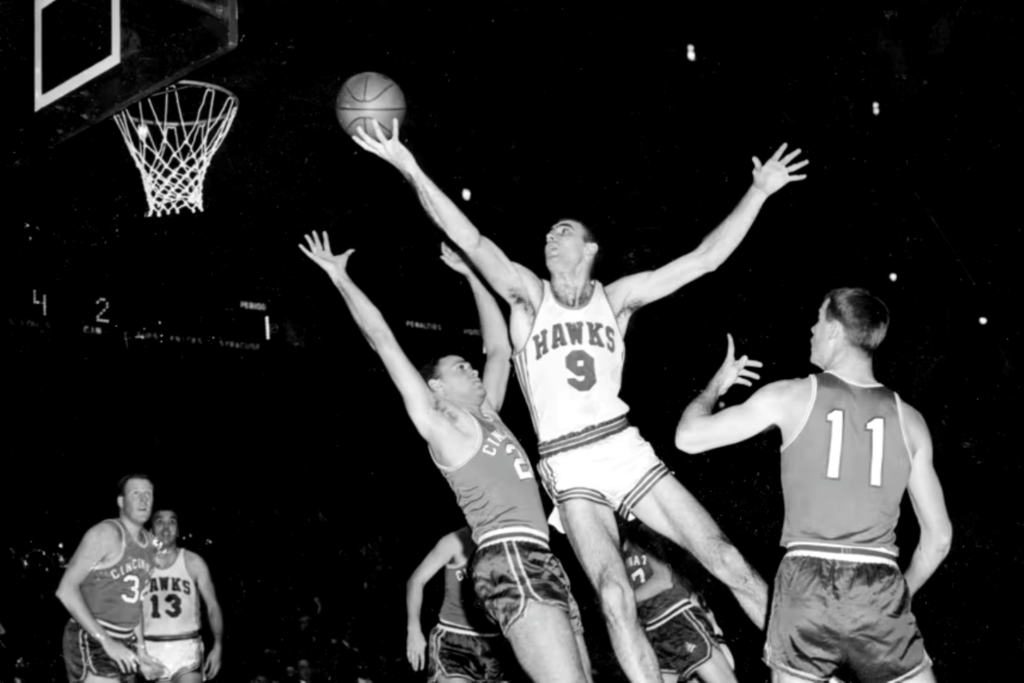
Bob Pettit
(Photo: AP)
One of the dominant players of the NBA’s early era, Pettit was selected as an All-Star in each of his 11 professional seasons, all with the Hawks. He won the league’s inaugural MVP award in 1956 and captured it again in 1959.
His defining achievement came in 1958, when St. Louis defeated the Boston Celtics in the NBA Finals, interrupting one of the most dominant championship runs in American professional sports.
Pettit also won four All-Star Game MVP awards, a record later matched by Los Angeles Lakers great Kobe Bryant.
At 6-foot-9 and 205 pounds, Pettit helped redefine what a big man could do offensively. Long before “power forward” became standard basketball terminology, he could score facing the basket rather than operating exclusively with his back to it.
“Lean, graceful, and always well-conditioned, Bob Pettit's physical build made him one of the first big men to play facing the basket,” his profile at the Naismith Memorial Basketball Hall of Fame says. “But Pettit's resolve set him apart from his peers; he simply would not be outworked.”
Pettit played in an era featuring Wilt Chamberlain, Bill Russell, Oscar Robertson and Elgin Baylor, but much of his career came before NBA games were regularly televised nationwide. Playing in St. Louis also limited his exposure compared with stars in larger markets.
He entered the league with the Milwaukee Hawks and was named Rookie of the Year in 1955, the franchise’s final season before moving to St. Louis.
A year later, Pettit averaged a league-leading 25.7 points per game and became the NBA’s first MVP. He again led the league in scoring in 1959, averaging 29.2 points.
By the time he retired following the 1964-65 season, Pettit had career averages of 26.4 points and 16.2 rebounds. His 20,880 points made him the NBA’s all-time leading scorer at the time, while his 12,849 rebounds ranked second.
He was inducted into the Basketball Hall of Fame in 1970.
The man who broke Boston’s championship run
Pettit’s career unfolded alongside the rise of Russell’s Celtics, who dominated the NBA for more than a decade.
The Hawks reached the Finals four times during Pettit’s career, facing Boston on each occasion.
Their first meeting in 1957 went to double overtime in Game 7 before the Celtics prevailed. A year later, Pettit and the Hawks turned the tables, winning the championship and becoming the only team to interrupt Boston’s run of nine titles in 10 seasons.
St. Louis returned to the Finals against Boston in 1960, losing in seven games, and again in 1961, falling in five.
From Baton Rouge to basketball history
Robert Lee Pettit Jr. was born Dec. 12, 1932, in Baton Rouge, Louisiana. His father worked in law enforcement and later served as sheriff of East Baton Rouge Parish.
Pettit developed relatively late as a basketball player, failing to make the Baton Rouge High School varsity team until his junior year.
By his senior season, however, he had led the school to a state championship and attracted more than a dozen college offers. He remained close to home and attended LSU.
Because freshmen were not yet permitted to play varsity basketball, Pettit began his varsity career as a sophomore. He led the Southeastern Conference in scoring in all three of his seasons, averaging 25.5 points as a sophomore, 24.9 as a junior and 31.4 as a senior.
Pettit is one of three LSU players in the Basketball Hall of Fame, alongside Pete Maravich and Shaquille O’Neal.
Bronze statues of Pettit and O’Neal stand outside LSU’s Pete Maravich Assembly Center. LSU retired Pettit’s No. 50, while the Hawks retired his No. 9.
“We are grateful for his contributions to our franchise and to basketball history,” the Hawks said in a statement. “His retired No. 9 jersey continues to hang proudly at State Farm Arena as a lasting reminder of the impact he made on our organization.”
After retiring from basketball, Pettit returned to Baton Rouge and worked in banking and financial consulting. In later years, he remained a familiar presence at LSU and New Orleans Pelicans games.
“We extend our deepest condolences to Bob’s family, friends and loved ones during this difficult time,” the Hawks said. “We also join those across the basketball world in celebrating a remarkable life and legacy that will never be forgotten.”