

Some people talk about feminism. Others run it into existence. Rachel Entrekin, 34, never competed in sports during elementary or high school in Madison, Alabama. She simply did not think she was good enough.
She began running while pursuing her undergraduate degree at the University of Alabama and did not stop until she earned her doctorate in 2016. She ran her first half marathon in 2010 and a full marathon a year later. “Then I realized I was actually good at this, so I just kept running until I reached a level of insanity,” she said. In short, she became an ultramarathon runner.
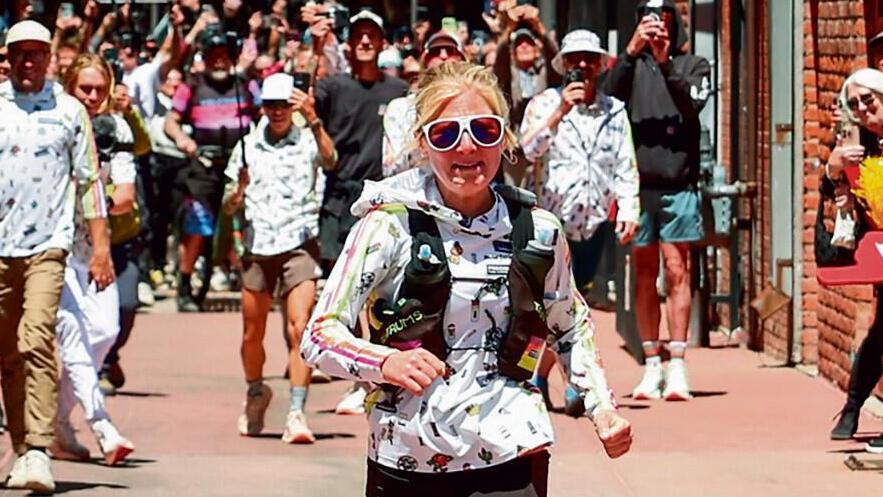
Rachel Entrekin
(Photo: Scott Rokis/Cocodona 250/Anadolu via Getty Images)
By 2024, after conquering mountains, trails and records in the 100-mile category and establishing herself as one of the world’s top ultramarathoners, Entrekin entered the Cocodona 250 for the first time. The brutal race winds through Arizona’s desert conditions, with extreme temperature swings over 407 kilometers (just over 250 miles, from which the race gets its name). The course includes a cumulative climb of 12 kilometers, cumulative descents of 10.5 kilometers and reaches a peak elevation of 2,800 meters. The conditions are notoriously harsh and dangerous. This year, a woman in her 40s collapsed and died during the race.
Entrekin won her first Cocodona in 73:31:25, then repeated the feat last year while breaking the women’s course record with a time of 63:50:55. Last week, she completed a three-peat — and made history in the process, becoming the first woman to finish first overall, ahead of both men and women, in 56:09:48. She shattered the men’s course record by two and a half hours and lowered her own women’s record by 7 hours and 41 minutes.
Put another way: for nearly two and a half days of running, Entrekin maintained a pace of 8 minutes, 15 seconds per kilometer, averaging 7.8 kph, while sleeping just 19 minutes during the entire race. Her first sleep break, five minutes at an aid station, came after 320 kilometers. She later took two more naps on the ground, each lasting seven minutes.
A six-person crew, including her parents, accompanied her throughout the race and helped her stick to a goal of consuming 60 grams of carbohydrates per hour. Her race diet consisted of gels, energy bars and large amounts of mashed potatoes, her favorite running food because it requires little energy to eat.
“You look for and find all sorts of ways to stay sane during the race and find the fuel to keep running,” she said after the victory and record-breaking performance. “I just kept repeating the same mantra over and over: ‘Someone is going to win this race, so why can’t it be me?’ I love that mantra because it helps me overcome the insecurity and self-doubt women often have about how good we really are. It helps me silence the voice telling me there’s no point in trying because I’m not talented enough. You can say a lot of negative things about yourself, but I decided to choose a positive mindset.”
In ordinary life, with eight hours of sleep a night in an actual bed, Entrekin used to work as a physical therapist at an oncology rehabilitation center in Colorado. That meant returning to work a day after running hundreds of kilometers. She is now a full-time ultramarathoner. Before her Cocodona success, she relied on crowdfunding campaigns to finance what she calls her madness.
“I’m addicted to running,” she said in a past interview. “Of course you constantly ask yourself why you need to put your body, mind and soul through this kind of suffering. The answer is that I love seeing so many landscapes and roads in a relatively short amount of time, but mostly I love that period when you are alone with yourself and discover so much about who you are.”
“I watched the race footage,” said Kilian Korth, who finished second overall and first among the men. “I see myself really struggling, while Rachel is running effortlessly, like she’s enjoying herself. I don’t like framing what she’s doing in terms of women’s sports or gender. I prefer to think about what she’s doing for the sport overall and how she’s pushing the boundaries for all of us.”
Anyone watching the race clips can see Entrekin crying throughout the final stretch, tears that were a mixture of relief as she neared the finish and victory, but also tears of pain from the physical ordeal she had endured.
After finishing the race, Entrekin slept for seven and a half hours, woke up and went back out to cheer on the other runners still on the course.
“In almost all of these events, men have an inherent physical advantage, which is why their times are usually better,” she said in explaining her victory and record. “But in a race like this, there’s a limit to how much the physical side matters. Your mental state and your ability to overcome challenges and pressure carry much more weight. Maybe this shows that in those areas, women can be equal to men, or even stronger.”