

For moments at a time, Saeid Mollaei seems unable to believe that he is standing on Israeli soil as a free man. Walking slowly along the beach in Netanya, he takes in the scene, occasionally bending toward the wet sand to collect seashells for his children, souvenirs from a visit he says he will never forget.
Beside him is Sagi Muki, the Israeli judoka who became his friend after one of the most politically charged episodes in the sport’s history. Mollaei came to Israel to face Muki in an exhibition bout held Wednesday, completing a circle that began seven years ago at the 2019 World Judo Championships, where pressure from Iran prevented the two from meeting in the final.
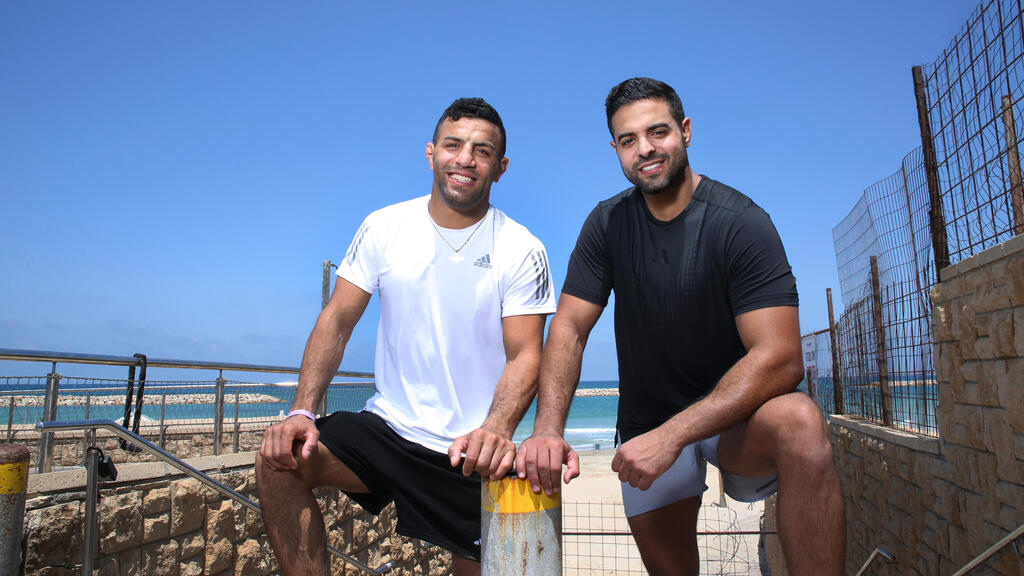
Muki said he was deeply moved to welcome Mollaei at the airport and hear him say that, despite being Iranian, he was able to come to Israel, and that many others like him wanted to do the same.
“He told me he was lucky,” said the retired Israeli champion. “Saeid had been here before, when he competed at the 2021 Tel Aviv Grand Slam, but it was during COVID and he could not do very much. Now everything is different and relaxed.
“He came to my parents’ home for dinner and was so moved. We danced to Persian songs. It was an incredible experience. Even in my best dream, I could not have imagined a moment like this, Saeid the Iranian and me sitting together for dinner at my home, laughing about life and enjoying ourselves. It is a victory for both of us after everything we have been through.”
Mollaei recalled the warmth he received during his previous visits to Israel.
“People from the Persian community who live here supported me, and not only them,” he said. “I remember that after I won the silver medal at the Masters in Jerusalem in December 2022, I went outside and people approached me. They told me how much of an honor it was for them, and it was an honor for me too. Now I am here again, and I do not know what else I can say except that I am so happy.”
A friendship born from hatred
The story began on August 28, 2019. Muki stood atop the podium after a historic day, becoming the first and only Israeli man to win a judo world championship. But another story unfolded alongside his victory, that of Mollaei, who entered the competition as the reigning world champion.
The draw put the two on course to meet in the final. Under pressure from authorities in Tehran, however, Mollaei deliberately lost his semifinal to avoid facing the Israeli. Iran was subsequently suspended by the International Judo Federation and did not return to international competition until late 2023. The consequences for Mollaei were even more dramatic. He fled Iran for Germany and later returned to Israel for two competitions. Along the way, he and Muki developed a close friendship.
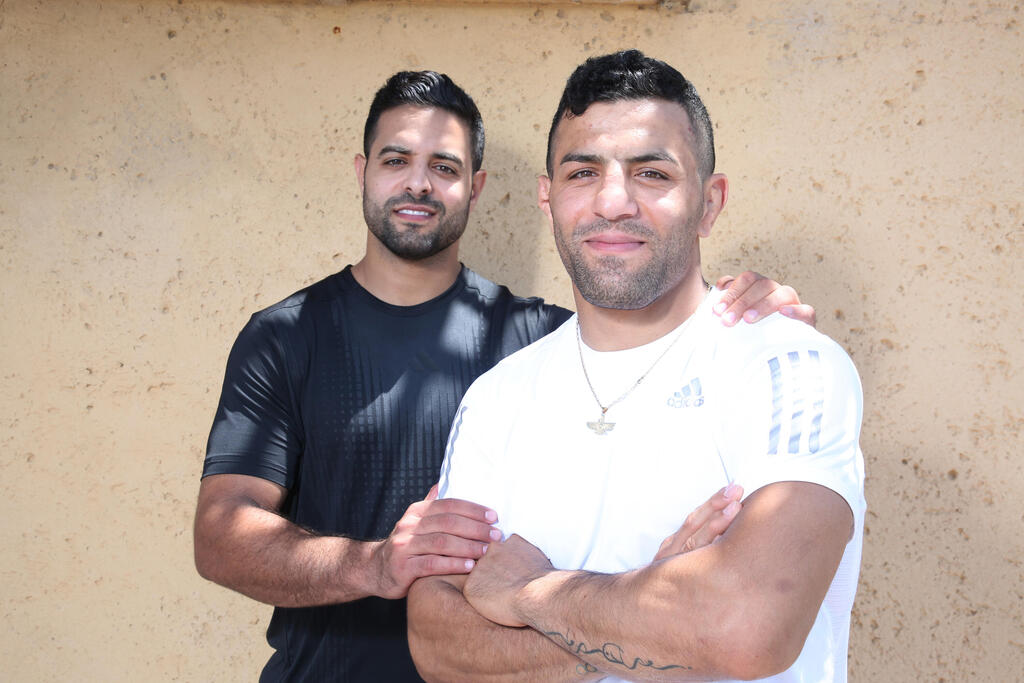
A warm friendship
(Photo: Ryan Frois)
“That bout was a moment many people had hoped for,” Muki said of the 2019 tournament. “There was hope that everything would come together and that an Israeli and an Iranian would step onto the same mat. But things happened that were beyond anything we could imagine.
“You could not avoid feeling the madness around it. My challenge was to block everything out. What people felt back home about Saeid was not what I felt during the competition. My phone was on airplane mode and nobody could reach me. Whenever I felt overwhelmed, I withdrew into myself and remembered that I wanted to be the best in the world.”
Mollaei said that, looking back, he would tell his 2019 self to learn from that championship “the meaning of peace and friendship.”
“In judo, the first word is respect and the second is friendship,” he said. “Now I feel that.”
Muki said their meeting had become something far greater than sport. “I feel we are making history here, beyond judo. This is life itself,” he said. “You see what is happening here, so many wars, so much hatred and hostility. People are dying on every side.
“Our story gives hope in a reality like this. It gives something to humanity. It is beyond politics, beyond everything. It is the simplicity of being human, the fact that we accept each other.”
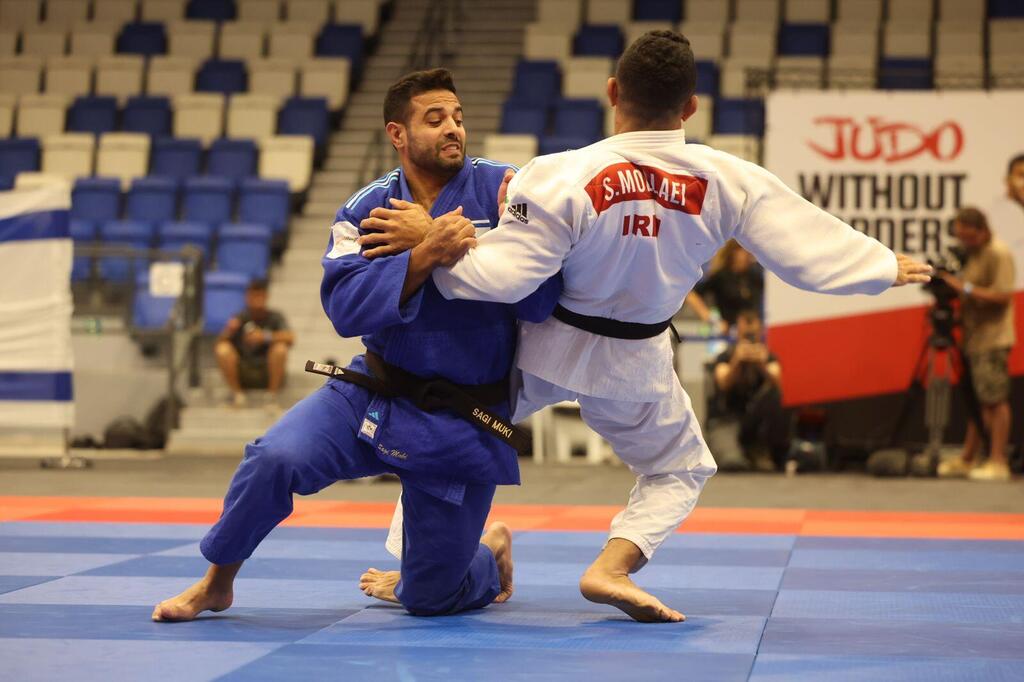
A messages of unity and hope
(Photo: SIPUR)
Mollaei agreed. “Our sport represents freedom and peace, and that is so important,” he said. “There are several messages in this bout between Sagi and me: Be strong, think for yourself, never be afraid of your opponent and fight with respect.
“Sagi is like a brother to me, and he is also a great champion. I was a champion too. Now that both our sporting careers are over and we are no longer active competitors, we want to show our two countries, Israel and Iran, and the entire world what reality looks like for us. We want to present our cultures, our countries and our peoples. Sagi and I are already doing that through our lectures.”
Muki said the two planned to continue telling their story around the world. “We will go to many places and tell a story filled with messages of unity, hope, faith, growth through crisis, challenges and confronting threats,” he said. “Major organizations and companies invite us.
“In the past, our mission was on the judo mat. Today, it is a mission in public diplomacy, connecting communities and religions.”
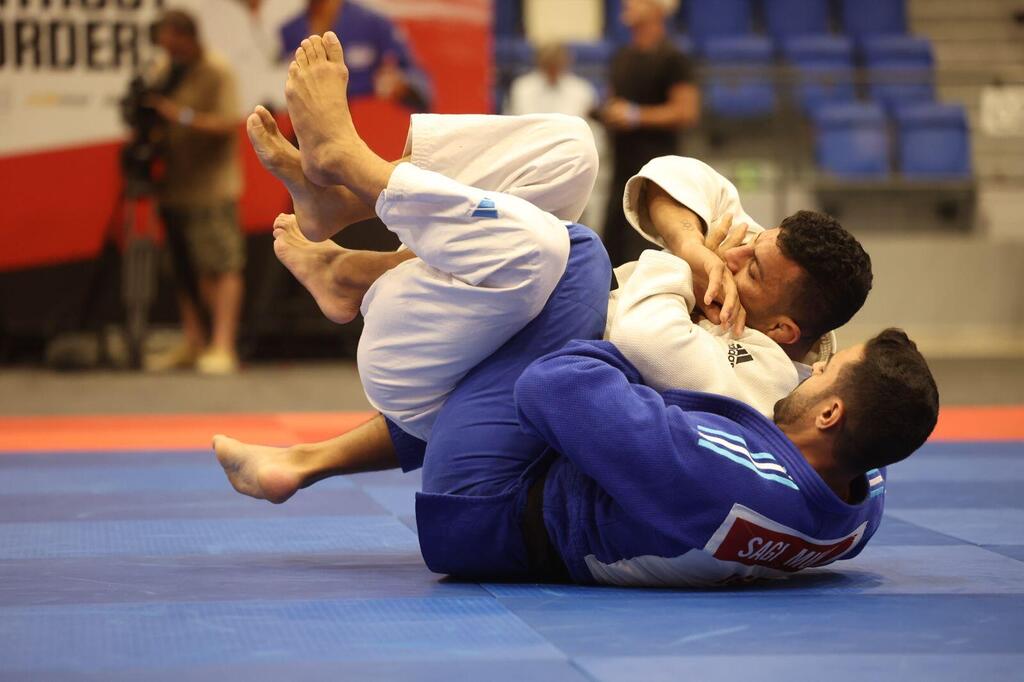
'A mission in public diplomacy'
(Photo: SIPUR)
A film about war and peace
The exhibition bout served as the final scene of a documentary about the two men. The event was produced by sports event company Mythos, with support from the Netanya Municipality and in cooperation with production company SIPUR, which has documented Muki and Mollaei’s friendship.
Directed by Yariv Mozer, the film is expected to be released in theaters beyond Israel and broadcast on Israel’s Channel 13.
“Saeid is excited about finishing the film and about our bout. He has been looking forward to it,” Muki said. “I am glad we did not give up and that we managed to show the humanity in this story. As an athlete, I was never close with my opponents. I always kept my distance. Every match against them felt like a world war. With Saeid, it is different, and I feel complete with this path. I am lucky that I went through it with him. Together, we showed the world that only love wins.”
Before the bout, Mollaei laughed as he said he was still arriving in competitive mode. He continues to train every day and was eager to discover what it would feel like to compete against Muki. He said he had no fear of the reactions or potential consequences that might follow.
“I do not feel relief that this journey, this circle, is about to close,” he said. “We are two champions representing cultures for people around the world. We can show a different path. Sagi and I are a symbol of peace.”
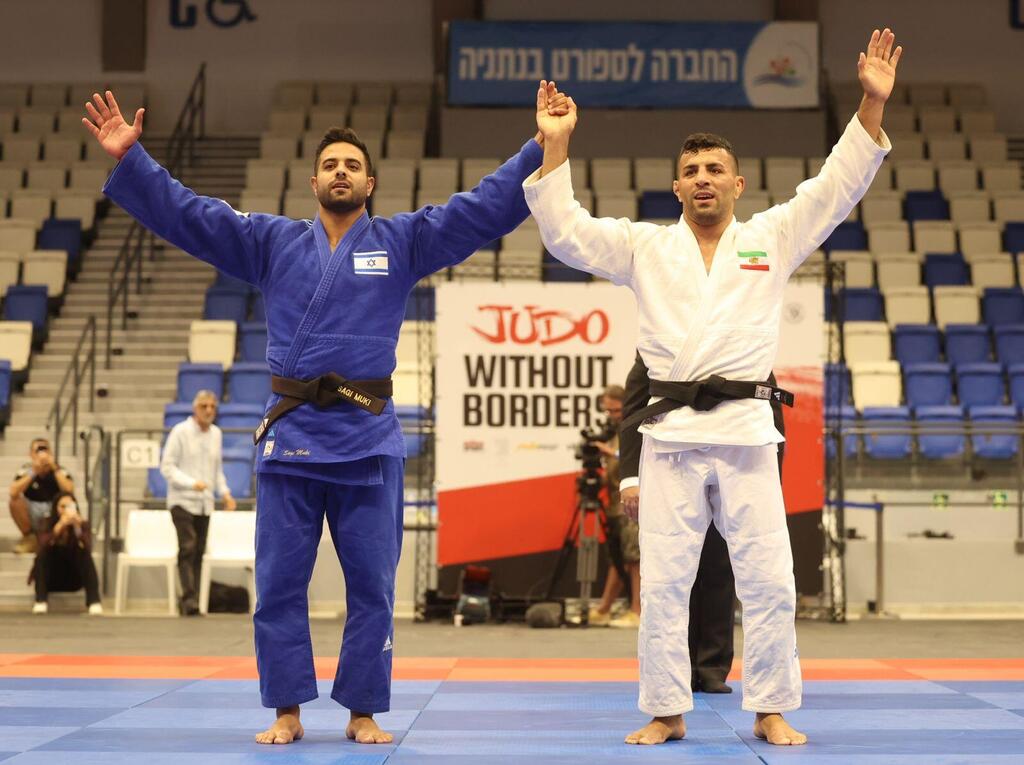
Later, inside the Netanya arena, two judo uniforms lay side by side in the dressing room, one bearing the Israeli flag and the other the Iranian flag. A sign featuring photographs of the two men read: “Judo without borders.”
“I cannot wait. I am happy,” Mollaei told Muki’s Instagram followers while sharing an image of the uniforms. Outside, spectators waited for what felt, at least briefly, like a glimpse of a different Middle East.
A symbol of peace'
(Photo: SIPUR)
No ordinary exhibition
When the bout began, Muki stepped onto the mat with the same intense expression that once unnerved his opponents during the peak of his career. Mollaei appeared slightly unsettled. He took a deep breath and adjusted his belt.
When the announcer introduced him as “one of the bravest judokas in the world,” the crowd erupted in applause. Mollaei approached Muki, bowed, and the two began trying to throw each other to the mat. Mollaei started aggressively, but even after two years away from competitive judo, Muki gave everything he had.
The Israeli scored a waza-ari for the first points of the bout. One of his signature weapons had always been control of his opponent’s sleeve, and he repeatedly searched for an opening to score an ippon.
Although it was officially an exhibition, neither man treated it casually.
Moments after slapping hands, Muki found the opening he needed and ended the contest with a victory. The referee declared him the winner before the two shook hands and embraced to the cheers of the crowd. They left the mat side by side, without security guards or hostile officials appearing to pull them apart.
Dozens of excited children waited behind them with phones raised, hoping for selfies. The announcer asked them to wait until the event concluded with the singing of Israel’s national anthem.
For one evening, “Hatikva,” Hebrew for “the hope,” became more than a song. It became a longing for the endless cycle of confrontation between Israel and Iran to be broken, and for moments like this to become part of ordinary competition rather than extraordinary drama.
The rest of the story will be left to the documentary, whose final scene may offer only a small preview of what could happen if genuine change ever arrives.