

It often starts around age 50. The kids are grown, careers are peaking and the need for “something for the soul” becomes harder to ignore. For a growing group of men in Israel, the answer isn’t a sports car, but a bicycle, sometimes costing more than a post-army backpacking trip. They call themselves “the cabinet” or simply “the guys,” building a culture around technology, endurance and shared road stories.
Eyal Shlibovsky, 65, who runs a boutique stone and marble business, is a classic example of a cycling obsessive. “It actually started with breathing issues I’ve had since childhood,” he said. “I’ve always trained and worked on my cardio. I’ve been into cycling for nearly 30 years. It’s my routine, riding at least three times a week, getting around by bike instead of sitting in traffic.”
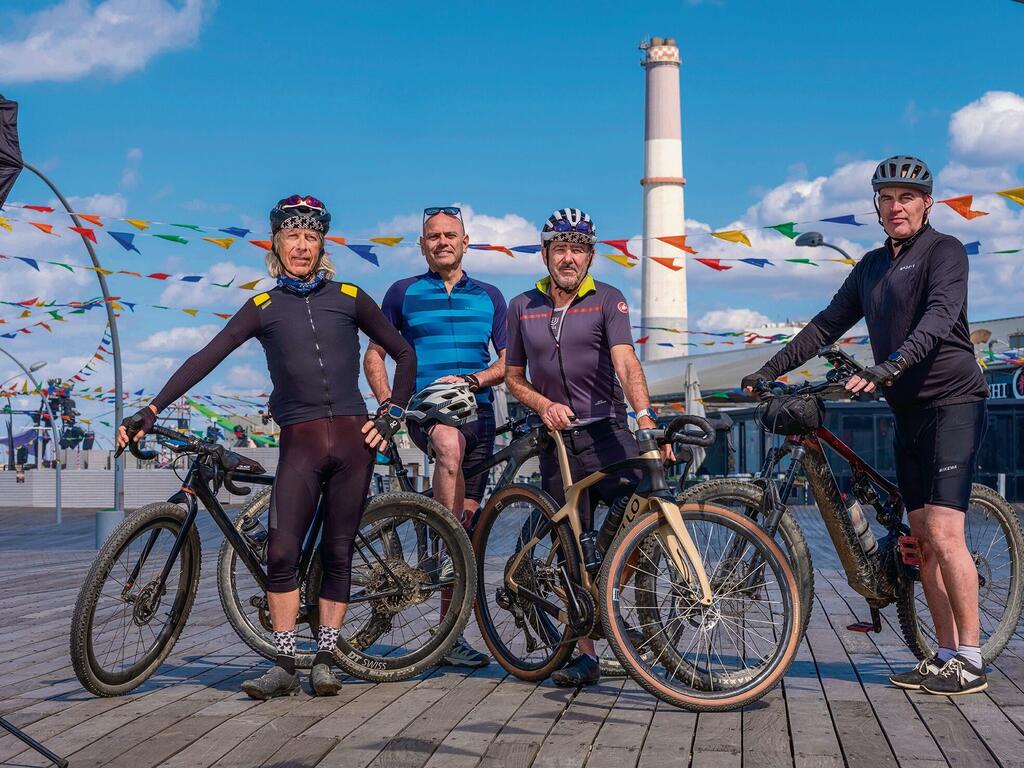
“Bikes are a million things.” The ‘cabinet’ on wheels
(Photo: Yuval Chen)
He once focused on road cycling, even riding an 800-kilometer route in the mountains following the Tour de France. Today, he prefers gravel riding on dirt and unpaved roads. “The roads here have become too dangerous. I was traumatized by cars and let it go,” he said. “My cars aren’t even with me anymore. They’re spread out among the kids, my son-in-law, and my wife. I get around by bike.”
For Shlibovsky and his friends, the ride is most of the story, but not all of it. Another key part happens at the Tel Aviv Port. “The 'parliament' meets Friday mornings,” he said. “We sit for two or three hours over a beer, either after a ride together or separately, and talk about upgrades. This isn’t a cheap hobby. Professional bikes start at about 18,000 shekels (about $6,000) and can reach 60,000 (about $20,000). We’re somewhere in the middle.
“The most important things are the frame and the wheels. Accessories come down to personal preference and comfort. I build my own wheels, customized. That’s my thing, precision. Some people buy just a frame and build from there. Others prefer buying complete bikes from abroad.”
A philosophy on two wheels
Eitan Raudor, 67, a recent retiree from a Rafael subsidiary, is the group’s mentor and handyman. With 35 years of riding experience, he sees cycling as a full philosophy. “Bikes are a million things,” he said with a laugh. “They’ve taken me places Waze doesn’t know. I’ve been riding for decades and still haven’t found the brakes on life.”
He enjoys riding hills and sandy terrain. “We’re people for whom bikes are a spirit. It’s a hobby that builds a whole story around it. Then we meet at the port and have philosophical debates about carbon and tires. These are meaningful 'cabinet' meetings.”
Raudor rides a modified road bike adapted for rough terrain, with wider tires and a different geometry, part of what he calls a global trend. Living alone, he says cycling has become central to his routine since retiring. “When you retire, it’s not always the rose garden they promise. You have to build a routine, an identity, and for me, the bike is the core element. It takes you to trails you didn’t know, to hills that feel like the Alps.”
Is cycling just a trend? Not for Raudor. “There are thousands of riders in Israel. But the real fanatics care about things like wheels. We even call them ‘lucky wheels’, tires, carbon, aluminum. And I don’t have just one bike, I have four. But it’s not just riding, it’s nature, people. Suddenly you get competitive too. I’ll race someone ‘to the port’ and I don’t even know who they are.”
For Ilan Hadar, 56, CEO of Silexion, a biotech company developing pancreatic cancer treatments, cycling offers balance. “Getting out into the field clears your head,” he said. “We don’t talk about work. We enjoy nature, the scenery, the technical challenges. It’s both sport and therapy.”
Hadar rides e-MTB, electric mountain bikes. “We’re not 20 anymore, climbing everything on our own. The motor helps on the tough climbs, so you can enjoy the descent. It’s an expensive hobby. Some people have invested hundreds of thousands of shekels. I’m only in the tens of thousands,” he said with a laugh.
For Rafi Elmaliach, 59, director general of the Planning Administration, the hobby has turned into a professional mission. He got into cycling while working on the Israel Bike Trail project. “We raised 45 million shekels to build that trail from north to Eilat,” he said. “Today I make sure every new neighborhood includes bike paths. Cycling releases endorphins and creates calm.”
Living in Modi’in, he considers the nearby Ben Shemen Forest his backyard, riding traditional geared mountain bikes. "I'm an old-fashioned type", he says. “Ben Shemen is a hub for cyclists,” Raudor added. “On Saturdays it is packed with thousands of people. It clears your mind for the whole week. You come down with a smile.”
Sirens in the middle of the ride
In recent years, that smile has collided with a more complex reality. Interviews that began in routine times took a turn as war became part of the ride. For cyclists, open terrain, once the safest and most enjoyable space, has become risky without shelters.
“We’ve ridden through sirens,” Shlibovsky said. “It happened to Eitan and me near Ga’ash, on the cliffs. Suddenly there’s an alert and nowhere to go. We just lay down in the sand, waited for it to be over and kept riding. That’s the fear in open terrain, unlike the city, you’re completely exposed.”
Still, they keep going. “You can’t stop riding,” Shlibovsky said. “When I don’t ride, I can’t sleep at night.” For this group of men, pedaling is not just a way to get from point A to point B. It’s the only way to stay balanced in a changing world, whether facing midlife shifts or the pressures beyond the trail.