

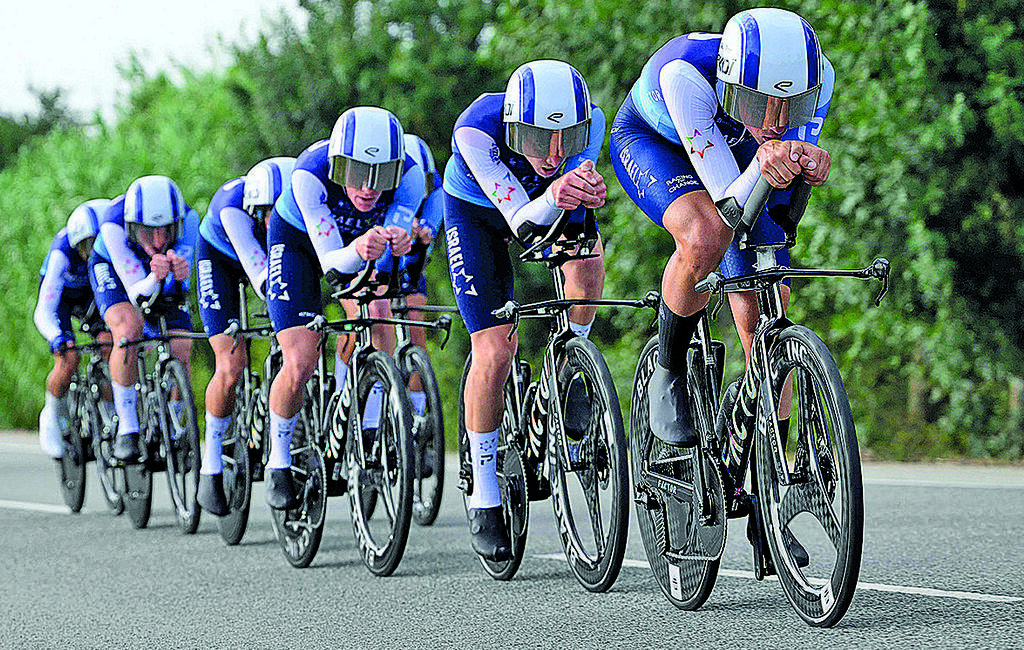
An Israeli team is riding in the heart of Europe’s pro-Palestinian stronghold. That is the reality for Israel Premier Tech cyclists, including 24-year-old Nadav Reisberg of Kibbutz Dafna, as they compete in Spain’s prestigious Vuelta race.
From the opening days, protesters stormed the course and blocked the Israeli riders, and in another incident obstructed the entire peloton. But the greatest concern now is the Basque Country, where anti-Israel hostility runs especially deep.
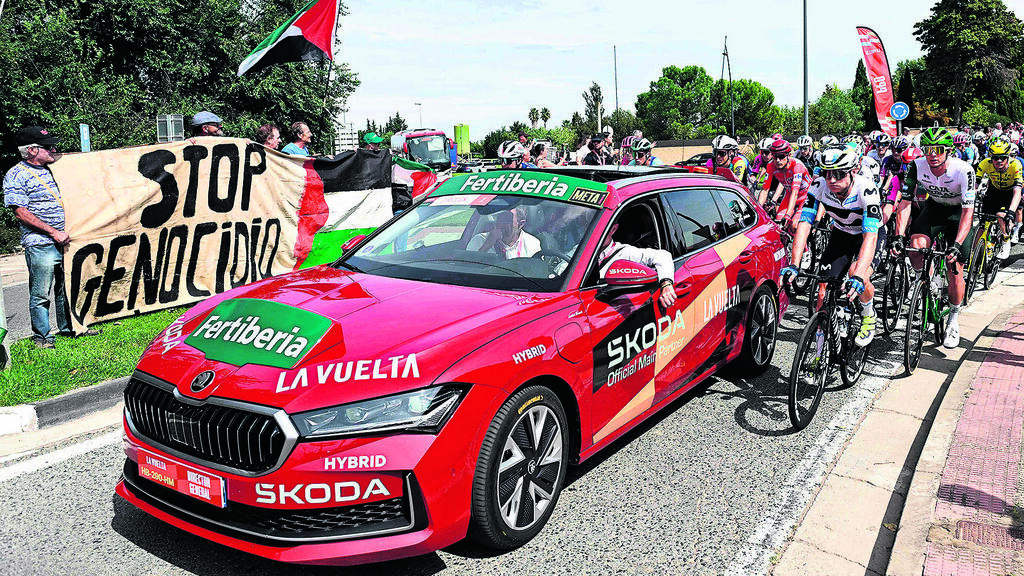
Spain’s national police have deployed heavily armed reinforcements in the Basque region after Catalan police were faulted for failing to prevent earlier disruptions. Escorts on motorcycles and street deployments, however, cannot cover the entire route. Pro-Palestinian mobilization there is not sporadic, but a coordinated campaign—sending crowds with Palestinian flags and signs to virtually every town and village along the course. On Tuesday, one protester’s intrusion caused a crash involving a rider from another team. Tensions are expected to peak Wednesday during Stage 11, which starts in Bilbao. The Basque capital’s narrow uphill opening makes risks especially difficult to predict.
Reisberg, whose family was evacuated from their northern border kibbutz during the war, described the strain on the team.
“My lowest point came when pro-Palestinians blocked the road for all the riders, and we just stood there for minutes,” he said. “I felt awful. Everyone was staring at me in silence. I asked myself: ‘What do they want from me, for God’s sake? What do they want from us? We’re the ones whose children and babies were murdered on October 7. I’m the one whose parents were evacuated, whose mother actually called me crying about how their lives were turned upside down. We have hostages being forced to dig their own graves."
"Why do they hate us like this? What do they want? It drove me crazy," he continued. "I stood there with tears of rage and frustration in my eyes. I wanted to stop riding, to go home. It wasn’t fear—I’m not afraid of them—but pure anger and despair. That was the first time I understood the scale of hatred against us in the world, and it made me furious. Why is this happening to us? How did it come to this? Somehow I kept going, but I was drained mentally. Only after crossing the finish line did I feel differently. I told myself I won’t give them the victory of making me quit."
(Photo: Josep Lago\AFP)
Reisberg added: 'You can’t imagine what it’s like on the climbs, when they’re packed together waving Palestinian flags, inflated with rage, yelling ‘quit, quit,’ cursing, shouting at me ‘murderer’ and ‘Nazi.’ So I learned to laugh. I see them getting angry, and it makes me feel better. Now we’re heading into the Basque Country. I’m a little worried. I take into account that they could do something, but I’ve decided I’m strong, and there’s no point being afraid because there’s nothing I can do about it anyway. My teammates are also angry they’re targeting us. But we keep going. I promised myself I’ll stay to the end.”
Team owner Sylvan Adams also confronted the hostility Tuesday, scouting part of the stage route himself.
“I rode wearing the team jersey as usual, and when we approached one of the towns I saw an enormous number of Palestinian flags. I had never seen anything like it," he described. "People in cars shouted things at us. We even have an undercover policeman with us now, which has never happened before, and we were asked to cut our ride short and avoid the town because of the protest crowds—so as not to inflame tensions before the race. I am proud of the team. The hostility has brought the riders closer together, and they’re looking out for one another.”
Oscar Guerrero, the Spanish sporting director of Israel Premier Tech, offered cultural context.
“This is part of Basque tradition, going back to the violent struggle against Spanish rule,” he said. “For them, identifying with the Palestinians is natural—they see themselves as the weak identifying with the weak. When they call me a ‘murderer,’ it hurts. I love this team, and I’m proud of it.”