

"I'm retiring from taekwondo. I don't intend to compete anymore," says Avishag Semberg, revealing for the first time in an interview with La'Isha that she has decided to end her Olympic career. "I'm an all-or-nothing kind of person. Some athletes retire but continue practicing their sport for fun, but that's not me. I'm leaving the sport completely. I've reached a point where I feel at peace with everything I've been through, and I'm putting it behind me."
After months of speculation in the sports media that Semberg was considering retirement, fueled partly by her appearance on Dancing with the Stars and her absence from competitions, she is now making it official. At 25, the bronze medalist from the Tokyo Olympics is saying goodbye to the sport around which she has built her life since childhood. "There was always a fire inside me, something burning that I can't really explain," she says. "Over the past year, I realized that fire wasn't there anymore."

Looking back at her achievements, Semberg says she has reached a point of acceptance. "I looked back at my journey and thought, 'Wow, I've come an incredible distance. I'm so proud of what I've achieved, and I'm happy with it. But now I'm ready to move on to the next chapter of my life. I still don't know what that chapter will be, but I'm curious to find out.'" She first said the words aloud only recently, during a conversation with her husband, fellow taekwondo athlete Nimrod Kravitsky. Although retirement had been on her mind for some time, participating in Dancing with the Stars finally convinced her she was ready for a change. The experience proved she could start from scratch in an entirely different discipline and succeed, even though she was eliminated shortly before the quarterfinals. More importantly, she realized that her desire to participate in the show revealed something about her changing priorities.
"In any other year, I would never have agreed to take a break from training and competing. The only thing that interested me was the next Olympics," she says. "Suddenly I found myself thinking, 'If I want to do Dancing with the Stars this badly, maybe I don't want to do taekwondo as much anymore?'" At first, she still considered returning to competition after the show. But as filming continued, she began questioning whether she was prepared to resume the demanding routine of intense training, constant hunger and spending half the year abroad. The sacrifices that had once seemed inseparable from her Olympic ambitions no longer felt as easy to accept. "I don't regret any of the sacrifices I made. It was the most incredible experience I've ever had or will ever have. I was lucky enough to wake up every morning and do what I loved. I fulfilled my dreams," she says. "But the sacrifices were enormous, and eventually you wear yourself down."
Looking back, Semberg realized she had already achieved more than she once dared to imagine. She had won an Olympic medal, competed at the Tokyo and Paris Games as well as the Youth Olympics, become European champion and reached fifth place in the world rankings. An elite sporting career could not last forever, she reasoned, and she no longer felt the same drive to pursue another Olympic appearance. "It was incredibly difficult to make the decision. Even now it feels a little strange, but I'm completely at peace with it," she says. Kravitsky assured her that he would support whatever she decided. Semberg suspects that both he and her mother were relieved, having witnessed the enormous pressure the sport placed not only on her but also on those closest to her. Her husband saw the early mornings, relentless running and training sessions, and the emotional swings between exhilarating victories and crushing defeats.
"Sometimes everything goes perfectly and I feel on top of the world, and sometimes it doesn't. It's a roller coaster," she says. "When I lose a competition, my mother's heart breaks for me." The anxiety was sometimes so overwhelming that her mother once fainted while watching Semberg compete for a place at the Paris Olympics. Her younger sister later described how their mother had been sitting on the couch when she suddenly collapsed onto the floor. It had been an exceptionally tense fight, and her mother knew exactly how much work and sacrifice had gone into reaching that moment.
What could I have done differently?
In a previous interview with La'Isha, shortly before the Paris Olympics, Semberg described how her parents had driven her to training sessions, waited outside for hours and initially paid for her trips to international competitions. Their investment helped her win a bronze medal at the Tokyo Olympics when she was just 19, becoming Israel's first Olympic medalist in taekwondo and, at the time, the youngest Israeli ever to win an Olympic medal. Taekwondo also brought her together with the man who would eventually become her husband. For years, she and Kravitsky, who is three years older, trained in different age groups. They only began training together when she was 17 and joined the senior team. "I fell in love with him from the very first moment," she recalled in the earlier interview. "But it took him longer to notice me and fall in love with me." They married in August 2025 and now live in Ashdod.
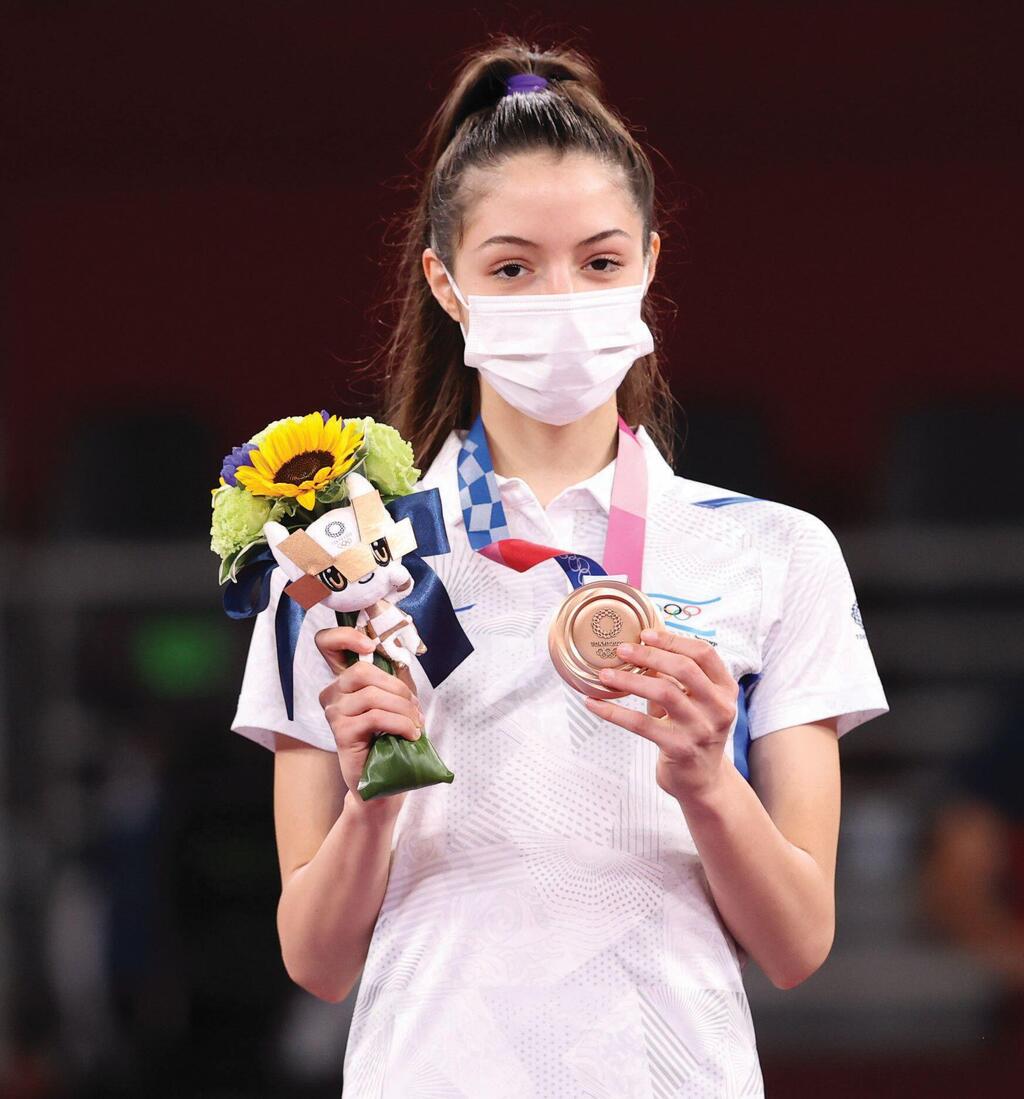
Semberg with her bronze medal at the Tokyo Olympics
(Photo: Oren Aharoni)
When Semberg spoke to La'Isha in 2024, she was already looking ahead to the Los Angeles Olympics in 2028. In retrospect, she says, having another Olympics on the horizon helped her cope with her disappointing performance in Paris, where she was eliminated in the round of 16. "I think having the Los Angeles Olympics to look forward to helped me calm myself down and say, 'Avishag, it's OK. You'll have another chance,'" she recalls. "But deep down, even then, I didn't know whether I wanted to keep going for another four years." The months following Paris were among the most difficult of her career. For four months, she struggled with sleepless nights and obsessive thoughts about the fight she had lost. She was living with her mother at the time and often remained awake until six in the morning, when her mother was already getting ready for work. "I wanted to be completely exhausted before I closed my eyes, because otherwise all the thoughts about the fight and what I could have done differently would come flooding back," she says.
Retirement had already crossed her mind, but she was not yet ready to make a final decision. The turning point came when she was invited to the Israeli Olympic Committee's annual awards ceremony. Initially, she wondered why she should attend an event honoring outstanding athletes when she had just suffered such a painful defeat. "I thought, 'What do I need this for? This is an event honoring outstanding athletes. I lost at the Olympics. What am I doing there?'" she recalls. "But there was also a voice inside me saying, 'Of course you belong there. You're a champion.'" She eventually attended and was surprised by the warmth and respect she received. Having withdrawn into herself after Paris, she had lost sight of her accomplishments and the esteem in which others held her. Seeing a photograph of herself from the Games helped her recognize that qualifying for the Olympics was itself an extraordinary achievement. "I started understanding that my worth wasn't determined by that one fight," she says.
Today, she is proud not only of her Tokyo medal but also of her decision to continue competing afterward, despite the risk of failure. She could have retired with an Olympic medal at a young age and pursued advertising campaigns, television appearances and other opportunities. Instead, she chose to keep training because she still felt the desire to compete. "I'm also glad that after losing in Paris, I went back to training and gave it another chance, because that helped me understand that my decision to retire now isn't because of the loss," she says. "It's because of years of hard work and burnout, and the realization that I no longer have the hunger to keep making all those sacrifices."
Three tablespoons of oatmeal
To understand the sacrifices Semberg describes, it helps to step away from the competition mat and sit down with her at the dinner table. For years, her athletic career dictated everything: what she could eat, how much and when. Even a short family vacation meant packing carefully weighed and measured food in her suitcase. Now, after so many years of restrictions, she can finally eat whatever she wants. She sums up the feeling in one word: "Freedom." Semberg was just 10 when she began monitoring her weight for competition. She emphasizes that nobody forced her to lose weight. Rather, she understood that taekwondo was divided into weight categories and that competing in a lighter division could improve her chances of success.
For example, if she weighed 52 kilograms (115 pounds) before the Olympics, the relevant competition categories were under 49 kilograms (108 pounds) and under 57 kilograms (126 pounds). Dropping to the lighter category meant avoiding significantly taller and stronger opponents. But the consequences of those calculations went far beyond the competition mat. As a child, Semberg sometimes had to turn down invitations to eat pizza with friends because the food did not fit her nutritional plan. "Suddenly I was a little girl telling herself, 'If my friends are getting together for pizza today, I can't go,'" she recalls.

(Photo: Shay Franco; Styling: Alex Gidron)
By 13, her parents had taken her to a sports nutritionist, and her weight management was professionally supervised. Semberg stresses that the restrictions were always connected to her athletic ambitions, not her appearance. "I always knew I was doing it for my career. If I wasn't eating with my family for a certain period, it was because I wanted to achieve my dream. It was never because I thought I'd look prettier that way." Although hunger was sometimes difficult, she says the greatest sacrifice was missing out on ordinary experiences that other children and teenagers took for granted. "I'd come to Friday night family dinners with my two eggs, a cucumber and half a container of cottage cheese. If a friend had a birthday party or a cousin was getting married, there was nothing for me to eat."
At weddings, she would eat dinner beforehand and then spend the evening watching everyone else enjoy the food while she drank water or a zero-calorie soft drink. Even dancing late into the night was difficult after a full day of training and such a limited meal. "I couldn't dance until two in the morning after eating two eggs and a cucumber, especially after eight hours of training," she says. "I was hungry and exhausted, my body hurt, and I knew that the next day I'd have to do it all over again."
Like a soldier starting civilian life
Semberg is now learning how to fill the hours once occupied by training sessions and competitions. She earns a living giving motivational talks under the title The Battle Beyond the Arena, speaking at companies, conferences and schools. She has also begun studying business administration at the College of Management Academic Studies. Although she is interested in marketing and the stock market, she has not yet decided what she wants to do professionally. After spending most of her life working toward a clearly defined goal, she finds the uncertainty both unfamiliar and exciting. "I feel like a soldier who's just finished military service," she says. "It's funny. When I was a little girl appearing on the television show The Boys and the Girls, my dream was to make it to the Tokyo Olympics."
By 13, Semberg knew exactly what she wanted from life. At 25, she finds herself in the unusual position of having achieved her greatest childhood ambition without knowing what should come next. "At 13, I knew exactly what I wanted. Now I'm 25, and suddenly I have no idea. But I'm enjoying it. I'm enjoying being able to give myself time to discover things and having free time," she says. "Suddenly, I can text my sister at lunchtime on a Tuesday and ask, 'Want to go to the beach?' Things like that just never happened before." For the first time in years, her calendar is no longer organized around training camps, competitions and maintaining a particular weight. She can make spontaneous plans without calculating how they might interfere with her preparation.
Starting a family is not currently among her immediate plans. After devoting so many years to taekwondo, she wants time to focus on herself and discover the parts of her identity that existed beyond the sport. "I've devoted so many years of my life to sports, and now I want to devote some time to myself and figure out who I am," she explains. "Until now, as far as I was concerned, I was taekwondo. I know there's so much more to me than that, and I want to discover what those things are." But even as Semberg begins discovering who she is outside the sport, some of the physical consequences of her career will remain with her.
She holds out her hands, showing fingers that have been injured repeatedly during fights. One injury is so severe that she cannot wear her wedding ring on its customary finger. "Have you noticed that my wedding ring is on a finger on my right hand? It's supposed to be on my left hand, but my finger on that hand is completely broken," she says. The damage extends beyond her hands. Years of competing have left her with injuries to her legs, head and face, including a crooked nose and a fractured eye socket. "It's a very violent sport, with a lot of injuries to your legs, head and hands. My nose is a little crooked, too, and I've fractured my eye socket," she says, pointing to a visible bump. "The two sides don't look the same."
One of the most immediate changes since stepping away from competition has been her relationship with food. After years of counting, measuring and restricting everything she ate, Semberg has abandoned the rigid meal plans that once controlled her daily routine. "I spent so many years counting everything and restricting myself that now I don't want any restrictions at all," she says. "I don't follow a fixed meal plan. I eat whatever I feel like eating at that moment. If I want pizza, I'll have pizza." During Dancing with the Stars, she frequently ate shawarma in pita bread simply because her schedule was so demanding and it was quick and convenient. The freedom to make such ordinary choices without worrying about her competition weight has become one of the pleasures of her new life.
She has also stopped weighing herself. Her mother used to tell her that she did not keep a scale in her bedroom and never weighed herself. For years, Semberg found that almost impossible to understand. Now, she says, she finally does. "No. I have no idea how much I weigh," she says. "The last time I weighed myself was before a competition abroad, almost a year ago, and I was 53 kilograms. Since then, I haven't thought about it." For someone who spent much of her childhood and adult life measuring her weight down to the smallest detail, that indifference represents a profound change. "Now you've made me a little curious," she adds, "but I'm still not going to check."